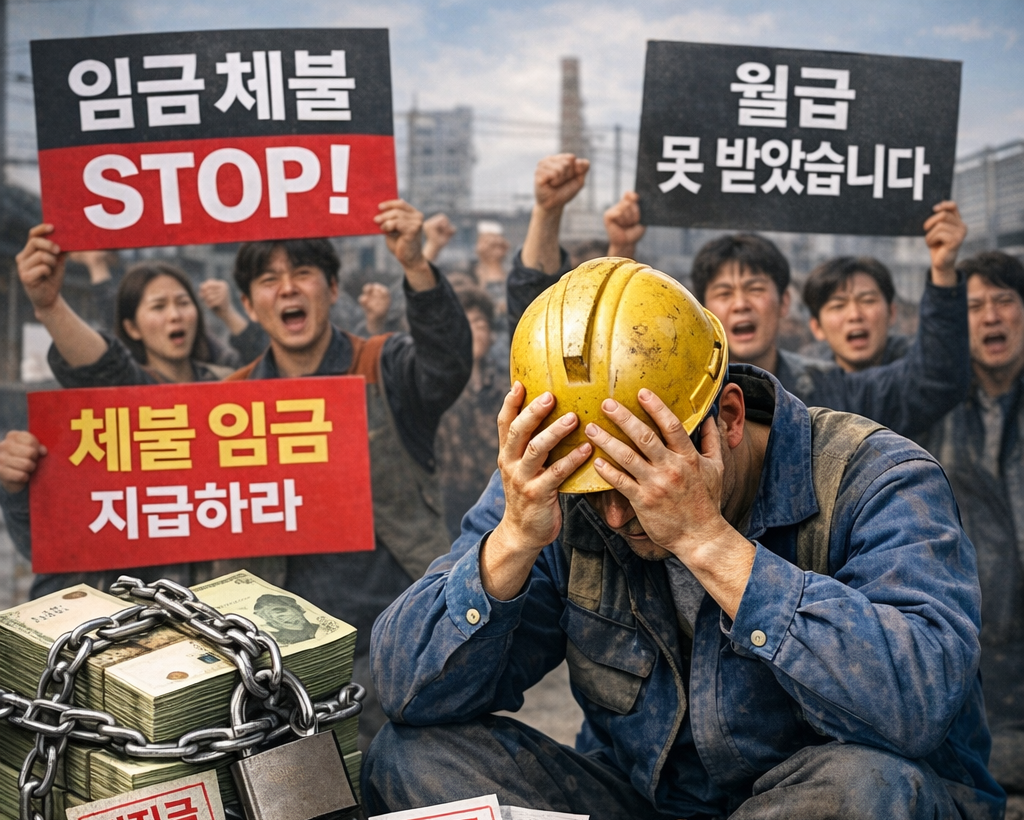
The Ministry of Employment and Labor has formally asked the Supreme Court's Sentencing Commission to raise sentencing guidelines for wage theft, arguing that actual court penalties must reflect the scale and frequency of violations as the statutory maximum punishment is set to increase sharply in October.
Minister Kim Young-hoon visited the Sentencing Commission on Thursday and met with its chairman, Lee Dong-won, to propose revisions to the sentencing guidelines for wage theft offenses, the ministry said.
The government announced a comprehensive plan to eradicate wage theft in September last year, and an amended Labor Standards Act taking effect Oct. 8 raises the maximum statutory penalty for wage theft from "up to three years in prison or a fine of up to 30 million won ($19,900)" to "up to five years in prison or a fine of up to 50 million won." The ministry said the sentencing guidelines used in actual trials must be updated to match.
The ministry asked the commission to break down the current sentencing tiers — which treat all cases involving 100 million won or more as a single category — into finer gradations so that larger amounts of unpaid wages result in heavier sentences. The existing guidelines divide cases into three tiers: below 50 million won, between 50 million won and 100 million won, and 100 million won or above.
The ministry also called for stiffer penalties for deliberate and repeat offenders. It asked that intentional or repeated wage theft be treated as an aggravating factor distinct from cases driven by genuine business hardship, and that the number of workers affected and the duration of the violations also be reflected as grounds for heavier sentencing.
The ministry particularly flagged the absence of separate sentencing guidelines for fines, noting that most cases currently result in only token fines. It said new fine guidelines should be established so that fines are proportionate to the harm caused.
The current sentencing guidelines have been in place since 2016. Under the existing framework, the standard sentence for unpaid wages below 50 million won is four to eight months in prison; for amounts between 50 million won and 100 million won, six months to one year; and for amounts of 100 million won or more, eight months to one year and six months. Sentences can be increased in cases of malicious conduct or severe harm.
"Wages are the rightful compensation for labor and must be paid on time under any circumstances," Kim said. "Wage theft is a serious crime that threatens not only the individual worker but also their family's livelihood, and sentencing guidelines that reflect the gravity of the offense are needed." He added that the ministry would continue working with the Sentencing Commission to achieve meaningful reform of the system.
fact0514@heraldcorp.com