At the 690-unit Kumho 1st apartment complex in Ssangmun-dong, Dobong-gu, the asking price for a jeonse contract on a 34-square-meter unit stands at 230 million won ($152,000) — just 30 million won below the 260 million won asking price for an outright sale. In early 2022, when home prices were rising sharply, the gap between jeonse and sale prices at this unit size had stretched to as wide as 200 million won.
In Junggye-dong, Nowon-gu, the lowest asking sale price for an 84-square-meter unit at the Hyundai 5th complex is 650 million won — only 100 million won above the current jeonse price. That gap has narrowed sharply because jeonse prices, which stood at around 400 million won in February, surged 150 million won in just four months to reach a record high.
As jeonse prices climb steeply, the gap between sale and jeonse prices is narrowing across outer Seoul neighborhoods. Industry watchers say the trend is pushing renters to consider buying outright, and that a wave of purchases could in turn drive sale prices higher, amplifying the broader upward momentum in the housing market.
According to KB Real Estate on Thursday, the jeonse-to-sale price ratio for Seoul apartments citywide stood at 50.28 percent last month. Districts with concentrations of high-end housing posted significantly lower ratios — Gangnam-gu at 38.16 percent, Seocho-gu at 41.98 percent, Songpa-gu at 39.27 percent and Yongsan-gu at 39.01 percent — but areas drawing demand for lower-priced homes told a different story.
Five districts posted jeonse-to-sale ratios more than 10 percentage points above the Seoul average: Gangbuk-gu at 63.4 percent, Geumcheon-gu at 62.95 percent, Jungnang-gu at 62.90 percent, Dobong-gu at 61.11 percent and Eunpyeong-gu at 60.26 percent.
A real estate agent in Ssangmun-dong, Dobong-gu, said the gap at some units had shrunk to 100 million won, prompting tenants to buy the homes they were already renting. "Jeonse prices are going up by the day," the agent said. "This is a quiet part of even Dobong-gu, but around July the distressed listings dried up and the mood has turned unsettled."
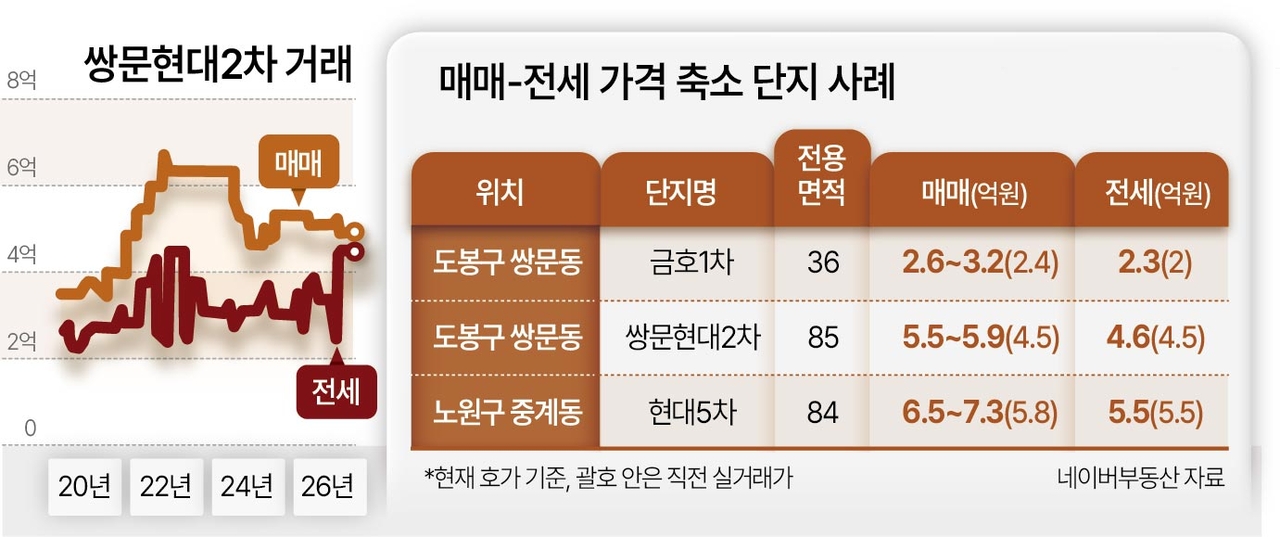
In some cases, the asking prices for jeonse and outright purchase have converged entirely. At the Geosung Hakmaul apartment complex in Banghak-dong, Dobong-gu, a 134-square-meter unit is listed for sale at the same price as the jeonse asking price for an equivalent unit. A broker at a Dobong-gu agency said the landlord had raised the jeonse price by about 250 million won compared with the previous contract. "We thought, who would come at that price?" the broker said. "But people are actually showing up to view it at that price — even we are surprised."
The head of a real estate agency in Nowon-gu said both rental and sale listings were so scarce that landlords were naming their own prices. "There are so few jeonse listings and so few properties for sale that owners are setting prices however they like," the agent said. "The gap in expectations between landlords and tenants, and between sellers and buyers, is so wide that brokering deals has become a struggle."
Industry insiders say that if jeonse prices continue to push sale prices higher in outer districts where end-users are concentrated, fear of missing out could fuel a wave of follow-on purchases.
Yoon Ji-hae, head of the research lab at Real Estate 114, said genuine end-user demand was driving jeonse and sale prices closer together in outer areas, and that sale prices would eventually break away again to the upside. "When deciding to buy, if a complex is moving independently of the leading apartment in that area, buyers need to take a careful approach and consider future liquidity," she said.
Ham Young-jin, head of the real estate research lab at Woori Bank, said the impact of shrinking jeonse supply tends to be more pronounced for small and mid-sized units. "When the jeonse-to-sale ratio surges sharply, some buyers may act out of anxiety rather than sound judgment," he said. "End-users should carefully assess whether a purchase is genuinely worthwhile, taking into account factors such as liquidity."
hope@heraldcorp.com