![A notice about capital gains tax is posted at a real estate agency in Songpa-gu, Seoul, on June 21. [Yonhap]](https://wimg.heraldcorp.com/news/cms/2026/07/09/rcv.YNA.20260621.PYH2026062103230001300_P1.jpg)
The number of people owning two homes ticked up slightly last month, reversing a decline that had run from February through May as owners braced for the reinstatement of a capital gains tax surcharge on multi-home holders. It was the first increase in four months. By contrast, those holding three or more properties continued to shed homes in June.
Court Registry Information Plaza data on collective-building ownership released Thursday showed 1,735,565 people nationwide held exactly two collective-building units — apartments, officetels or multi-family homes — as of June.
The two-property count had risen consistently since last year, hitting a record high of 1,740,319 in January. It then began falling after President Lee Jae Myung announced on his personal social media account on Jan. 23 that the capital gains tax surcharge for multi-home owners would be reinstated. The numbers declined steadily — 1,739,975 in February, 1,738,635 in March, 1,737,226 in April and 1,735,357 in May — a drop of nearly 5,000 over five months.
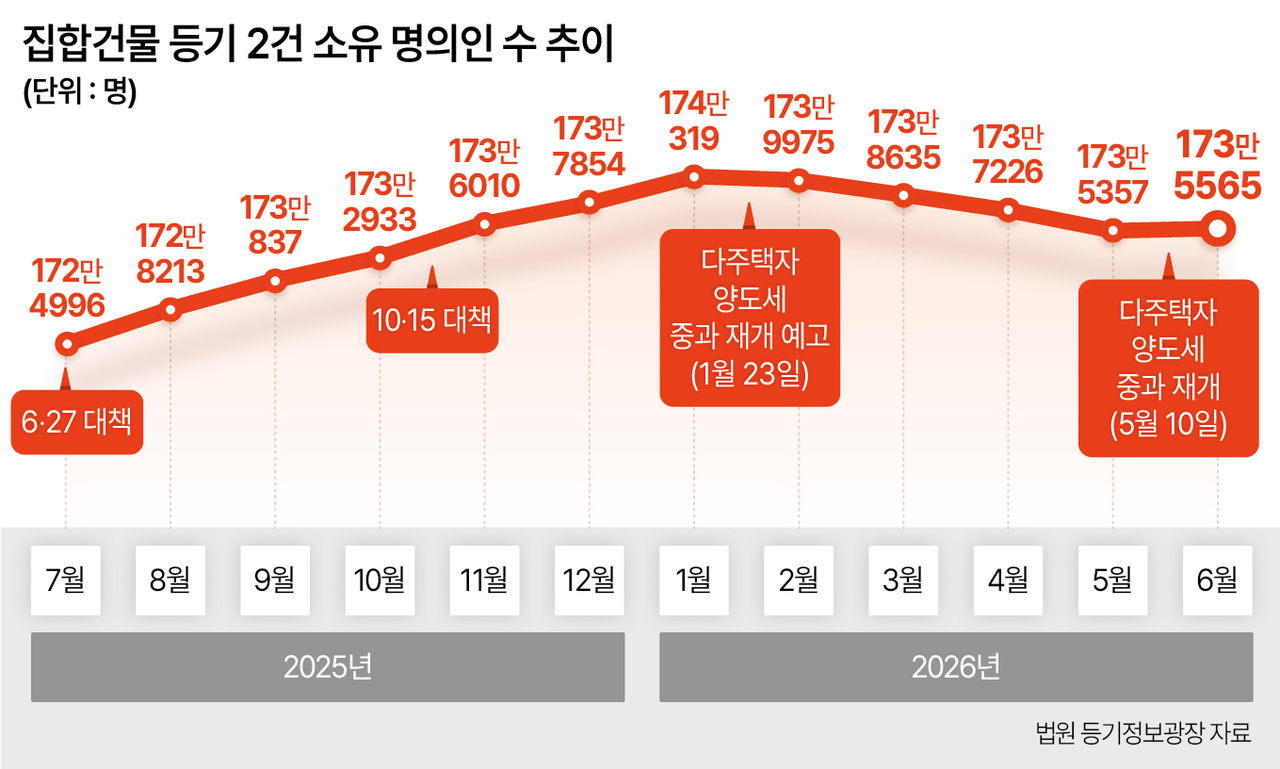
Analysts attribute the rebound in two-property ownership to a weakening incentive to sell now that the surcharge has kicked back in. Through May 9, a temporary exemption from the multi-home capital gains surcharge had been in effect, allowing sellers to reduce their tax burden. From May 10 onward, the surcharge rules were reinstated.
"Virtually no multi-home owner is willing to sell and absorb the reinstated surcharge since May 10," said the head of a real estate agency in Banpo-dong, Seocho-gu. "Those holding high-value properties are watching closely for the direction of the tax reform announced for July."
The agent added that while the current property holding tax is not yet at a level most owners find immediately unmanageable, the government's forthcoming July tax overhaul could restructure the tax system based on the number or type of properties held. "Depending on which way the reform goes, the response from two-property owners and those with three or more could diverge significantly," the agent said.
Under the current tax system, both two-property owners and those with three or more are classified as multi-home holders, but their tax burdens differ. Property tax does not distinguish between the two groups, but the comprehensive real estate holding tax applies different individual residential rate brackets — one for owners of two or fewer homes and another for those with three or more. The rates are the same up to a tax base of 1.2 billion won ($795,000), but above that threshold, higher rates apply to owners of three or more properties.
The gap is equally clear in capital gains tax. When the temporary surcharge exemption ended May 9 and the surcharge rules resumed from May 10, owners selling homes in designated adjustment-target zones became subject to a 20-percentage-point addition to the standard rate for two-property owners and a 30-percentage-point addition for those with three or more.
Owners of three or more properties — who face a sharply heavier tax burden — continued to reduce their holdings last month. The number of people registered as owning three or more collective-building units peaked at a record 504,266 in January, the same month as the two-property peak, and has since fallen for five consecutive months, reaching 499,705 in June.
Experts say the diverging trends between two-property owners and those with three or more may reflect a temporary effect stemming from changes in transaction taxes for multi-home holders that took effect this year.
"Two-property owners are not lightly taxed either," said Woo Byung-tak, a senior adviser at Shinhan Premier Pathfinder. "It is true they carry a lighter burden than those with three or more, but it would be hard to call two properties an attractive tax bracket in its own right."
Woo added that the uptick in two-property ownership likely reflects an intermediate state in an ongoing consolidation process rather than a deliberate strategic choice. "Multi-home owners who tried to sell before the surcharge exemption expired may not have managed to offload everything in time, and those left holding two properties ended up being counted in the statistics," he said.
Ham Young-jin, head of the real estate research lab at Woori Bank, said the most likely explanation is that owners who had held multiple properties trimmed down to two, planning to keep one and consider gifting or passing the other on through inheritance.
quq@heraldcorp.com