
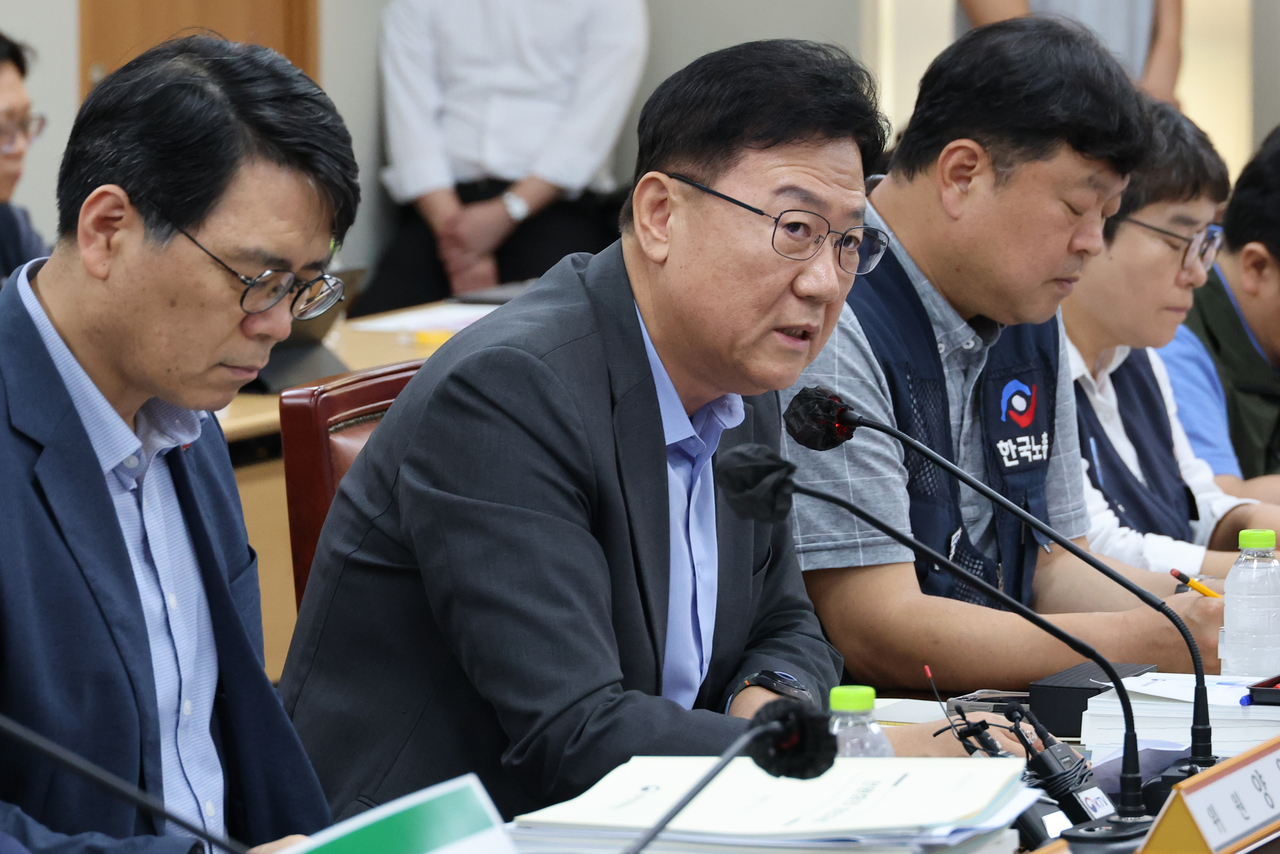
The gap between labor and management in negotiations over next year's minimum wage has narrowed to 990 won, but the two sides have still failed to reach an agreement.
With the statutory deliberation deadline already passed, attention is turning to whether public interest members of the Minimum Wage Commission will propose a "deliberation facilitation range" — an upper and lower bound — at the 13th plenary session Thursday to push the two sides toward a final compromise.
The commission will hold its 13th plenary session Thursday afternoon at the Government Sejong Complex to continue deliberations on next year's minimum wage. The rate is determined by a panel of 27 members — nine each representing workers, employers and the public interest.
Labor and management have been narrowing their differences through successive rounds of revised proposals since submitting their initial positions. Workers' representatives opened with a demand of 12,000 won per hour — a 16.3 percent increase over this year's minimum wage of 10,320 won ($7) per hour — while the employers' side began negotiations by proposing a freeze.
At the 12th plenary session held Tuesday, both sides submitted their sixth revised offers. Labor proposed 11,450 won per hour and management proposed 10,460 won, bringing the gap down to 990 won — 70 won narrower than the 1,060-won difference recorded after the fifth round of revisions.
With the two sides still far apart and administrative procedures required before the minimum wage can be officially announced, there is growing speculation that public interest members will present a deliberation facilitation range at Thursday's session. Once such a range is proposed, both sides must submit new revised offers within those bounds; if no agreement is reached, the matter proceeds to a vote.
The minimum wage deliberations have already exceeded the legal deadline. The commission is required to complete its review by the end of June each year but has again missed that deadline this year.
The commission must submit its proposed minimum wage to the minister of employment and labor by mid-July, and the minister must finalize and officially announce next year's minimum wage by Aug. 5. The new rate takes effect Jan. 1 next year.
fact0514@heraldcorp.com




