![A staged image depicting stalking. [Generated with AI]](https://wimg.heraldcorp.com/news/cms/2026/07/07/news-p.v1.20260707.6264864c59ea496a8dcf97139e6400fb_P1.png)
Another tragedy has unfolded as a man tracked down and killed a former partner — the latest in a string of stalking crimes that show no sign of abating. The number of stalking reports and police-initiated "emergency protective orders" have both risen sharply since the Stalking Punishment Act took effect.
Police and the Ministry of Justice have been working to close gaps in the system, but experts say more aggressive physical separation of perpetrators from victims is needed. Some victims have even turned to private security firms for protection.
Police emergency orders rise every year
According to Korean National Police Agency data on emergency protective orders from 2021 to 2025, released Tuesday, police issued 7,911 such orders last year — more than double the figure recorded roughly four years earlier, when the Stalking Punishment Act first took effect around October 2021. The numbers have climbed steadily each year: 3,402 in 2022, 4,046 in 2023 and 4,610 in 2024.
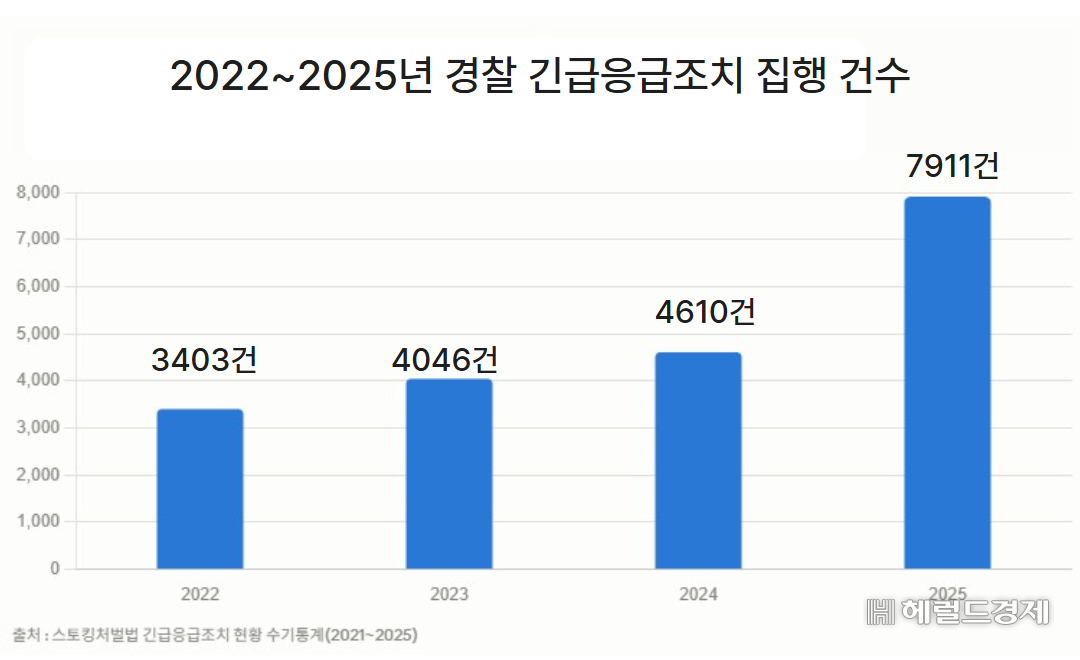
A police emergency protective order is a victim-protection measure that officers can issue on their own authority. It prohibits the perpetrator from approaching within 100 meters of the victim and bars contact through telecommunications, including phone calls. The order can remain in effect for up to one month before a court issues a formal interim measure.
A police official handling stalking policy said the agency directed officers to strengthen emergency protective orders following a stalking murder in Dongtan in May last year, and that a proactive response posture has been maintained as cases have continued since.
Even with more aggressive use of emergency orders, blind spots remain. In the early hours of Sunday, a man in his 50s identified as A waited along the route his former girlfriend, a woman in her 60s identified as B, took home and stabbed her to death on a street in Jungwon-gu, Seongnam, Gyeonggi Province. When the attack began, B used a protective smartwatch to call for help. Police arrived at the scene within three minutes, but were unable to prevent the tragedy. B died from her injuries, and A is recovering after injuring himself.
![Police demonstrate how a person under protection can spot an intruder via an AI-enabled closed-circuit television system and call for help using a smartwatch, at a demonstration held at a residence in Yeon-dong, Jeju, in October 2021. [Yonhap]](https://wimg.heraldcorp.com/news/cms/2026/07/07/news-p.v1.20260316.d8c561b842cf4e41b7f69af32aa44add_P1.jpg)
In March, Kim Hun, 44, tracked down a former girlfriend on a street in Onam-eup, Namyangju, Gyeonggi Province, and killed her. The victim was wearing a police-issued smartwatch at the time and managed to send an alert through it just before the attack, but the tragedy could not be prevented.
Particularly troubling was that Kim was wearing an electronic ankle monitor at the time — yet it proved useless. It had not been configured to help prevent stalking.
Kim had been ordered to wear the ankle monitor following a 2013 aggravated rape conviction and was required to wear it from July 2016 through July 2029. The device was not set up to alert authorities when he approached his stalking victim, because the legal basis for sharing stalking case information with the monitoring system was lacking.
Efforts to close that institutional gap are now under way. On Monday, police and the Ministry of Justice launched a "high-risk offender cooperative response" framework, under which agencies can share information to protect victims when a person convicted of murder, sexual violence or other serious crimes commits an additional stalking offense.
![A staged image depicting stalking. [Getty Images Bank]](https://wimg.heraldcorp.com/news/cms/2026/07/07/news-p.v1.20260707.472490e19bcf443385e03f35bd3cdd6a_P1.jpg)
Under the new framework, when a person already wearing an electronic ankle monitor for a prior conviction — such as murder, sexual violence or robbery — goes on to commit stalking or domestic violence and is issued a no-contact order, agencies can now share information and coordinate a response.
Experts say the next step must be ensuring perpetrators and victims are kept physically apart without fail. Lee Yun-ho, an emeritus professor of police administration at Dongguk University, said stalking crimes occur fundamentally because the perpetrator and victim can occupy the same time and space. "The perpetrator's access must be blocked at the source. A smartwatch alone cannot protect victims," he said.
He added that requiring perpetrators to wear electronic devices and dispatching officers immediately whenever they approach a victim's vicinity could resolve the problem.
Kwak Dae-gyeong, a professor at Dongguk University's College of Police and Criminal Justice, said stalking offenders have an extremely strong and persistent intent to torment their victims. "From the victim's perspective, it is very difficult to stop the perpetrator from approaching. Institutional improvements are needed to lower the threshold for issuing no-contact orders," he said.
As stalking crimes rise, some victims turn to private security
A string of stalking and dating-related killings, combined with anxiety over the limits of public protection, has driven a growing number of people to seek help from private security firms.
A representative of a security company specializing in stalking cases said the firm receives about 10 requests a month from clients who want an escort when breaking up with a partner, and that stalking-related inquiries have been increasing of late. Most clients are women in their 20s to 40s, the representative said.

The service is designed to help clients deliver a breakup in a safer environment. A bodyguard poses as another customer at a cafe or similar venue while keeping watch over the client.
The guard monitors the situation closely and steps in to de-escalate if tensions rise. "Even when we intervene, we act like someone nearby," the company representative said. "If we reveal we're a security firm, it can provoke the other person further and make things more dangerous."
The firm also handles other forms of stalking: cases where a stalking perpetrator was released with only a warning, and cases involving a customer stalking a bank employee.
20ki@heraldcorp.com