
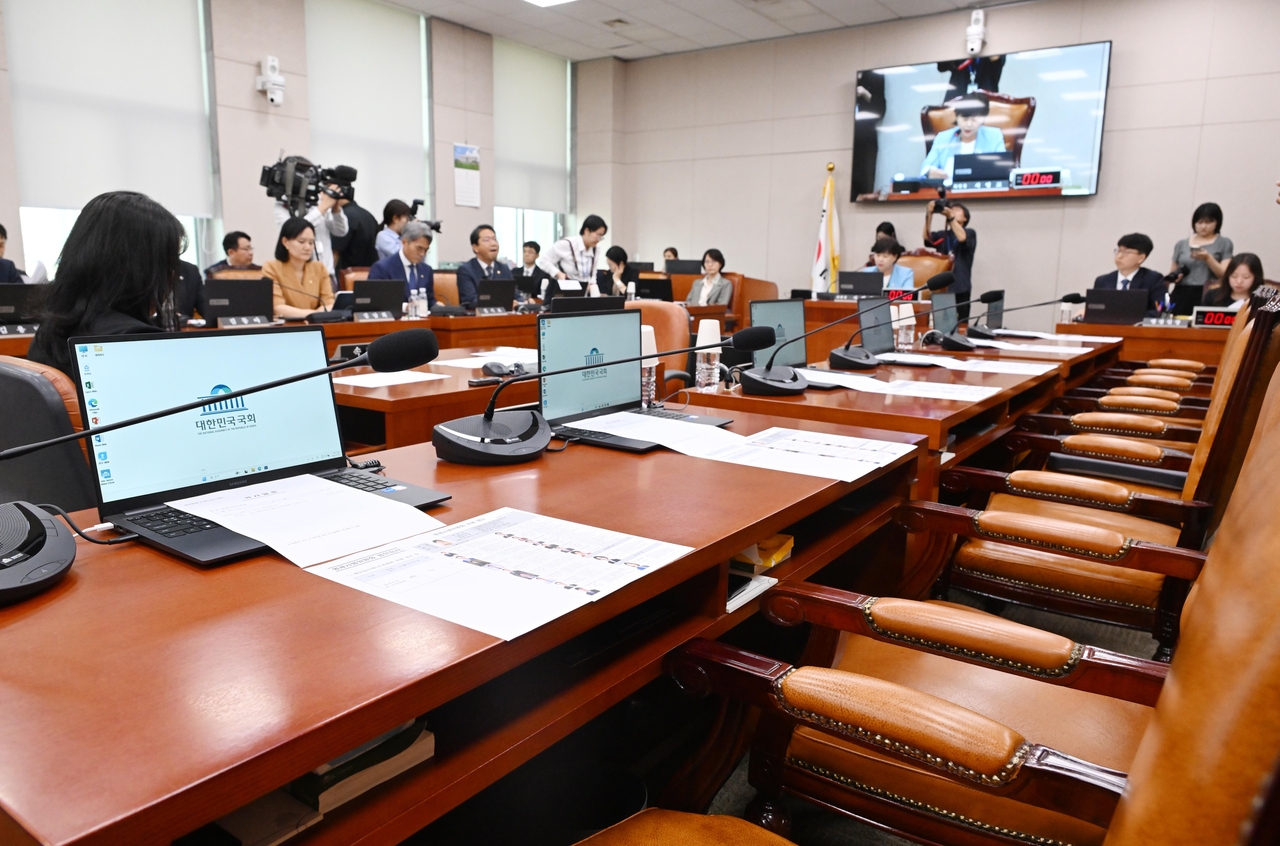
The ruling and opposition parties remained locked in a standoff over the allocation of National Assembly standing committees on Monday, the first day of the July extraordinary session. The Democratic Party of Korea moved ahead and appointed chairs for 11 committees, including the powerful Legislation and Judiciary Committee, while the People Power Party denounced the move as unilateral and continued its boycott.
Democratic Party floor leader Han Byung-do said at a Supreme Council meeting Monday that bills addressing people's livelihoods — including legislation to expand renewable energy distribution and a youth welfare bill supporting young people leaving home — were piling up in the Assembly. "Despite this, the People Power Party is rejecting the committee structure and signaling an even harder fight," he said.
The People Power Party is weighing its options: whether to claim the remaining seven standing committees through negotiations or to walk away entirely to highlight what it calls the Democratic Party's high-handed conduct. Opinions within the party are divided, with some members calling for drastic action. "We should throw down our badges as a last resort," said Rep. Kim So-hee. Floor leader Jeong Jeom-sik plans to convene a general assembly of lawmakers this week to canvass members' views again.
PPP floor spokesperson Kim Tae-gyu said on YTN Radio on Monday that many party lawmakers believe the Democratic Party's push to take the Legislation and Judiciary Committee is aimed at securing the dismissal of indictments and the cancellation of trials, reaffirming the party's position that it cannot yield the committee.
The two sides are also sharply divided over a special prosecutor to investigate the National Election Commission and hold those responsible accountable for a ballot shortage crisis. While both parties agree in principle on pursuing the special prosecutor, they remain at odds over how the prosecutor should be recommended.
Han said Monday that a special prosecutor tasked with investigating the election commission must be designed around fairness and independence, not political advantage. "Insisting that only the opposition party make the recommendation is not about uncovering the truth — it is no more than a political argument," he said.
The Democratic Party proposed limiting the scope of the investigation to the circumstances behind the reduction in ballots printed, the failure to report to and delays in briefing the election-day command, and internal matters within the election commission.
People Power Party leader Jang Dong-hyeok pushed back, saying ballots from past elections had turned up inside ballot boxes and that Rep. Seo Young-gyo and former National Election Commission Chairman Noh Tae-ak had been found to have spoken by phone on election day. "To uncover the full truth going back years and root out the election cartel, limiting the scope of the investigation makes no sense," Jang said. "What the public wants is a special prosecutor recommended by the opposition party, with an unlimited scope of investigation."
thanks@heraldcorp.com




