Seongdong-gu in Seoul said Tuesday that the city's 11th Joint Urban and Architecture Committee approved the "Seongsu Quasi-Industrial District Unit Plan Zone Designation and Plan Decision" on July 1, laying the groundwork to develop Seongsu-dong into a future innovation hub where cultural content and advanced industries converge. District Mayor Yoo Bo-hwa announced the decision.
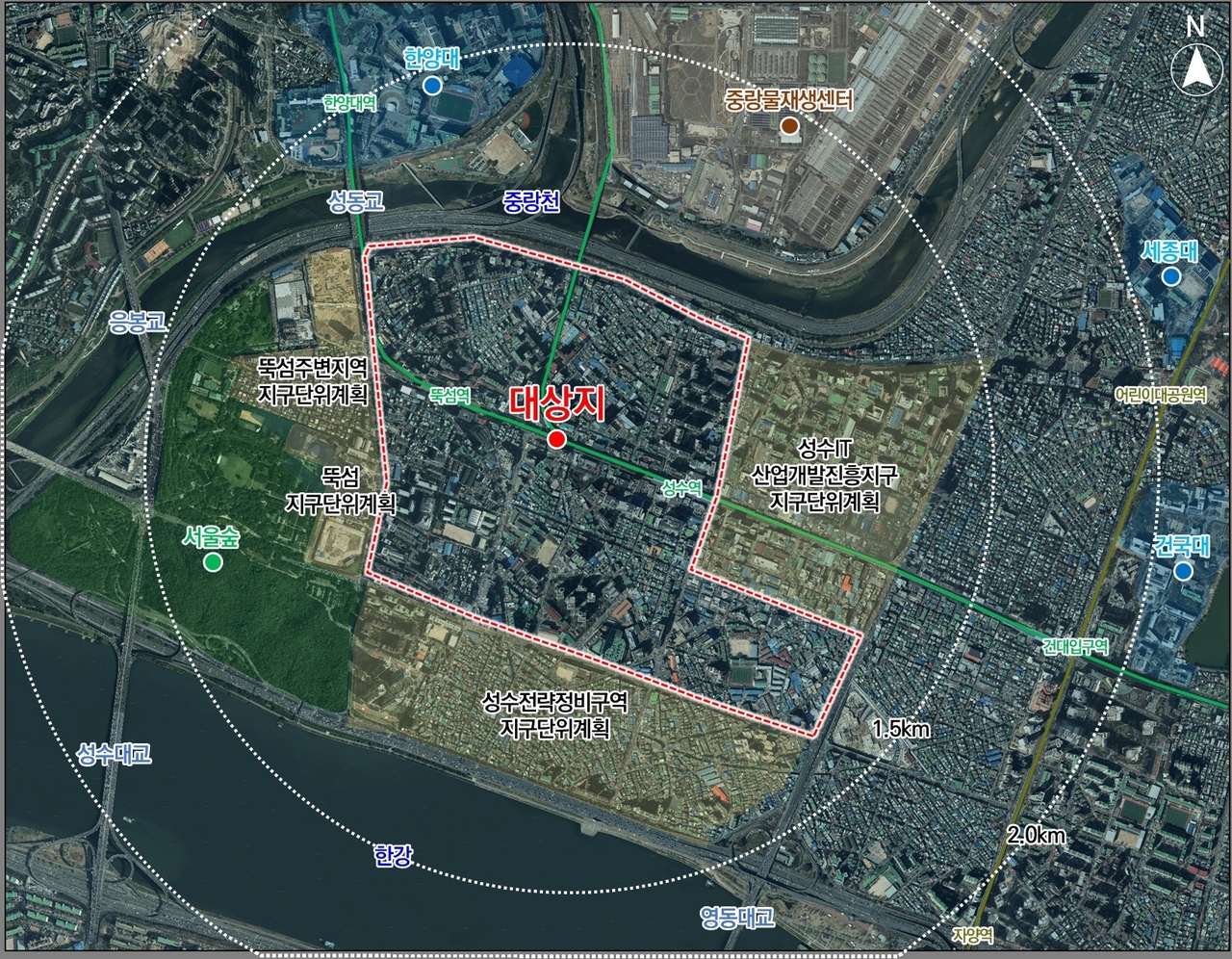
The plan covers the entire quasi-industrial zone in Seongsu-dong 1-ga and 2-ga — roughly 1.58 million square meters — excluding the area already governed by the existing Seongsu IT Industry and Retail Development Promotion District unit plan. The zone is prized for its central accessibility and its mix of traditional manufacturing, high-tech industries and cultural content businesses.
Once a dense cluster of factories, Seongsu-dong has transformed in recent years into a popular destination among younger visitors. Large factory sites have been converted into knowledge industry centers and co-working spaces, drawing a steady stream of IT and retail startups as well as unicorn companies.
Large-scale urban development projects are also underway in the area, including residential development in the Seongsu Strategic Renewal Zone, the creation of a global future business district on the former Sampyo Ready-Mixed Concrete site, and the "Krafton Town" development on the former E-mart site. In line with these changes, Seongdong-gu drew up the district unit plan with the goal of establishing an innovation hub centered on cultural content and advanced industries while improving the local environment.
The area was designated in March as the "Seongsu IT, Cultural Content Industry and Retail Development Promotion District." As a follow-up measure, the new plan allows floor area ratios and maximum building heights to be relaxed by up to 1.2 times when IT, R&D, or cultural content businesses — the zone's recommended uses — move in.
Buildings that meet public-interest requirements — such as installing public open spaces, obtaining green building certification or making public contributions — can qualify for an upper-limit floor area ratio incentive of up to 800 percent.
To cultivate a distinctive local streetscape, the plan also relaxes the building coverage ratio to up to 70 percent for new construction or extensions built in red brick, encouraging the continuous red-brick street character that defines Seongsu-dong. Measures to protect small businesses from franchise encroachment have also been included for the Yeonmujang-gil area and the vicinity of Ttukseom Station.
"Seongsu-dong is rapidly emerging as a center where global culture and advanced industries converge," district Mayor Yoo said. "Through this district unit plan, we will improve aging industrial facilities and the surrounding environment, and work in tandem with nearby development projects to nurture Seongsu-dong into an innovation hub where cultural content and advanced industries grow together."
seouldream01@heraldcorp.com