
![A job posting board at a university employment center in Seoul [Yonhap]](https://wimg.heraldcorp.com/news/cms/2026/07/05/rcv.YNA.20260513.PYH2026051308060001300_P1.jpg)
South Korea's economy is expected to grow around 2.5 percent this year, driven largely by the semiconductor sector, but the resulting job creation is forecast to be the weakest in eight years, according to a new analysis.
Analysts say "jobless growth" is becoming increasingly pronounced as capital-intensive industries such as semiconductors lead the expansion and companies accelerate automation over new hiring amid the spread of AI.
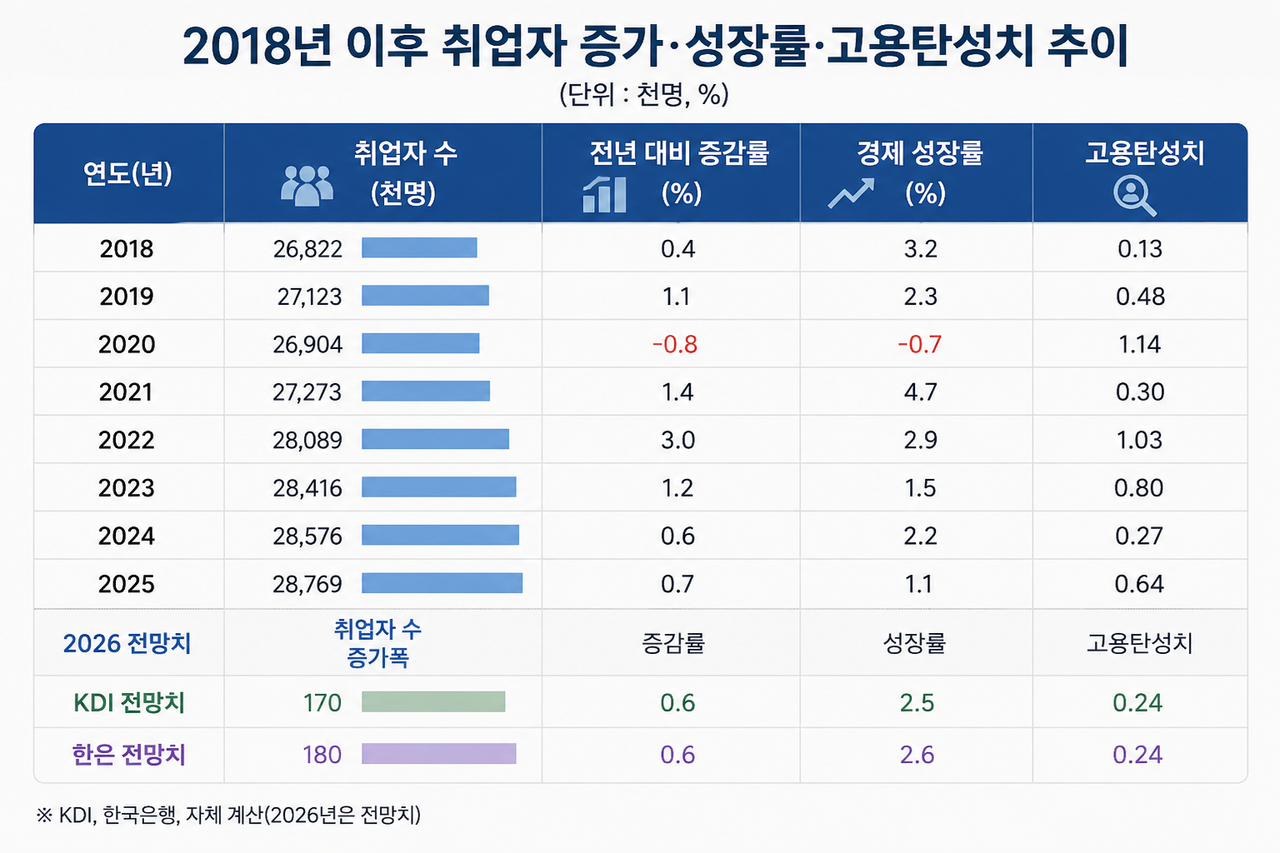
Based on economic outlooks from the Korea Development Institute and the Bank of Korea, South Korea's employment elasticity is estimated at 0.24 this year. The figure measures how much employment grows relative to economic growth — specifically, the ratio of the rate of increase in employed persons to the GDP growth rate.
![A job posting board at a university employment center in Seoul [Yonhap]](https://wimg.heraldcorp.com/news/cms/2026/07/05/rcv.YNA.20260513.PYH2026051308030001300_P1.jpg)
The Korea Development Institute projects GDP growth of 2.5 percent this year and an increase of 170,000 employed persons. That translates to an employment growth rate of 0.6 percent relative to last year's workforce, which divided by the GDP growth rate yields an employment elasticity of 0.24. The Bank of Korea's forecast — 2.6 percent growth and 180,000 additional jobs — produces the same result.
If those projections hold, employment elasticity would fall to its lowest level since 2018, when it stood at 0.13 — a sharp drop from last year's reading of 0.64. The GDP growth rate is expected to more than double from last year's 1.1 percent, yet the employment growth rate is set to slip from 0.7 percent to 0.6 percent, meaning job creation is failing to keep pace with economic expansion.
The trend is even more pronounced in the first quarter alone. GDP grew 3.8 percent in the first quarter, yet employment grew just 0.6 percent, pushing employment elasticity down to 0.16 — the lowest since 2021, when the economy was reeling from the COVID-19 shock.
Analysts point to the semiconductor-centered growth structure as the primary driver of the disconnect.
The semiconductor industry, which has been powering South Korea's recent export surge, generates high productivity and added value but relatively few jobs. With other industries also failing to grow strongly enough, the overall employment effect of economic expansion remains limited.
The spread of AI is also reshaping the labor market. Companies are increasingly replacing repetitive and routine tasks with AI to cut costs and improve efficiency, reducing new hires and shifting recruitment toward managerial and experienced workers whose roles are harder for AI to replicate.
Young people are bearing the brunt of these changes. The number of employed persons aged 15 to 29 fell year-on-year for five consecutive months from January through May, making youth the only age group to see a sustained employment decline during that period.
The Bank of Korea noted in a report last year that youth employment had declined while middle-aged and older workers saw job gains following the spread of generative AI. The analysis found that AI adoption has strengthened companies' preference for experienced workers who can contribute immediately over new graduates.
Experts say a meaningful employment recovery is unlikely anytime soon.
"As AI adoption expands, companies are maintaining hiring for experienced positions while cutting back on new recruitment," said Kim Kwang-seok, an adjunct professor at Hanyang University. "If young people lose even the opportunity to build experience, it could have a long-term negative impact on industrial competitiveness." He also called for expanding incentives for companies that hire young workers and strengthening support for youth technology startups to broaden entry points into the labor market.
fact0514@heraldcorp.com




