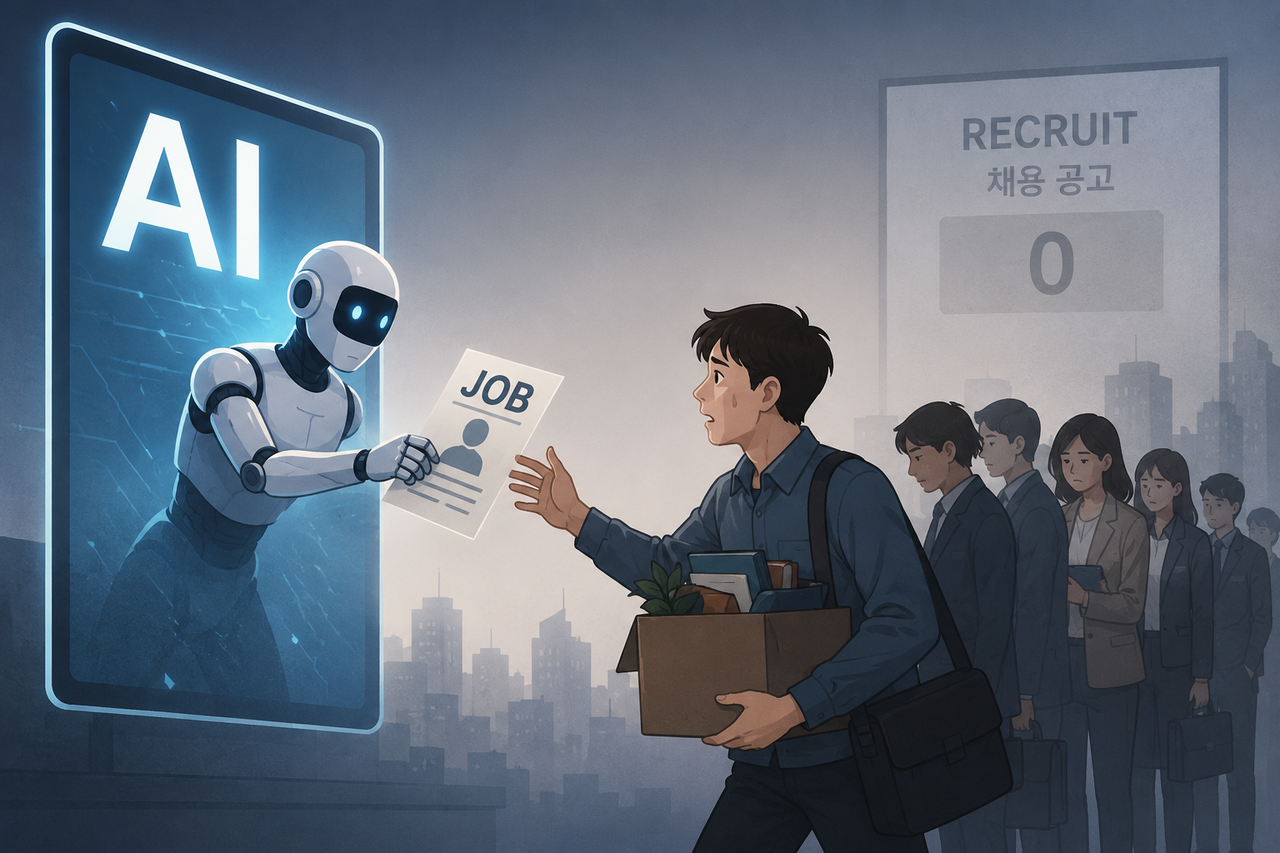
Even as AI investment and a semiconductor boom continue, youth employment is deteriorating. Workers in their 20s and 30s are losing ground particularly in information technology and professional services — sectors where AI adoption is highest — and the steepest declines are concentrated in occupations most often cited as vulnerable to AI substitution, including legal clerks, translators, designers and software developers.
Employment insurance enrollment data from the Ministry of Statistics' national statistics portal KOSIS showed that total enrollment stood at about 15.848 million in May, up 268,000, or 1.7 percent, from a year earlier. Among workers under 30, however, enrollment fell to about 2.233 million — a drop of 65,000, or 2.8 percent. Of all age groups, only those under 30 and those in their 40s recorded declines, while workers aged 60 and older posted the highest growth rate, rising 207,000, or 7.5 percent.
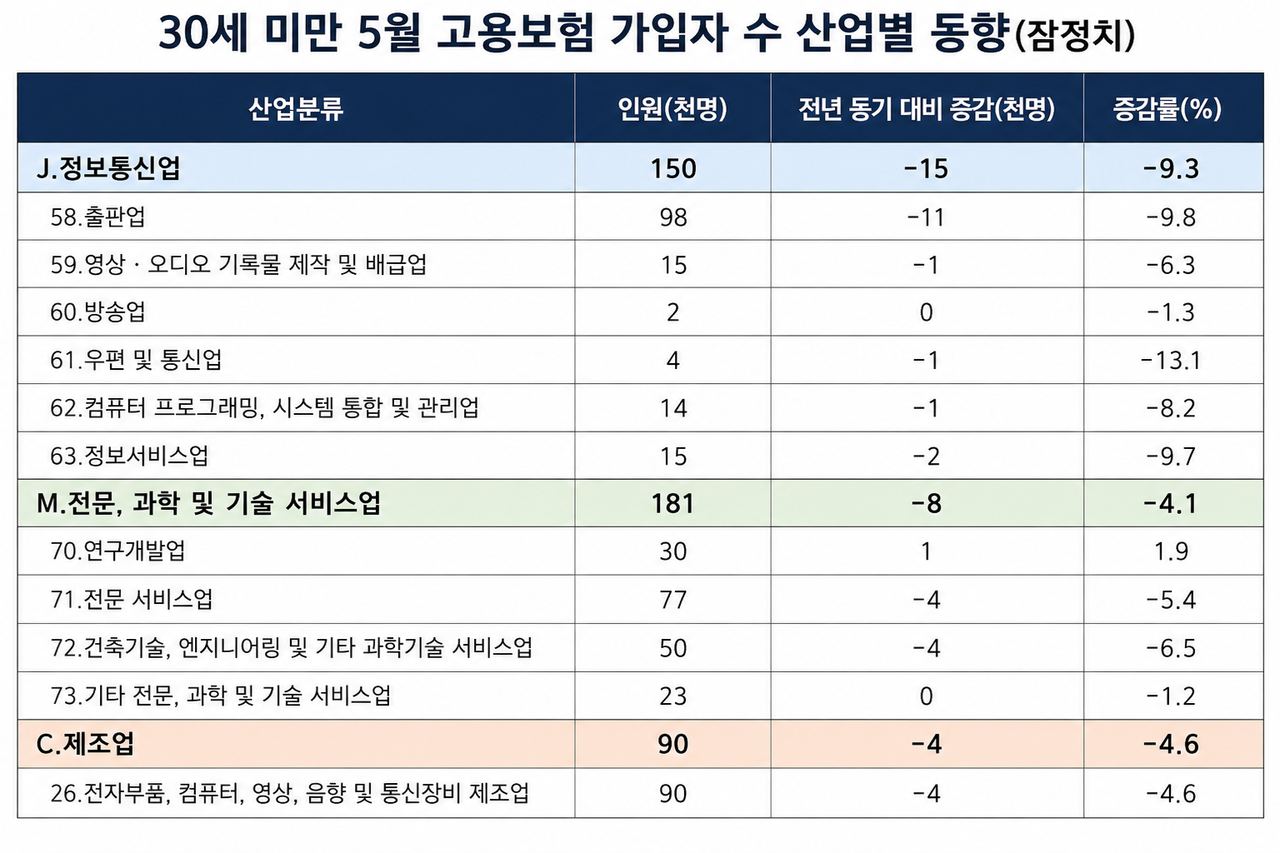
The decline among young workers was particularly pronounced in industries where AI is most actively used. Employment insurance enrollment among workers under 30 fell 9.3 percent in the information and communications sector and 4.1 percent in professional, scientific and technical services. The information and communications sector covers publishing, video and audio production, broadcasting, computer programming and information services, while professional, scientific and technical services encompasses research and development, legal work, accounting, advertising, management consulting, architectural design and engineering.
The economically active population survey pointed in the same direction: employment in professional, scientific and technical services has fallen for six consecutive months since December last year. In May, the number of workers in the sector stood at about 1.422 million — down 89,000, or 5.9 percent, from a year earlier — the largest decline among all 21 major industry categories.
Youth employment also contracted in the electronic components, computers, video, audio and communications equipment manufacturing sector, which has been among the biggest beneficiaries of the semiconductor boom. Workers under 30 covered by employment insurance in that sector fell by 4,000, or 4.6 percent, from a year ago. Analysts say the gains chipmakers such as Samsung Electronics and SK hynix have made through large-scale investment and improving earnings have not translated sufficiently into jobs for young workers.
Occupation-level data showed similarly sharp drops in fields expected to be most affected by AI. Among workers in their 20s covered by employment insurance, writers and translators recorded the steepest decline at 20.6 percent. Network systems developers and information security specialists fell 15.2 percent, followed by accounting and bookkeeping clerks at 11.5 percent, software developers at 10.1 percent, computer systems specialists at 9.1 percent, designers at 7.6 percent and legal clerks at 6.1 percent.
Legal clerks in particular have now declined for 13 consecutive months, with enrollment standing at 7,175 — down 468, or 6.1 percent, from the same month last year. The pace of decline has also been widening over time.
Workforce trend data from businesses pointed in the same direction. In the second half of last year, the number of computer hardware and telecommunications engineering technicians fell 9.0 percent, computer systems specialists dropped 16.1 percent and designers declined 6.5 percent. New hiring demand contracted as well — by 32.4 percent, 27.5 percent and 15.9 percent, respectively — while job openings for writers and translators fell 32.7 percent.
The government, however, has stopped short of attributing the job losses directly to AI. Instead, officials say that as industrial structures shift rapidly amid the AI transformation, the focus will be on expanding retraining and skills-development opportunities for workers who need to change roles, and on strengthening job-transition and career-change support.
fact0514@heraldcorp.com