
![A notice about unemployment benefits posted at a job center in Seoul [Yonhap]](https://wimg.heraldcorp.com/news/cms/2026/07/05/news-p.v1.20241118.a6ff1bd515b54c5e809ddfa86e841126_P1.png)
Job seekers who received unemployment benefits went on to earn higher wages after reemployment, a new study has found. The findings suggest that unemployment benefits do not simply delay job searches but help workers find better-matched positions and reduce wage inequality in the labor market.
According to research published Saturday by the Korea Employment Information Service, an analysis of job transition and hiring data, average monthly wages, and unemployment benefit receipt among employment insurance subscribers from 2018 to 2023 showed that benefit recipients earned higher wages after returning to work.
After controlling for variables including gender, age, education, tenure, occupation, industry and company size, a regression analysis found that workers who received unemployment benefits saw their log wages rise by an average of about 0.054 after reemployment.
The researchers said unemployment benefits ease the financial burden immediately after job loss, allowing workers to take time to find a well-matched position rather than rushing into a low-wage job.
The study also confirmed a wage-inequality-reducing effect. The Gini coefficient for unemployment benefit recipients was about 6.4 to 7.5 percent lower than for non-recipients, indicating that the benefits contributed to narrowing wage gaps in the labor market.
However, recipients did tend to take somewhat longer to find reemployment in the short term. The researchers interpreted this as reflecting recipients' willingness to extend their job searches in pursuit of better opportunities rather than accepting the first available offer. They concluded that while unemployment benefits carry a short-term cost of slightly delaying reemployment, they produce positive long-term effects by raising wage levels and reducing income inequality.
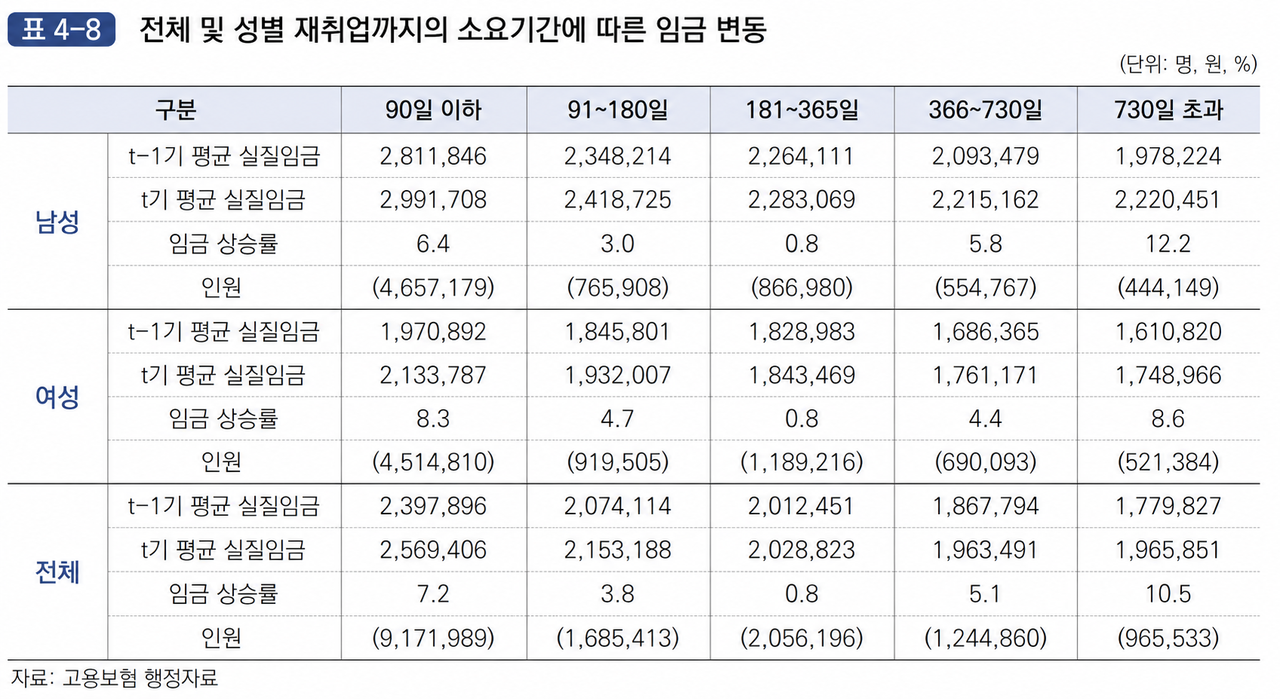
The study also examined the relationship between the length of the gap between jobs and the rate of wage growth after reemployment. Workers who found new jobs within 90 days of leaving their previous position recorded the highest average wage growth, at 7.2 percent. That figure fell to 3.8 percent for those who took 91 to 180 days and to 0.8 percent for those who took 181 to 365 days. Wage growth rebounded for workers with gaps exceeding one year — rising to 5.1 percent for gaps of 366 to 730 days and to 10.5 percent for gaps of more than 730 days.
The researchers said the rebound in wages after extended unemployment may reflect workers successfully transitioning to higher-quality jobs through more thorough job searches.
"Policies are needed that go beyond simply raising employment rates and instead support matching workers with jobs that are a good fit," the researchers said. "Since unemployment benefits have the effect of improving the long-term income trajectory of reemployed workers, they should be actively utilized."
fact0514@heraldcorp.com




