
National Assembly Budget Office cites lack of price benchmarks and split oversight as sources of confusion
Report calls for easing 10% raw-material threshold, standard formula and Japan-style public price indices

A regime introduced in 2023 to ease the burden on small and medium-sized enterprises from surging raw-material costs has entered its third year of operation, yet only one in five companies actually understands how it works, according to a new government report.
The National Assembly Budget Office said the government's failure to provide standard price indices by industry has forced companies to prove cost increases on their own. The split administration of the regime between the Ministry of SMEs and Startups and the Korea Fair Trade Commission has created significant confusion on the ground.
The office's report, "Progress and Implications of the Supply-Price Indexing Regime," published Saturday, found that 54.7 percent of companies said they were aware of the supply-price indexing regime, but only 19.0 percent said they understood its details. Awareness of the subcontracting-payment indexing regime was also low — 39.3 percent among primary contractors and 30.3 percent among subcontractors.
The supply-price indexing regime requires that fluctuations in raw-material prices beyond a set threshold be reflected in delivery payments. It was introduced in October 2023 to address the difficulty small and medium-sized enterprises faced in passing on rising input costs to their contract prices, a problem that worsened as raw-material volatility increased through the COVID-19 pandemic and the Russia-Ukraine war.
The budget office said significant limitations have emerged in how the regime operates. The most serious problem, it said, is that the government does not provide standard price indices by industry or product category, leaving the parties to each transaction to negotiate the key raw materials, price-change benchmarks and indexing formula themselves. This places a heavy burden on subcontractors, who must independently demonstrate the link between rising raw-material costs and higher delivery prices. A survey last year found that the most common reason companies gave for not signing an indexing agreement — cited by 45.7 percent of respondents — was that they did not want to share cost information with the contracting company.
The report also found that the regime's eligibility criteria are out of step with reality. Under the current rules, only raw materials that account for 10 percent or more of the delivery price qualify for indexing. But many small and medium-sized enterprises that produce a wide variety of items in small volumes, or that manufacture complex processed components, have no single raw material that clears that threshold. Last year's survey found that only 12.5 percent of subcontractors said they met the criterion.
The split administrative structure was also flagged as a problem. The Ministry of SMEs and Startups runs the supply-price indexing regime under the Mutually Beneficial Cooperation Act, while the Korea Fair Trade Commission administers the subcontracting-payment indexing regime under the Subcontracting Act. Although the two regimes share the same purpose, they operate under different laws, use separate dispute-resolution channels and produce different educational materials — making it difficult for companies to determine which regime applies to them and adding to their administrative burden.
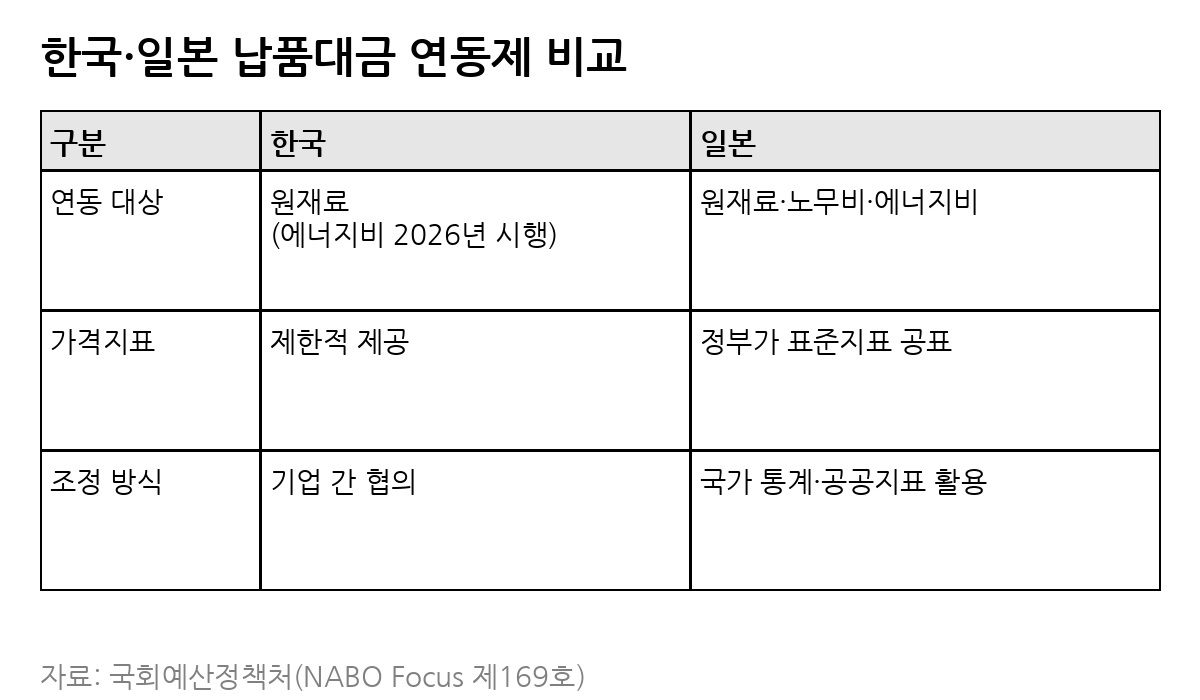
The budget office also highlighted Japan's approach as a reference. The Japanese government provides public price indices covering not only raw-material costs but also labor and energy costs, which companies can use as a basis for negotiations. South Korea, by contrast, offers only reference price information, leaving a heavier negotiating burden on the parties involved, the report said.
Jeong Geun-ju, an analyst in the office's economic and industrial project evaluation division, said the government should develop concrete raw-material criteria that reflect the characteristics of different industries and product categories, along with standard indexing formulas, and should revise the current 10 percent threshold to better reflect the reality of companies that produce diverse products in small volumes. "Because the indexing regimes under the Mutually Beneficial Cooperation Act and the Subcontracting Act are administered separately, the promotional and educational materials, administrative guidelines and standard contracts of the two ministries need to be better aligned so that companies can more easily understand and use the system," Jeong said.
fact0514@heraldcorp.com




