Analysis of both companies' sustainability reports
Direct PPA regime launched in 2022; a key renewable energy procurement channel
Global big tech pushing for carbon-free energy expansion
Samsung Electronics has signed 11 cumulative deals, securing 681 MW
SK hynix sourced 31% of energy from renewables
Samsung Vice Chairman Jeon Young-hyun calls for PPA expansion
![Samsung Electronics and SK hynix. [Yonhap]](https://wimg.heraldcorp.com/news/cms/2026/07/02/news-p.v1.20260520.8f334cf5f31d4f8a9b3c212b212c69a2_P1.jpg)
Interest in power purchase agreements, or PPAs, is growing in South Korea's semiconductor industry following Samsung Electronics and SK hynix's announcement of a combined 800 trillion won ($515 billion) investment in a new chipmaking cluster in the country's southwest. The industry has been calling for expanded PPA access to secure a stable power supply.
Both chipmakers already use PPAs as a primary channel for procuring renewable energy, building up carbon-free power capacity to meet the decarbonization demands of their global big-tech customers.
Samsung Electronics' DS (semiconductor) division began expanding renewable energy through PPAs in the United States in the late 2010s, and domestic contracts accelerated from 2023. SK hynix has also been raising its renewable energy usage rate since signing its first PPA in 2024.
The two companies' 2026 sustainability reports, released recently, offer a detailed picture of their respective PPA portfolios.
A PPA is a contract under which a power producer and a buyer trade electricity directly. As demand for carbon-free power has risen, PPAs have become a leading renewable energy procurement vehicle. South Korea introduced a direct PPA regime in September 2022, allowing buyers to purchase renewable electricity without routing transactions through Korea Electric Power Corp.
Samsung Electronics moved first overseas. In November 2019, its Austin, Texas facility joined Apple, eBay, Sprint and others in signing a 75-megawatt wind power PPA, enabling the site to achieve 100 percent renewable energy by 2020.
Domestic contracts picked up after the direct PPA regime took effect. Samsung Electronics signed a PPA with SK E&S in November 2023 and with Samsung C&T in March the following year, securing annual supply of 76.2 gigawatt-hours of renewable energy for 20 years starting in 2025 from solar plants with a combined capacity of 60 MW.
The pace of deal-making has quickened since. In June 2024, the DS division signed a 20-year, 115 MW solar PPA with Hanmaeum Energy and a 10-year, 254 MW tidal power PPA with the Korea Water Resources Corporation covering the Sihwa Lake facility, bringing the division's annual renewable energy procurement to roughly 620 GWh.
Last year, the DS division added six new domestic PPAs totaling 252 MW. Across all deals to date, the division has secured 681 MW of renewable energy capacity through 11 cumulative contracts.
Expanding PPA coverage is also a requirement from big-tech customers. By managing their supply chains' energy mix, these companies are effectively extending their own carbon-neutrality targets downstream.
In this year's report, Samsung Electronics said that big-tech customers operating data centers "are securing carbon-free energy, including renewables, to obtain power and reduce carbon emissions, and are requiring us — as their supply chain — to supply products made using carbon-free energy." The company added that its DS division "is expanding renewable energy use while at the same time considering carbon-reduction measures using carbon-free energy recognized by customers."
SK hynix is also actively pursuing PPAs. It signed its first PPA in February 2024 — a 100 MW solar agreement through a solar plant operated by Topsun, a company backed by SK hynix affiliate SK Ecoplant.
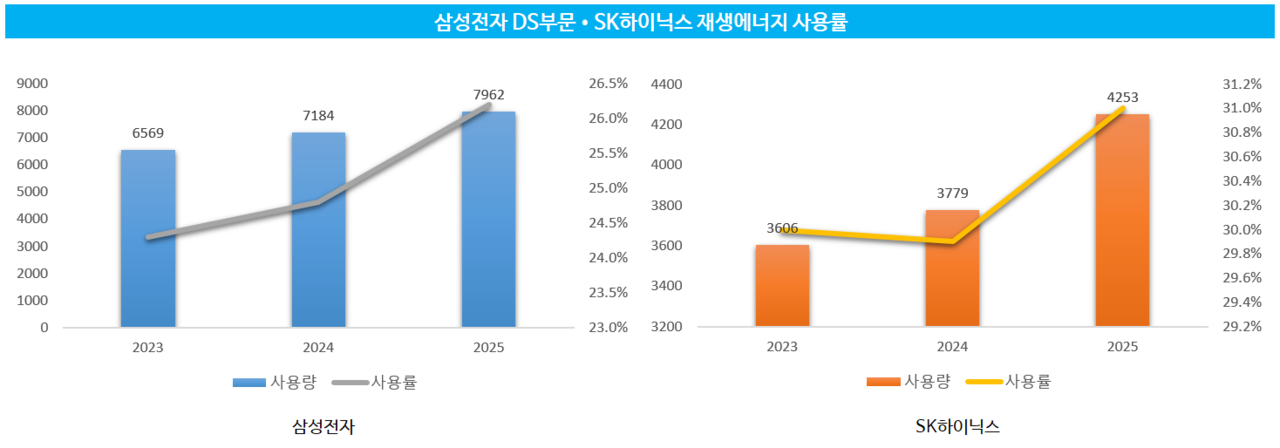
From June last year, SK hynix began receiving hydropower-based clean energy under a separate PPA agreement. As a result, the company sourced 31 percent of its global power consumption from renewables last year. Total renewable energy volume rose about 13 percent from 2024, though the conversion ratio increased by only 1 percentage point year on year as overall power consumption climbed alongside higher output.
The semiconductor industry recently urged the government to improve the PPA regime in connection with the announcement of the new southwest cluster investment. Samsung Electronics Vice Chairman Jeon Young-hyun said Monday that the government should "actively pursue nuclear power plant expansion and PPAs to compensate for the intermittency of renewable energy."
Jeon's remarks have raised expectations that the scope of PPAs could be broadened. Carbon-free power sources eligible under the PPA framework are currently limited to renewables. Including nuclear power — as other countries have done — would strengthen the regime's role as a stable power supply channel, analysts say.
The Korea Federation of Enterprises said in a report on PPA policy reform published last July that Microsoft, Google and Amazon "are signing long-term PPAs with restarted nuclear plants and small modular reactors," and called for nuclear power to be included in the definition of carbon-free electricity "to pursue genuine decarbonization of the power system."
jeongwan@heraldcorp.com