Company unveils precision casting, advanced materials and AI manufacturing strategy
Expanding into robots and smart farms
Targeting Japan's industrial machinery and semiconductor equipment parts market
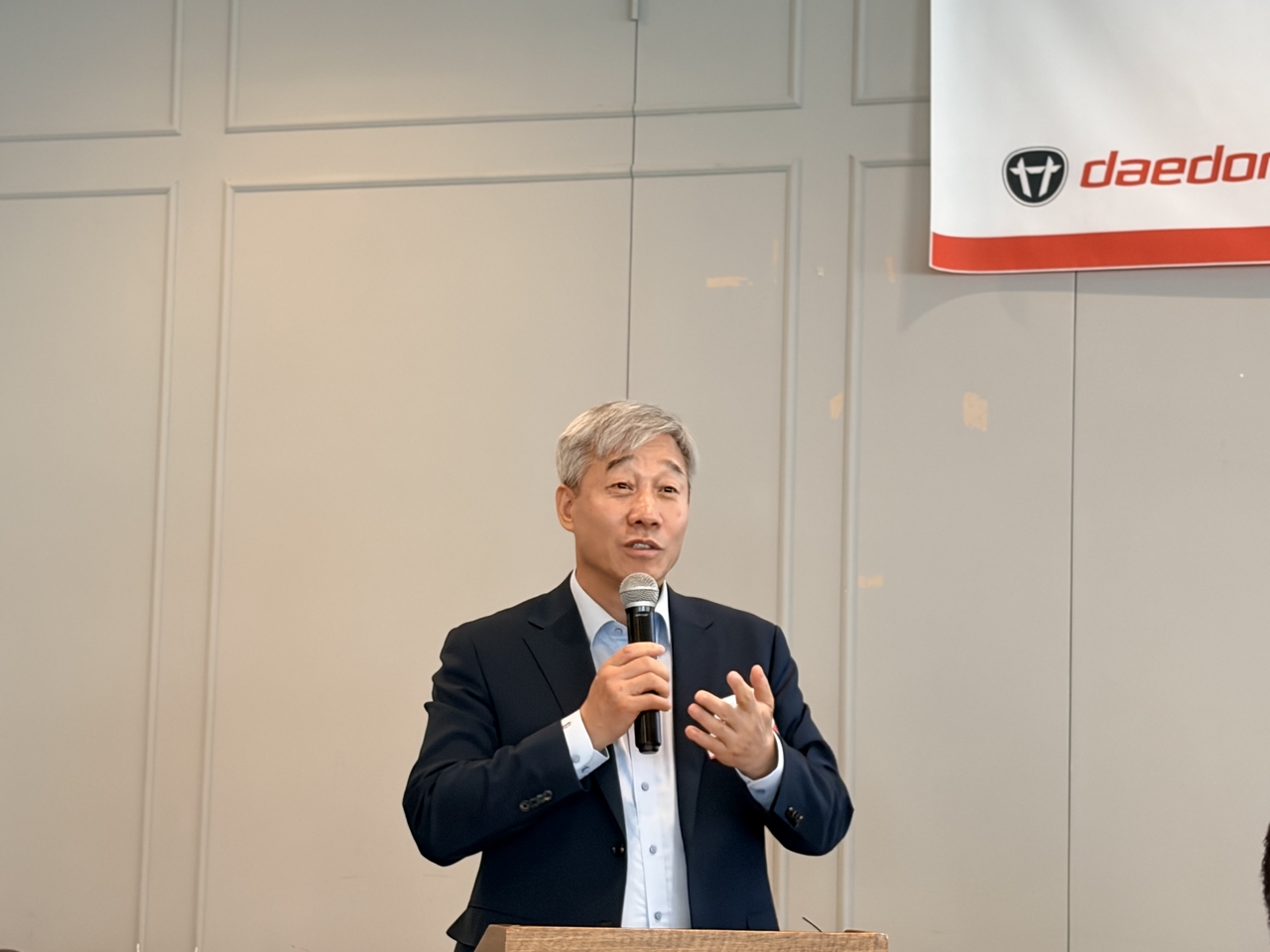
"Vacuum pump production is rising on the back of the semiconductor boom, and there will be even more areas we can supply," said Lee Pung-woo, CEO of Daedong Metal.
Lee made the remarks Wednesday at a press briefing at Baekwon in Yeouido, Seoul. He said the company would "leap forward as a materials and components company for future industries through expanded orders in high-value precision casting, new advanced materials businesses, and an AI-driven manufacturing transformation."
Daedong Metal, a foundry with a 79-year history, is moving beyond its roots as a maker of automotive and agricultural machinery parts to become a materials and components supplier for robots, semiconductors and smart farms. The company has deep casting expertise — it has manufactured engines for Hyundai Motor Company for more than 40 years — and supplies materials to Edwards, the world's leading manufacturer of vacuum pumps for semiconductors. Building on that technological foundation, Daedong Metal has set a target of more than doubling its sales by 2030, developing high-value precision casting and advanced materials as its future growth engines.
The company unveiled its medium- to long-term growth strategy Wednesday, outlining a plan to transform its business around two pillars: expanding high-value precision casting and launching new advanced materials businesses. It is targeting 240 billion won (about $154 million) in sales by 2030. Last year, sales stood at 101.8 billion won, and the company returned to operating profit.
Daedong Metal has taken note of growing demand for precision casting over conventional foundry work, driven by electrification trends, environmental regulations and the reshuffling of global supply chains. The company secured 48.4 billion won in new orders last year by winning customers in the automotive, semiconductor, shipbuilding and industrial machinery sectors. This year it is broadening its base to include power generation equipment, semiconductor equipment, construction machinery and agricultural machinery. It is also pushing into overseas markets — particularly Japan's industrial machinery and semiconductor equipment parts sector. Lee said the company aims to raise the share of global sales from under 10 percent currently to 30 percent by 2030.
Beyond precision casting, the company is moving into advanced materials development. Daedong Metal plans to co-develop new alloys with the Korea Institute of Materials Science for use in humanoid robot joints, reducer cases and actuator housings, as well as lightweight components for electric vehicles, urban air mobility vehicles and drones. The company aims to complete customer performance validation and begin generating revenue from these materials from 2029.
Daedong Metal is also entering the smart farm structural materials market, linking the move to its parent Daedong Group's AI greenhouse initiative. Daedong Group has been selected as a lead company for the government's national agricultural AI transformation platform and is preparing to build an advanced AI greenhouse spanning 65,000 pyeong (1 pyeong equals 3.3 square meters) in Muan-gun, South Jeolla Province. Daedong Metal plans to enter the smart farm structural materials market in connection with that project, and eventually expand into materials for agricultural robots.
The greenhouse smart farm market is projected to grow to 9.4 trillion won by 2030, with structural materials accounting for 35 percent of the construction segment — the largest share of that market. Daedong Metal is targeting its first sales in the structural materials segment in 2027, leveraging its precision casting technology and manufacturing capabilities. The company also plans to expand supply to follow-on smart farm projects in Saemangeum and Gangjin, and over the longer term to move into agricultural robot materials.
To support its expansion, Daedong Metal is upgrading its production systems through an AI-driven manufacturing transformation. The company will begin with a specialized AI manufacturing project worth more than 400 million won this year, then invest more than 1.2 billion won from 2027 onward to build an autonomous factory in stages. It aims to achieve a fully ESG-compliant smart factory by 2030. The initiative is designed to strengthen the manufacturing competitiveness needed to scale up high-value precision casting — reducing defect rates, improving equipment utilization, stabilizing delivery schedules and cutting energy costs. The company also plans to raise the share of new-business sales from 5 percent in 2026 to 28 percent by 2030.
Daedong Metal's transformation reflects a broader shift under way in South Korea's foundry industry. As the spread of electric vehicles erodes demand for internal combustion engine parts, the market for high-precision metal components — used in semiconductor equipment, robots and aerospace mobility — is expanding rapidly. Domestic foundry companies that have long focused on agricultural machinery and automotive parts are now diversifying their business portfolios through high-value precision casting and advanced materials development.
"We have expanded into high-value industries such as shipbuilding, power generation, semiconductors and industrial machinery, drawing on the precision casting technology and quality competitiveness we have built over 79 years," Lee said. "We are not simply a traditional foundry — we are a company with significant growth potential."
boo@heraldcorp.com