
Rate touches 1,550.2 won at 10:15 a.m.
Foreign investors net-sell 1.6 trillion won worth of Kospi shares
Yen breaks 162 per dollar, highest since Plaza Accord
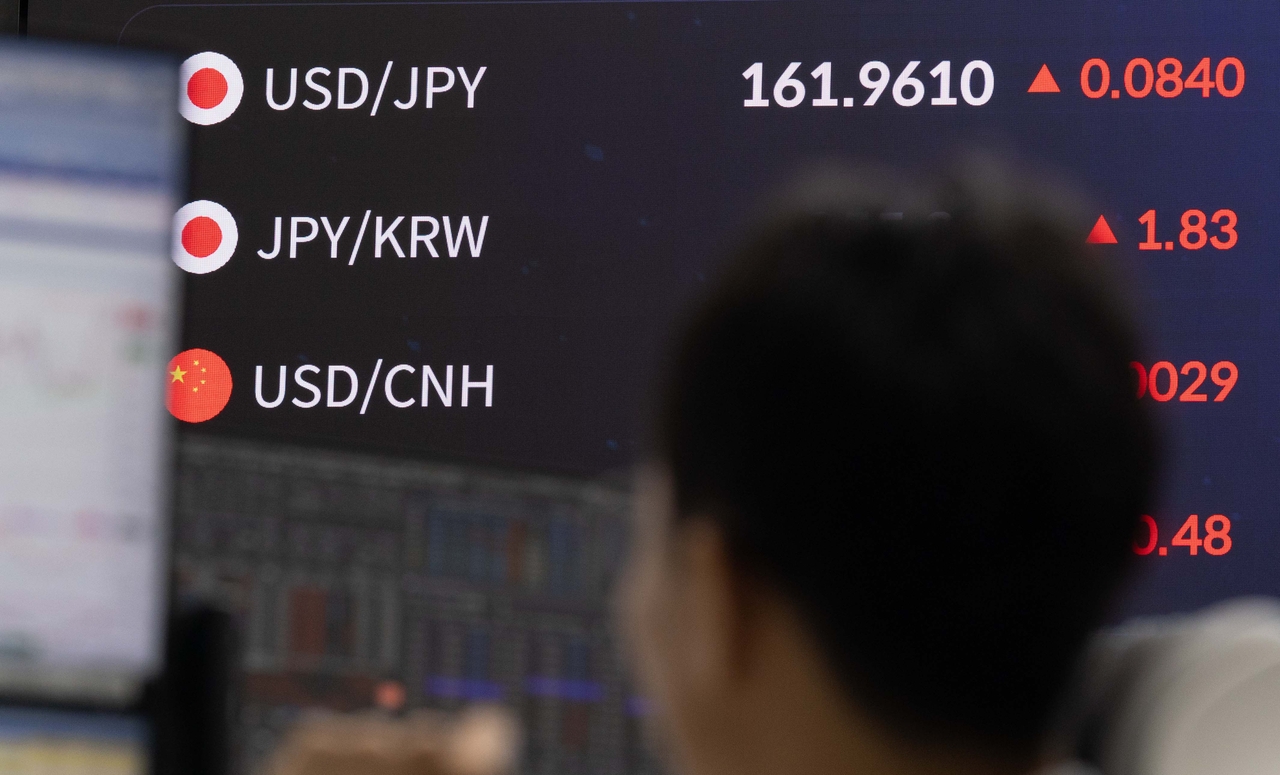
The won-dollar exchange rate broke through 1,550 won intraday for the first time in 16 trading sessions Tuesday, heightening concerns over exchange-rate risk. The yen-dollar rate also climbed into the 162-yen range, pushing the yen to its weakest level in 40 years, as both the Korean and Japanese currencies continued to lose ground against the dollar.
The won opened Tuesday's session on the Seoul foreign exchange market at 1,543.1 won per dollar, down 2.1 won from the previous session, before climbing again to touch 1,550.2 won around 10:15 a.m. The last time the rate breached 1,550 won intraday was June 8, when it also hit 1,550.2 won — 16 trading sessions ago.
On Friday, the won closed at 1,545.2 won, up 13.2 won from the previous session — the highest closing level since March 9, 2009, when the rate stood at 1,549 won during the global financial crisis.
Large-scale selling of domestic equities by foreign investors drove the exchange rate higher. As of 10:30 a.m. Tuesday, foreign investors had net-sold 1.63 trillion won ($1.06 billion) worth of Kospi shares. Net selling means more shares were sold than bought. The previous day, they net-sold a record 7.7 trillion won worth of shares.
According to the Financial Supervisory Service, foreign investors maintained a net-selling stance for five consecutive months through May. In May alone, they net-sold 47.02 trillion won worth of listed domestic shares. Their cumulative net selling through May reached 114.22 trillion won — more than 10 times the 11.08 trillion won recorded for all of last year.
The strong-dollar trend, another factor pushing the exchange rate higher, showed some signs of easing, but the dollar remained elevated. The dollar index, which measures the greenback against six major currencies, edged down after the United States and Iran agreed to halt attacks through the weekend and hold further talks, but still held above 101.
"Every time the exchange rate dips, end-users move to secure dollars, making it difficult for a won-friendly environment to take hold," said Min Gyeong-won, an economist at Woori Bank. "The continued trend of foreign investors reducing their domestic equity exposure is also a worrying factor."
The yen-dollar rate also climbed into the 162-yen range Tuesday, reaching its highest level in roughly 40 years.
According to the Nikkei, the yen-dollar rate surged to 162.14 yen around 10:20 a.m. Tuesday, surpassing the previous peak of 161.96 yen set in July 2024 and marking the highest level since December 1986, shortly after the Plaza Accord. On Sunday (local time), the yen also rose to 161.98 yen per dollar on the New York foreign exchange market.
Japanese media attributed the yen's decline to growing market expectations that the US Federal Reserve could raise interest rates within the year, amid rising prices and a continuing employment recovery driven by Middle East tensions. Uncertainty over the pace of future rate increases by the Bank of Japan compounded the outlook, raising the possibility of a widening interest rate gap between the two countries and pushing the yen-dollar rate even higher.
In December 1986, the yen-dollar rate stood in the 158-to-163-yen range. The Plaza Accord triggered a sharp adjustment that sent the yen higher, ushering in a prolonged period of yen strength.
With the yen approaching historically weak levels, wariness is growing that the Japanese government and the Bank of Japan may intervene in currency markets by buying yen. On June 22, after the yen-dollar rate hit 161.93 yen on the New York foreign exchange market, Japanese Finance Minister Satsuki Katayama and US Treasury Secretary Scott Bessent held an online consultation to discuss foreign exchange market developments.
kimstar@heraldcorp.com




