'A turning point in national industrial strategy,' says mayor-elect, pledging full administrative support
Water supply of 800,000 tons per day secured by 2030
"We welcome the 800 trillion won semiconductor investment in the southwest. We will join forces to ensure results are delivered within the president's term."
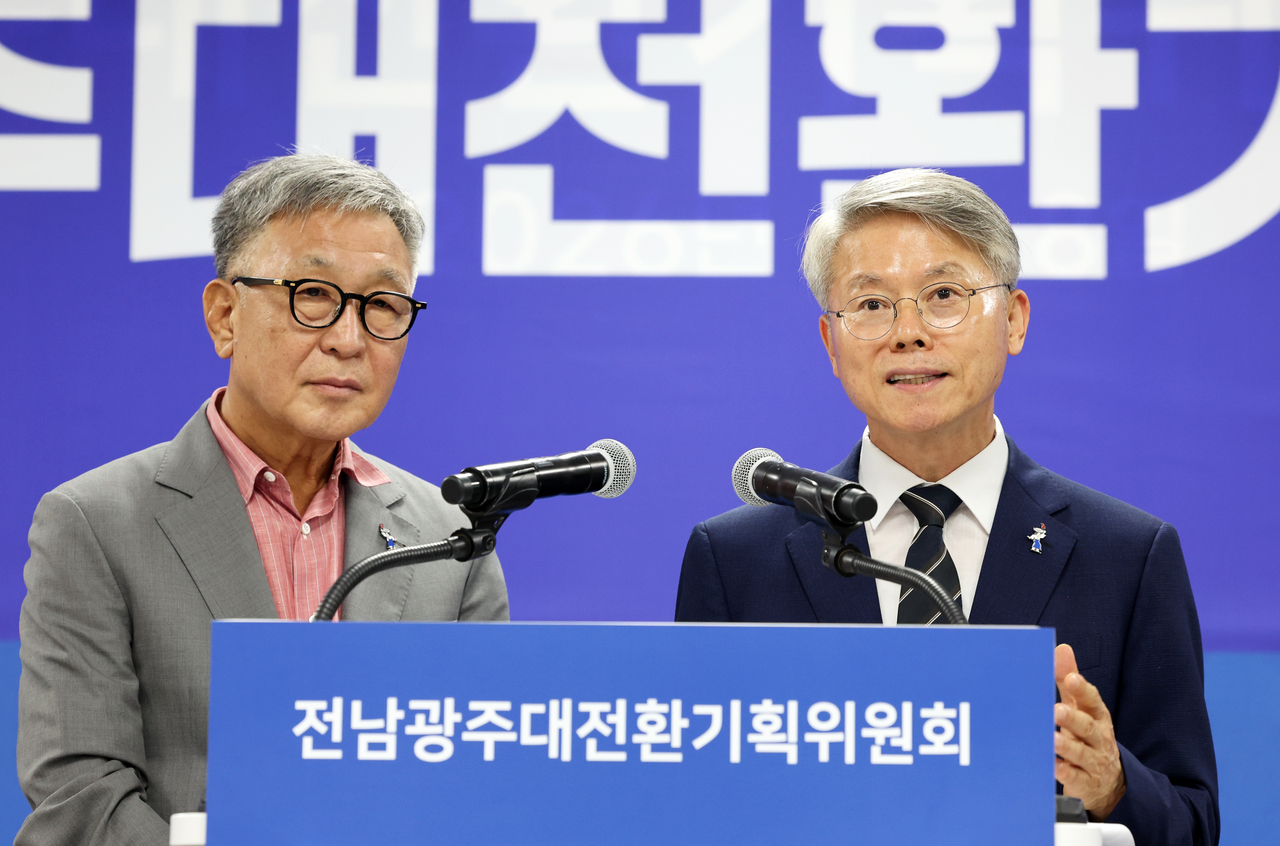
Min Hyeong-bae, mayor-elect of the integrated special city of South Jeolla Province and Gwangju, said Sunday that the government's announcement to develop the southwest as a semiconductor production hub marks "a turning point in the national industrial strategy," pledging active support for the initiative.
Speaking at a press conference at the South Jeolla-Gwangju Great Transformation Planning Committee briefing room, Min said he warmly welcomes the national land transformation vision unveiled at the government's briefing on the three major mega-projects for South Korea's great leap forward. "I am deeply grateful to President Lee Jae-myung for making a bold decision for the nation's future, and to Samsung and SK Group for committing to 800 trillion won ($518 billion) in semiconductor investment," he said.
Min said the integrated special city's electricity self-sufficiency rate stands at 170 to 180 percent, adding that the issue lies not in the volume of power but in the supply system. "If we reinforce the power grid and energy storage systems, operating around four fabs should be no problem," he said. On factory locations, he said several sites are under review but that it is too early to disclose specifics. He added that the term "Gwangju" should be understood to encompass not just the administrative city of Gwangju but also its surrounding areas and the broader southwest region.
Min said the goal is to break ground before the end of autumn if possible. "We will work together with citizens, the government and businesses to ensure production output is achieved within the president's term," he said.
He said he hopes to correct the perception that the Honam semiconductor investment benefits only one particular region. "The Honam semiconductor cluster is about correcting historical distortions that arose during the modernization process and redrawing the country's industrial map," he said.
"Whatever gaps remain will be addressed jointly and responsibly by the newly launched integrated special city and the Lee Jae-myung administration," he added. "The administration will move first to ensure businesses face no inconvenience during the investment process."
Among the specific support measures he outlined were the formation of a dedicated task force, bold investment and corporate incentive packages, affordable land provision, power and water supply infrastructure, fast-tracked permits, a talent development system and the creation of livable residential conditions.
Min said the 20 trillion won in funding the government has pledged to the integrated special city will be channeled toward building the semiconductor and AI industry foundation. "We are considering committing at least 5 trillion won, and if necessary, all of it," he said.
On water supply, he said each fab requires about 60,000 tons of first-grade water per day, adding that there is no cause for concern. "We understand that we can secure up to 800,000 tons per day by 2030 and up to 1.1 million tons per day by 2032," he said.
sij@heraldcorp.com