
Opposition parties mount fierce resistance to Honam semiconductor investment; Gwangju and South Jeolla officials demand end to 'distortion of facts'
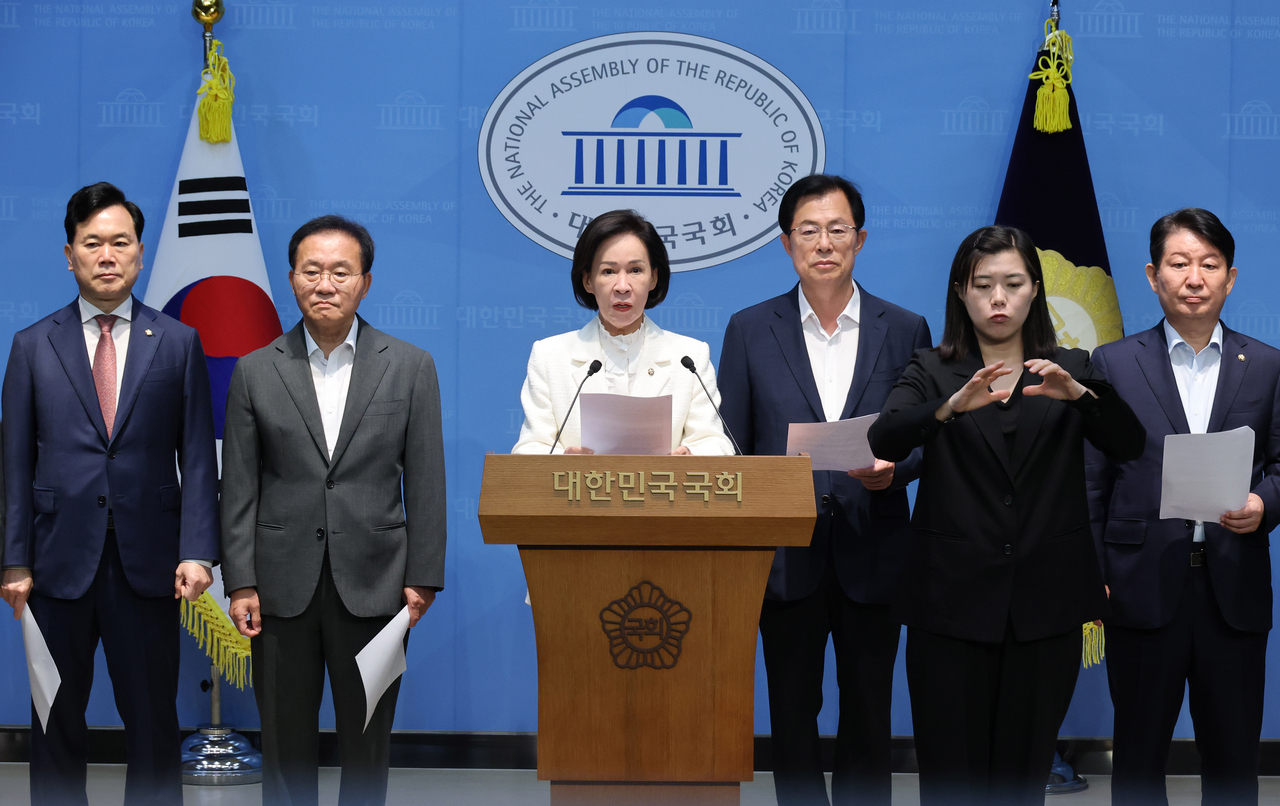
"Gwangju has sufficient water, land, electricity and talent."
As opposition parties mount fierce resistance to major companies' semiconductor investment plans in the Honam region, political and civic leaders in Gwangju and South Jeolla Province have raised their voices in defense of the project.
Gwangju Mayor Kang Ki-jung said Sunday on Facebook that "no amount of hollow political bickering or attempts to deceive the public with falsehoods will work," adding that "no one should stand in the way of Gwangju — a city of democracy — as it moves toward becoming a prosperous city."
Kang said the city already has enough water to run more than two fabrication plants and that additional land will open up once the Gwangju military airport relocates, freeing up 1.85 million pyeong (about 6.1 million square meters) on top of existing sites — including the future mobility industrial complex (1.02 million pyeong), the Air Force ammunition depot (630,000 pyeong) and the Cheomdan District 3 site (more than 100,000 pyeong). Power supply is being secured through the Hanbit nuclear power plant in Yeonggwang and the construction of the Sinjangseong substation. A "talent pipeline" — comprising an AI gifted high school, an AI convergence university, a semiconductor joint engineering college and an AI officer academy — is also being built to develop the workforce.
South Jeolla Province Governor Kim Yeong-rok also lent his support.
Kim said he "strongly urges the People Power Party to immediately stop its cheap political attacks and actively cooperate with balanced national development and the era of Honam semiconductors," adding that the PPP "is using even companies' voluntary investment decisions in the Honam region as a tool for political warfare."
He also criticized the party, saying, "One cannot help but ask what is really behind their obstruction — loudly calling for balanced development and support for Honam on the surface, yet throwing a tantrum the moment actual investment is about to happen."
Min Hyeong-bae, mayor-elect of the proposed Jeonnam-Gwangju Special City, said young people from South Jeolla Province and Gwangju "keep leaving for the greater Seoul area because jobs and industries worth choosing are concentrated there," and that "leaving out this core issue and simply saying talent won't come to Honam is a distortion of the facts."
He argued that "if semiconductor factories come to Jeonnam-Gwangju, Honam-born talent who have already moved to the greater Seoul area will return, and high schools and universities in the region can quickly shift to curricula that train workers in semiconductor processes, equipment and software."
Local lawmakers also spoke in unison.
Rep. Jeong Jun-ho (Gwangju Buk-gu Gap) said the investment decision "was made with consideration for the business interests of the companies involved." Rep. Jeon Jin-suk (Gwangju Buk-gu Eul) called it "highly irresponsible to judge the site selection for South Korea's future industries using the language of political warfare." Rep. Jeong Jin-uk (Gwangju Dongnam Gap) asked, "Must Honam always live in a world of poverty and no investment?" Rep. Ahn Do-geol (Gwangju Dongnam Eul) said "companies' voluntary investment decisions and national future strategies must not be used as tools for political conflict."
Rep. Park Ji-won (South Jeolla Province — Haenam, Wando, Jindo) said "overseas expansion by our companies is welcome, but balanced national development and locally driven growth are more important." Rep. Moon Geum-ju (South Jeolla Province — Goheung, Boseong, Jangheung, Gangjin) called on the PPP to "stop dividing the regions." Rep. Lee Gae-ho (South Jeolla Province — Damyang, Hampyeong, Yeongam, Jangseong) demanded, "What sin has Honam committed?" — all pushing back sharply against the PPP's offensive.
sij@heraldcorp.com




