
Financial legislation set to restart as National Assembly forms second-half committees
Inclusive finance fund targets low-income borrowers
No-fault voice phishing compensation at center of debate
Industry warns of excessive cost burden, floats joint fund alternative
![Han Byung-do, acting leader and floor leader of the Democratic Party of Korea, speaks at a Supreme Council meeting at the National Assembly on Friday, announcing his intention to swiftly form the second-half committee structure of the 22nd National Assembly. [Yonhap]](https://wimg.heraldcorp.com/news/cms/2026/06/27/news-p.v1.20260627.329640808d0c44eaaa08471348ca1df5_P2.jpg)
With the Democratic Party of Korea pledging to accelerate the formation of second-half National Assembly committees, a wave of financial legislation is queued for action — including the establishment of a low-income financial stability fund to underpin the Lee Jae Myung government's inclusive finance agenda, a no-fault compensation regime for voice phishing victims, and the introduction of a financial stability account. The financial industry broadly supports the policy goals of consumer protection and financial stability, but anxiety is mounting over the potential expansion of lender liability and cost burdens.
According to industry sources Sunday, the Financial Services Commission presented five priority financial bills in its annual Assembly briefing earlier this year, but only one — an amendment to the Credit Information Act — cleared the legislation subcommittee in the first half. The remaining bills, centered on expanding inclusive finance, strengthening consumer protection, and reinforcing the financial stability framework, are now expected to become the Assembly's key legislative priorities for the second half.
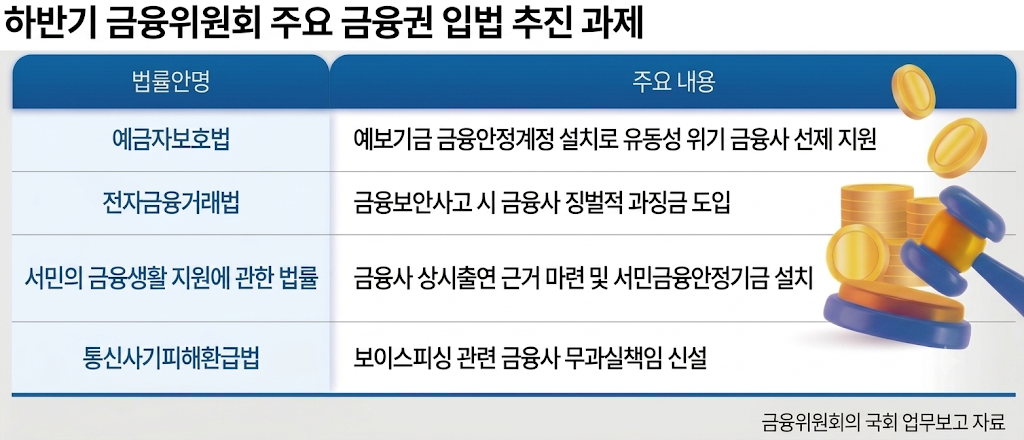
The first item on the second-half financial legislative agenda is expected to be an amendment to the Act on Support for People's Financial Services. The bill would create a "People's Financial Stability Fund" within the Korea Inclusive Finance Agency and remove the expiration date — currently set for Oct. 8 — on mandatory contribution obligations. It is considered the cornerstone legislation for securing funding for the Lee Jae Myung government's inclusive finance policy. The ruling party says the bill must pass by August, before budget deliberations begin, to allow the fund to launch in January.
The ruling party also gained legislative momentum after a recently commissioned research report submitted to the Assembly concluded that the social benefits of expanding financial access for low-credit, low-income borrowers outweigh the increased burden on the government from subrogated repayments.
The opposition party, however, remains cautious, citing concerns over the contribution burden on financial institutions and the possibility of government bailouts. The government already raised the contribution rate for financial firms from 0.06 percent to 0.1 percent in April. Total contributions this year are estimated at around 381.8 billion won ($247 million), up 134.5 billion won from last year.
The bill drawing the most attention from the financial industry is an amendment to the Act on Special Cases Concerning the Return of Damage Caused by Telecommunications Fraud, which would introduce no-fault compensation liability for voice phishing losses. Two separate amendment bills — sponsored by Democratic Party lawmakers Kang Jun-hyeon and Jo In-cheol — are currently pending in the Assembly. Both would require financial institutions to compensate victims up to a set amount regardless of whether the institution was at fault. The compensation ceiling would be set by presidential decree, up to a maximum of 50 million won.
Financial Services Commission Chairman Lee Eok-won signaled his commitment to the measure at a June 10 meeting with the heads of the five major financial holding companies, saying he would "actively push forward the introduction of no-fault liability to strengthen the financial sector's accountability for phishing crimes and provide effective relief to victims." As AI-powered voice phishing schemes grow increasingly sophisticated and individuals can no longer protect themselves through caution alone, regulators argue that financial institutions must bear a share of the responsibility. The FSC also announced plans to amend the Electronic Financial Transactions Act to impose punitive surcharges on financial firms in the event of security incidents.
The financial industry, while acknowledging the need to protect victims, argues that concentrating the cost burden solely on financial institutions is inequitable. Financial regulators estimated in materials submitted to the Assembly that applying the maximum compensation ceiling of 50 million won would saddle the entire financial sector with annual liability costs of around 280 billion won. There is growing interest in whether legislative discussions might explore a joint fund model in which financial firms, telecommunications companies, and the government share the cost. The National Assembly's Political Affairs Committee also flagged, in a review report in March, the risk of undermining the principle of personal responsibility and the potential for moral hazard.
In addition, the introduction of a financial stability account — a measure regulators have pursued for four years — is expected to be revived in the second half. The financial stability account would allow solvent financial institutions facing temporary liquidity crises to receive debt guarantees and capital support, preventing stress from spreading across the broader financial system. Unlike the Korea Deposit Insurance Corporation fund, which can only be deployed once insolvency has materialized, the account would enable preemptive intervention at the first signs of distress.
The proposal has long stalled in the Assembly over concerns about depleting the deposit insurance fund and encouraging moral hazard. Financial regulators and the KDIC now argue that growing volatility in domestic and global financial markets makes it essential to establish a preemptive crisis-response mechanism. KDIC President Kim Seong-sik urged action at the corporation's 30th anniversary ceremony on June 1, saying: "We can no longer delay the financial stability account, which would cut off the spread of insolvency through effective funding before a crisis erupts, or the rapid resolution framework that would allow swift administrative measures such as contract transfers in the event of a bank run."
forest@heraldcorp.com




