Banks halt MCI/MCG coverage, raising mortgage barriers
'Last-chance' demand spreads as buyers rush before further restrictions
Mid- to low-priced apartments in Dongdaemun, Nowon-Dobong-Gangbuk areas see buying surge
![Mortgage interest rates are displayed at a bank branch in central Seoul. [Herald DB]](https://wimg.heraldcorp.com/news/cms/2026/06/26/news-p.v1.20260518.5a15e0658fc34cd1b7b34518733f7110_P1.jpg)
There's a unit listed slightly below market price because it has a provisional seizure on it. Buyers have to put down more than twice the usual deposit to clear the lien, but people who want to buy before the lending restrictions kick in are still lining up. You have to take a number just to get a viewing.
As banks tighten mortgage loan limits in line with the government's push to rein in household debt, last-chance demand is flooding into Seoul's mid- to low-priced apartment segment — units priced below 1.5 billion won ($971,000). With borrowing capacity running dry at both primary and secondary lenders, owner-occupiers looking to make full use of the 600 million won mortgage ceiling are picking up the pace.
Banks move to shut lending door — 'buyers queue up even as asking prices jump 100 million won'
Real estate industry sources say listings in Seoul's mid- to low-priced apartment market are selling almost as soon as they appear. The rush reflects a "last train" dynamic: supply has tightened since the capital gains tax surcharge exemption for multi-home owners expired May 9, and the few listings that remain are being snapped up by buyers who expect mortgage access to become even harder.
An agent at a brokerage in Jongno-gu said the owner of one unit suddenly raised the asking price by 20 million won, yet three groups of buyers still asked to view the property over the weekend. "They're practically queuing up to get in," the agent said.
A broker in Dongdaemun-gu echoed the sentiment. "Even when sellers list 100 million won above the last recorded transaction price, there's no shortage of takers," the agent said. "We can't sell because there's nothing left to sell."
Banks raising their lending thresholds is adding further fuel to buying demand. KB began Friday restricting enrollment in mortgage credit insurance (MCI) and mortgage credit guarantees (MCG), tightening its home loan management. Once access to those products is cut off, borrowers can only receive loans up to the limit after the small-tenancy deposit deduction. That haircut can reach as much as 55 million won depending on the area, directly reducing the amount a buyer can borrow.
![A residential neighborhood in Yeongdeungpo-gu, Seoul. [Herald DB]](https://wimg.heraldcorp.com/news/cms/2026/06/26/news-p.v1.20251015.ac3ae396da574c8aa03b3afe129409f1_P1.jpg)
Hana Bank and NH NongHyup Bank will also restrict MCI and MCG enrollment starting July 1, trimming their loan limits. As borrowers shift to whichever lender still offers full limits, analysts expect all major commercial banks to move toward aggregate loan volume controls. Stacked on top of existing rules — the third-stage stress debt service ratio (DSR) and the 600 million won mortgage cap on homes priced below 1.5 billion won — the banks' own volume management will push the borrowing bar even higher.
Secondary lenders face a similar bind. Their mortgage rates run about 100 basis points above those of commercial banks, yet even that capacity is nearly exhausted. One loan broker said insurance companies' mortgage allocations for July and August are already fully booked. "September settlement slots still have some room, but that's not guaranteed either," the broker said. "Approvals are already being rejected because demand is so concentrated right now."
'Up to 600 million won available' drives mid-range demand — Dongdaemun average sale price jumps from 900 million to over 1.1 billion won
Prices in the mid- to low-priced apartment segment are climbing sharply as buying demand surges ahead of tighter lending restrictions. According to KB Real Estate data, Dongdaemun-gu recorded the steepest price gains in Seoul from Oct. 22 last year — just after the government's Oct. 15 policy package was announced — through Thursday. The district's average apartment sale price rose 18.2 percent, from 967.03 million won to 1.14 billion won.
Dongdaemun's mid- to low-priced apartments, which had hovered around the 900 million won range, attracted a wave of owner-occupier demand from newlyweds and young first-time buyers. That pushed prices from the 900 million won range into the 1.1 billion won range in roughly eight months. Over the same period, Gwanak-gu rose 15.3 percent — from 823.61 million won to 949.49 million won — while Seongbuk-gu climbed 14.4 percent (873.68 million won to 999.67 million won) and Gangseo-gu gained 13.7 percent (937.39 million won to 1.07 billion won).
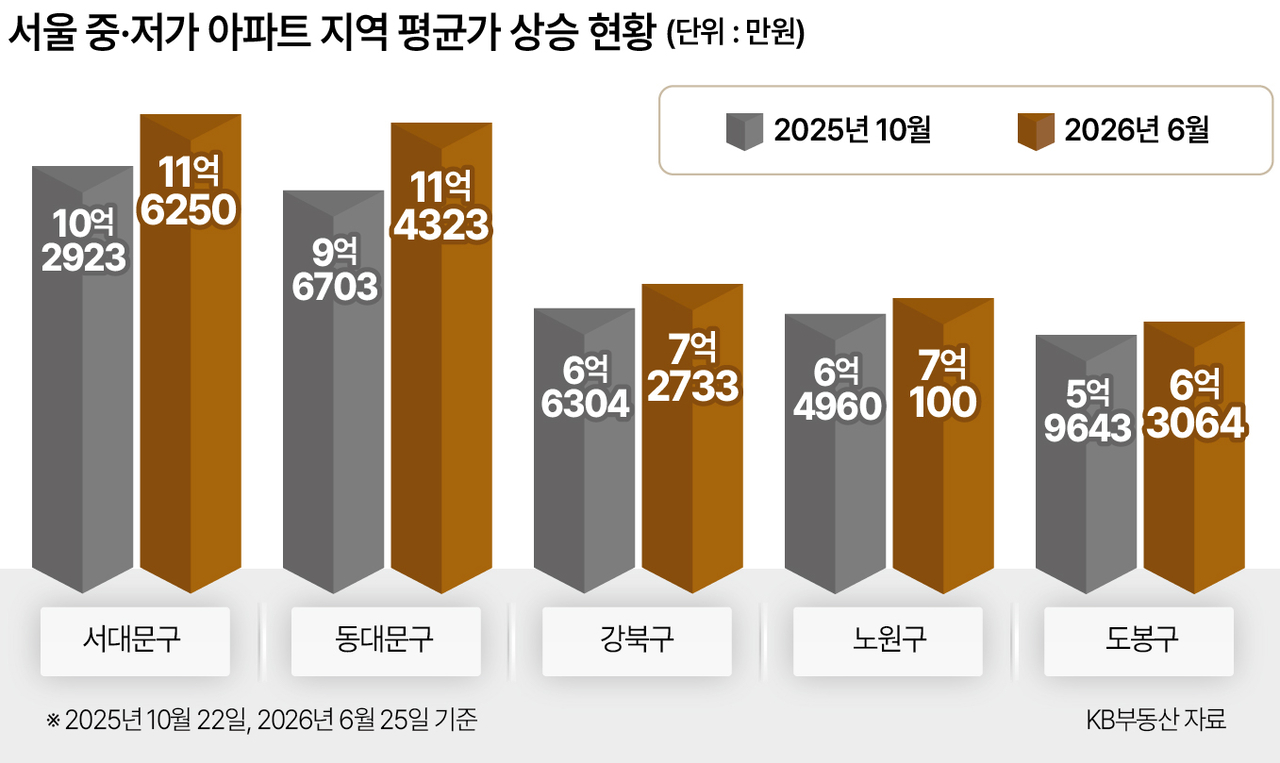
The upward trend was also pronounced in the "Nodo-Gang" cluster — Nowon-gu, Dobong-gu and Gangbuk-gu — where lower-priced apartments are concentrated. Over the same period, average sale prices in Nowon-gu rose from 649.6 million won to 701 million won, a gain of 7.9 percent, while Gangbuk-gu climbed 9.6 percent, from 663.04 million won to 727.33 million won. Dobong-gu advanced 5.7 percent — from 596.43 million won to 630.64 million won — crossing the 600 million won threshold for the first time.
Nam Hyeok-woo, a real estate researcher at Woori Bank, said demand from single-person households and newlywed couples without existing home ownership is consistently flowing into outer Seoul neighborhoods. The demand centers on apartments priced around 600 million won that qualify for policy-backed loans, as well as smaller unit types. "The stronger the owner-occupier demand in a given area, the more likely prices there are to keep rising," Nam said.
hss@heraldcorp.com