Base target of 12,500, bull case of 15,000 for 12-month Kospi outlook; AI, memory chip boom seen continuing as Korea named Asia's most preferred market
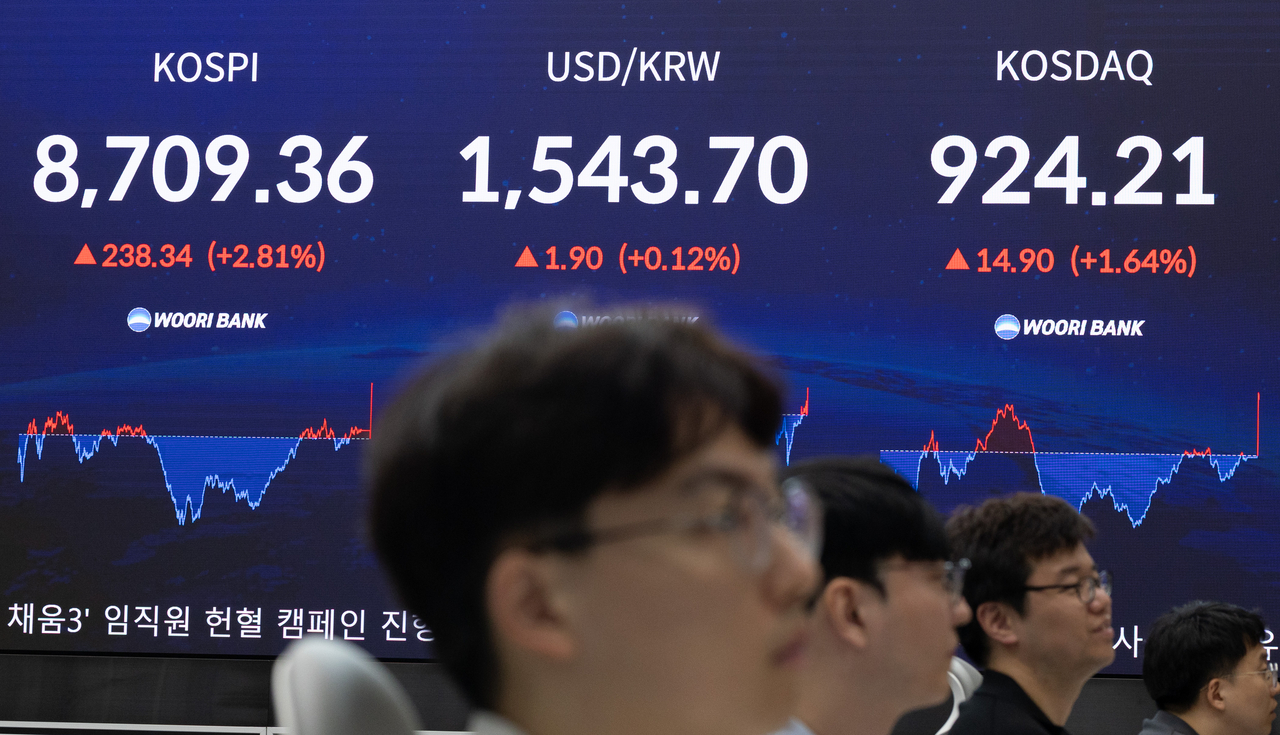
JPMorgan has raised its Kospi target to as high as 15,000 points, surpassing the 12,000 forecasts from KB Securities and Goldman Sachs and making it the most bullish call among domestic and foreign brokerages.
In a Korea equity strategy report released Thursday, JPMorgan said it "maintains a directionally bullish view on Korean equities" even as forced foreign selling and elevated volatility are likely to persist for now. The bank recommended investors "add on dips and maintain maximum exposure to the Korean market."
JPMorgan set its 12-month Kospi targets at 12,500 for the base scenario, 15,000 for the bull scenario and 8,000 for the bear scenario.
The bank cited improving earnings at hardware companies driven by growing AI investment as the key driver of the bullish outlook. "It is noteworthy that the profit pool of technology companies participating in AI data center buildouts has grown to a macroeconomically meaningful scale," JPMorgan said.
The bank also said AI momentum remains intact. JPMorgan equity strategist Mixo Das said the Korean market's fundamentals are "tied to the AI cycle," adding that JPMorgan analysts are positive on a "higher-for-longer" memory chip cycle.
JPMorgan warned that high volatility in the domestic market is likely to continue. The report noted that assets under management in leveraged exchange-traded funds tracking Korean underlying assets have grown to $50 billion, significantly amplifying market swings. The expansion of futures- and options-based strategies alongside spot holdings has rapidly enlarged the domestic derivatives market, while demand for inverse ETFs has pushed up implied volatility.
Given the strong appetite for leveraged products, JPMorgan said investment demand is unlikely to shrink in the near term, meaning elevated volatility will persist.
On foreign capital outflows, the bank said Korea has "become a victim of its own success." As the market capitalizations of memory heavyweights such as Samsung Electronics and SK Hynix surged, they began bumping against the position limits of emerging-market investors, creating a structural dynamic in which funds are forced to trim holdings whenever share prices rise.
The report said the foreign selling pressure is unlikely to resolve on its own. If Korean equities — led by memory stocks — continue to outperform regional benchmarks, the operational constraints facing emerging-market and Asia-focused investors are likely to persist as well.
However, JPMorgan noted that global investors' allocation to Korea remains low, leaving room for further buying.
Beyond AI, JPMorgan identified banks, biotech and pharmaceuticals, preferred shares, and sectors benefiting from a "wealth effect" — including department stores, cosmetics, travel, securities and construction — as alternative investment themes. It singled out bank stocks as the most attractive sector, citing improving asset quality, net interest margin expansion and higher brokerage commission income from increased trading volumes.
JPMorgan's top picks are Samsung Electronics, Samsung Electro-Mechanics, Hyundai Motor, Samsung Life, Hanwha Aerospace, KB Financial Group, SK Corp, HD Hyundai Electric, APR and Isupetasys. Its least preferred names are Posco Future M, Hyundai Marine & Fire Insurance and Kakao.

moon@heraldcorp.com