Didimdol and Buitimok loan disbursements plunge after cap cuts
Tighter limits and surging home prices squeeze low-income borrowers
Fewer Seoul homes qualify for policy loans, making homeownership harder
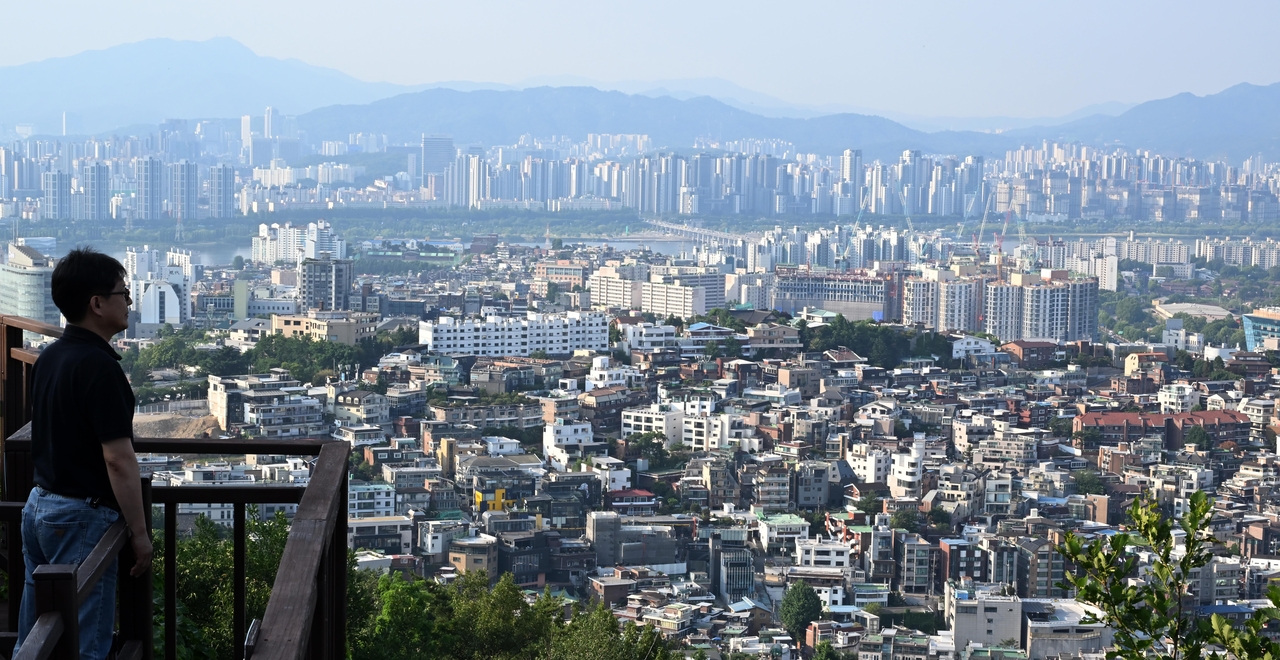
Policy-backed home loan disbursements fell by about 19 trillion won ($12.4 billion) over roughly a year following the government's June 27 real estate measures, which lowered lending caps to cool housing prices in the greater Seoul area. Analysts attribute the sharp drop to both the reduced loan ceilings and a simultaneous surge in home sale and jeonse prices across Seoul and key parts of Gyeonggi Province, which has shrunk the pool of homes eligible for policy loans.
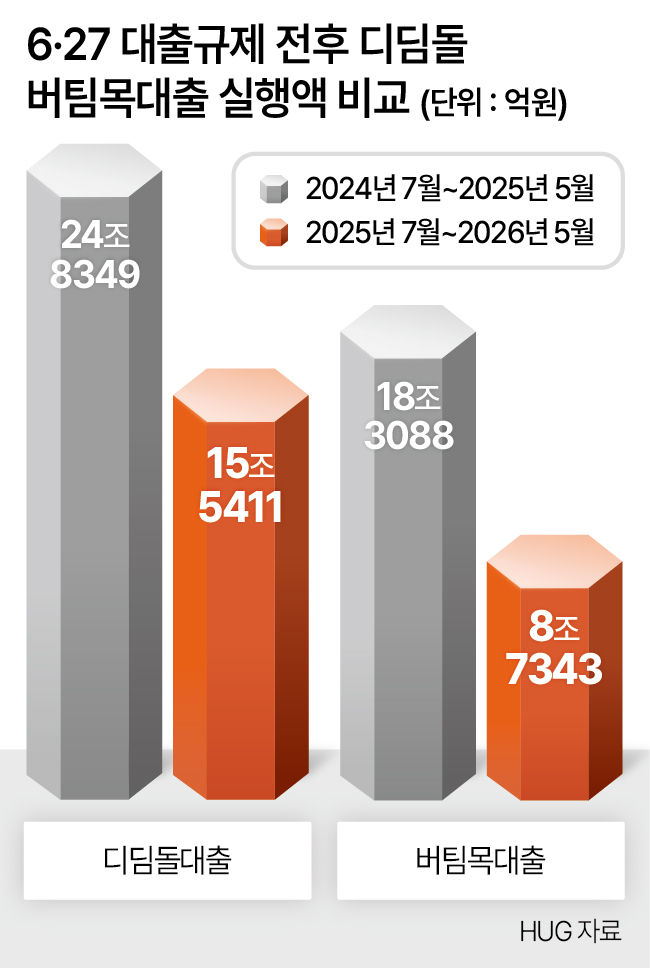
According to housing finance loan statistics from the Korea Housing Finance Corporation (HUG) released Thursday, disbursements of Didimdol (home purchase) and Buitimok (jeonse and monthly rent) loans from July last year through the end of May this year fell sharply compared with the same period a year earlier.
Under the June 27 measures, the government cut Didimdol loan limits — available to households without a home when purchasing a property — by 50 million to 100 million won, and Buitimok loan limits by 50 million to 60 million won (about $39,000) for the greater Seoul area, effective June 28 last year.
As a result, Didimdol loan disbursements from July last year through May totaled 15.54 trillion won, including the newborn special purchase loan, down 9.29 trillion won from 24.83 trillion won in the same period before the regulations (July 2024–May 2025).
Buitimok loan disbursements also contracted sharply over the same period, falling from 18.31 trillion won to 8.73 trillion won — a decline of more than 9 trillion won.
The steep drop in policy loan disbursements — programs designed to help low-income households without homes achieve housing stability — is being cited as evidence that homeownership in Seoul has become effectively out of reach for ordinary buyers.
When the June 27 measures were announced, concerns were already widespread that tighter policy loan caps would raise the barrier to homeownership even further. The Didimdol loan, a government-backed home purchase loan funded by the National Housing Fund and offered at low interest rates to low-income households without homes, saw its limits cut as follows: the general limit from 250 million won to 200 million won, the first-time buyer limit from 300 million won to 240 million won, the newlywed limit from 400 million won to 320 million won, and the newborn limit from 500 million won to 400 million won.
Even as loan caps fell, home prices rose sharply. To use a Didimdol loan, a property must have an exclusive use area of no more than 85 square meters and a price of no more than 500 million won for general borrowers (600 million won for newlyweds, young buyers and households with two or more children; 900 million won for newborn borrowers). Even if a young buyer saves 100 million won and takes out the largest available policy loan — the newborn special loan — the combined sum barely reaches 500 million won, and the number of homes available at that price has plunged.
As of last month, <style ref="s0">the average apartment sale price in Seoul stood at 1.248 billion won</style> (Seoul Real Estate Information Plaza data), far above the policy loan threshold. Even relatively affordable outer districts within Seoul posted year-on-year price increases: Gangbuk at 709.63 million won, Gwanak at 815.21 million won, Guro at 614.82 million won, Geumcheon at 671.81 million won, Nowon at 657.09 million won and Dobong at 582 million won. Districts in Seoul's northwestern corridor bordering Gyeonggi Province — Gangseo at 930.64 million won, Eunpyeong at 909.61 million won and Seodaemun at 1.064 billion won — also exceed even the most accessible threshold, the newborn special loan limit.
<style ref="s0">Gyeonggi Province's average apartment price in May also crossed the 600 million won mark, reaching 619.06 million won</style> (Zigbang data). Twenty-one cities in the province have average prices above 500 million won. Areas with strong demand due to easy access to Seoul — Gwangmyeong at 854.75 million won, Guri at 725.65 million won and Hanam at 1.044 billion won — have all surpassed the policy loan threshold.
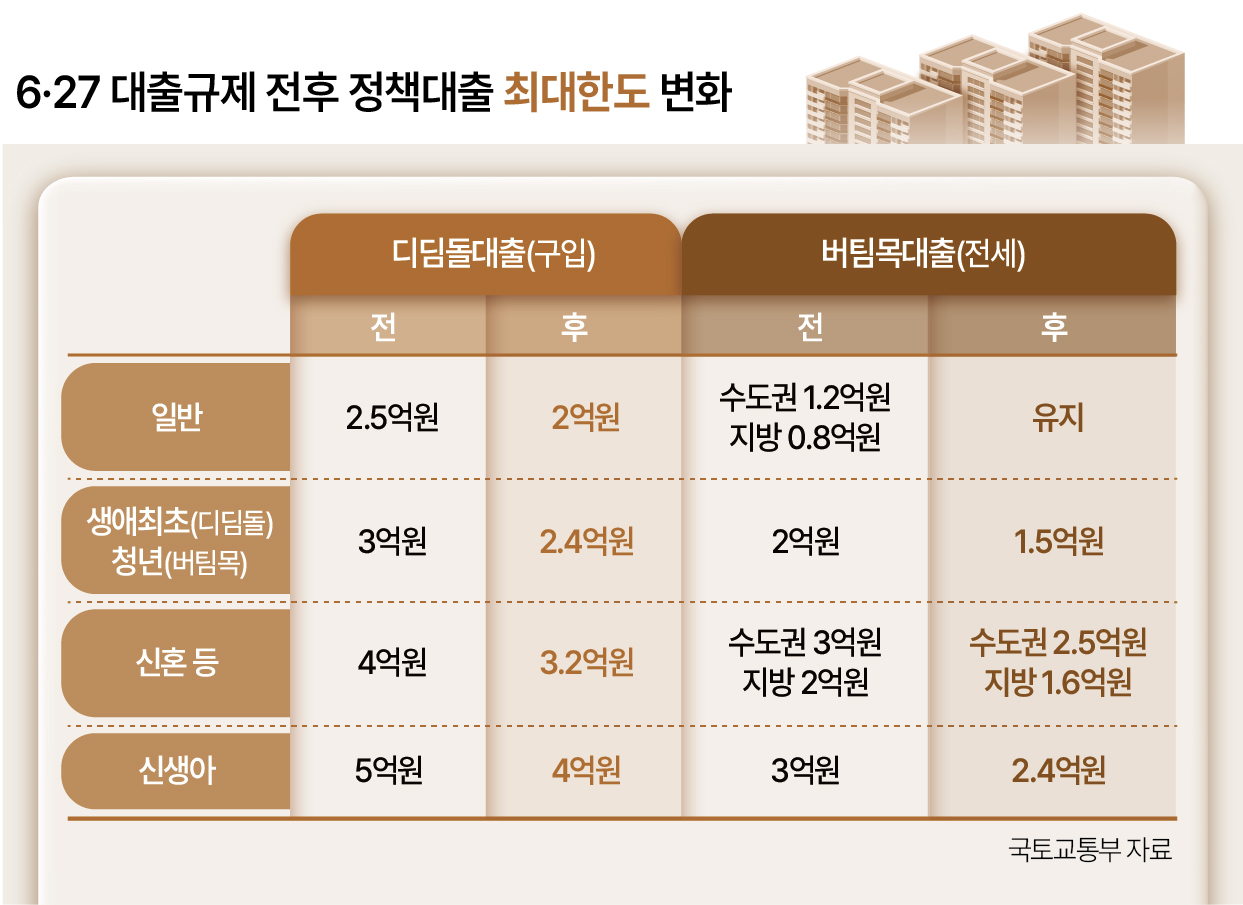
Buitimok loans — which cover jeonse and monthly rent deposits and were also subject to cap cuts under the June 27 regulations — likewise saw disbursements fall sharply. The product lends up to 80 percent of the jeonse deposit, with limits reduced separately for the greater Seoul area and other regions. In the greater Seoul area, the newlywed limit dropped from 300 million won to 250 million won, and the newborn limit from 300 million won to 240 million won.
Experts say the policy loan eligibility thresholds need to be revisited, as rising prices in Seoul and other major areas are spreading beyond apartments to villas. "Seoul apartments crossed the policy loan threshold a long time ago, and of late even villa prices have been climbing," said Kim Hyo-seon, a senior real estate specialist at KB Kookmin Bank. "In addition, prices in key parts of Gyeonggi Province have continued to rise, and the policy loan criteria need to be adjusted to reflect current market prices."
hwshin@heraldcorp.com