
Production overhaul for next year at risk as wage talks collapse
US output transfer, Ulsan reconstruction both set for next year
About 200,000 units of Tucson HEV, Palisade targeted for US shift
Labor, management clash over staffing during 40-month rebuild
Automation transition raises fears of workforce cuts
![Hyundai Motor's union holds a rally at the front lawn of the Ulsan plant headquarters on May 13, kicking off its wage negotiation campaign for this year. [Yonhap]](https://wimg.heraldcorp.com/news/cms/2026/06/25/rcv.YNA.20260513.PYH2026051319000005700_P1.jpg)
The labor dispute at Hyundai Motor is spilling beyond wage negotiations into a broader fight over production restructuring. With the union having voted to authorize a strike, there are growing concerns that planned production changes for next year — pursued on a separate track from this year's wage talks — could also be derailed.
According to industry sources, Hyundai Motor's labor and management held their fourth Job Security Committee meeting on June 18 to discuss shifting North America-bound production to US factories and rebuilding the Ulsan plant. Although wage negotiations broke down after the union declared a bargaining impasse on June 12, the meeting reflected a sense of urgency that production restructuring set for next year could no longer be put off.
That momentum now faces a new obstacle. The union passed a strike authorization motion on Wednesday with 92 percent approval among voters, raising the likelihood that Job Security Committee discussions will also be disrupted. The union is now considering whether to fold the US production transfer and Ulsan plant reconstruction — alongside wage increases — into a single set of demands during any strike action.
![Vehicles awaiting export are lined up at Pyeongtaek Port in Pyeongtaek, Gyeonggi Province, on Jan. 27. [Lee Sang-sub]](https://wimg.heraldcorp.com/news/cms/2026/06/25/9/news-p.v1.20260127.56a0bef04ce74b1db25edcea4507563d_P1.jpg)
Labor-management agreement the key variable ahead of production overhaul
For Hyundai Motor to begin the restructuring as early as next year, it needs to wrap up wage negotiations quickly and launch full-scale preparations no later than the second half of this year.
Before tackling global competition, the company must first resolve an internal challenge: securing union consent. Unlike overseas rivals such as Tesla, where top management can rapidly reconfigure production lines on their own authority, Hyundai Motor cannot pursue restructuring that affects employment without union approval. Article 41 of Hyundai Motor's collective bargaining agreement stipulates that "matters affecting employment shall be deliberated and decided by labor and management through the Job Security Committee."
US local production expansion driven by demand
Hyundai Motor is pursuing a plan to shift roughly 200,000 units of Tucson hybrid and Palisade vehicles — currently produced domestically and exported to North America — to its US factories. The company has already begun transferring know-how, bringing US plant workers to Korea for training.
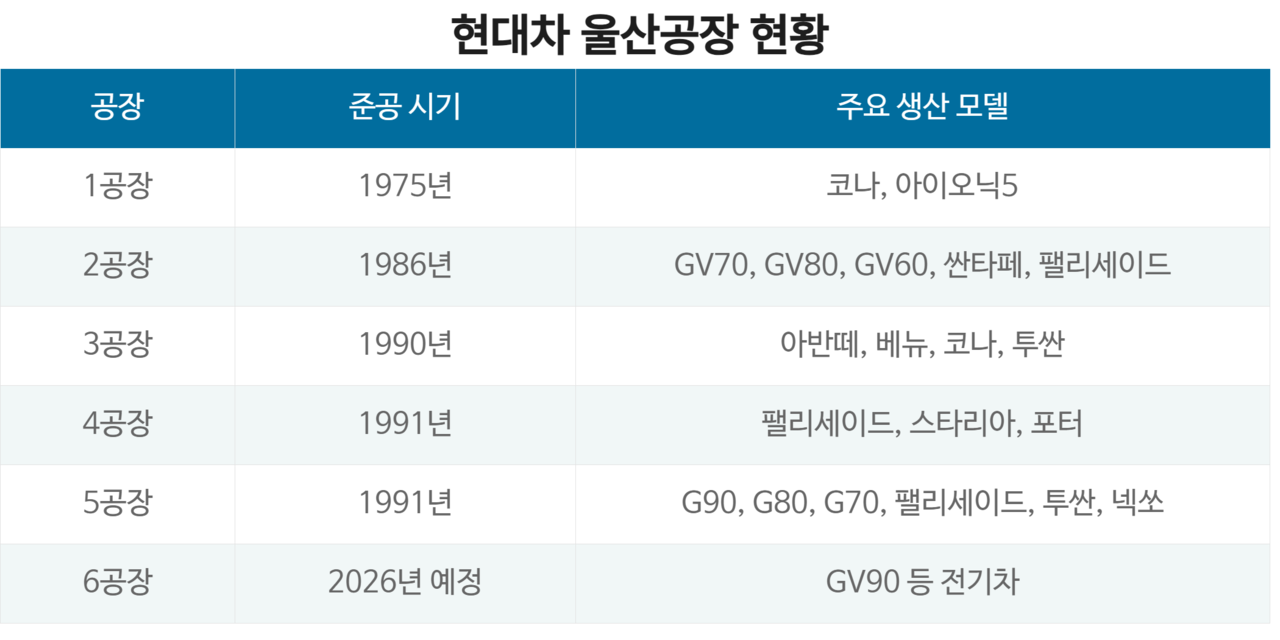
The core driver is demand. Orders for both the Palisade and Tucson currently exceed production capacity. The Palisade is built at Ulsan Plant 4 but is also co-produced at Plants 2 and 5 to meet demand, while the Tucson is assembled at both Plant 5 and Plant 3. With the Ulsan plant reconstruction making it difficult to expand domestic production lines further, ramping up output quickly will require expanding US local production.
Reducing exposure to tariffs and logistics risks from volatile oil prices is an additional motivation. There is also pressure to raise the utilization rate at Hyundai Motor's new US plant. The Hyundai Motor Group Metaplant America in Georgia ran at just 38.2 percent capacity in the first quarter. Kiwoom Securities said that if the plant's utilization rate remains below 50 percent, it could post an annual operating loss of around 300 billion won ($195 million).
Fears grow that domestic output target of 1.74 million units is at risk
As a result, Hyundai Motor's US plant output is expected to expand to around 660,000 units next year, up from 420,000 last year and 460,000 this year.
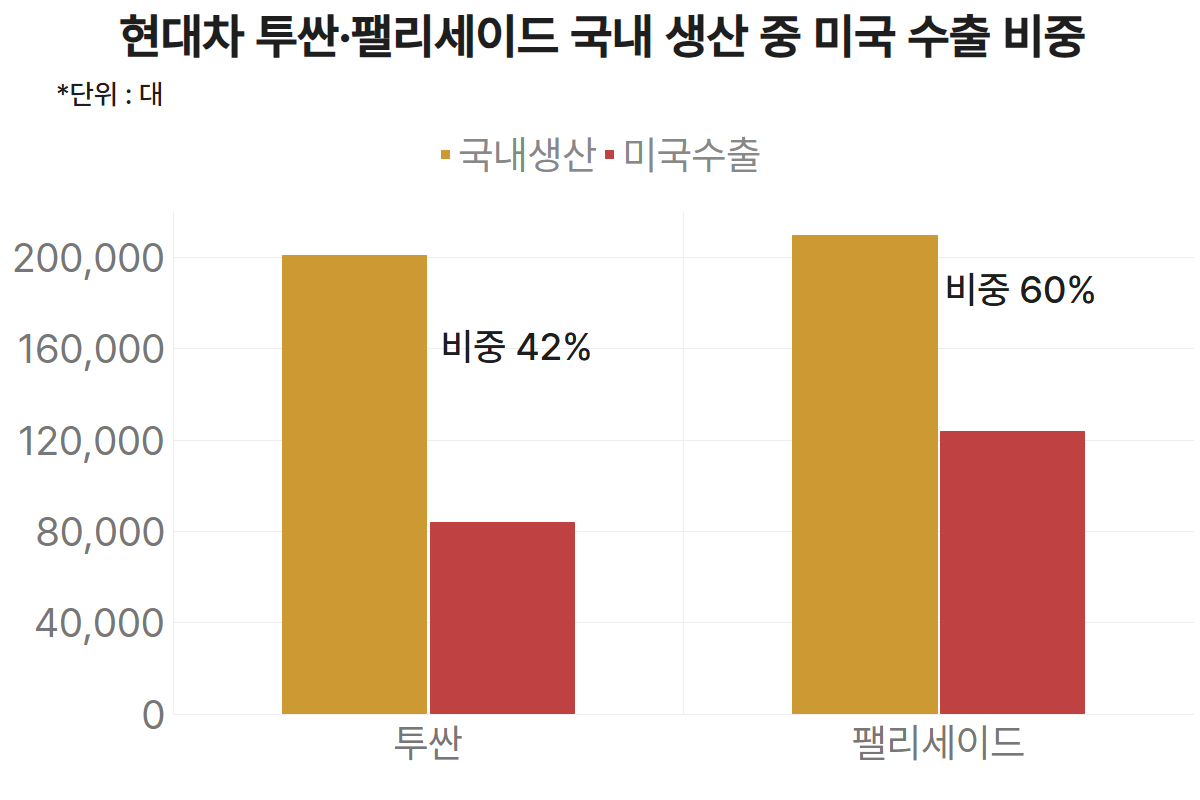
The union is pushing back hard. Last year, combined domestic production of the Tucson and Palisade totaled 410,000 units, of which 208,000 — or 51 percent of total domestic output — were exported to the United States.
Breaking that down by model, 84,000 of the 200,000 Tucson units produced domestically were exported to the US, accounting for 42 percent of domestic output. For the Palisade, 124,000 of 210,000 domestically produced units went to the US, representing 60 percent.
The union fears that transferring this volume to the US will reduce output at the Ulsan plant and threaten members' job security. Particularly acute is the concern that the 1.74 million-unit annual domestic production target — long regarded as the floor below which employment cannot be sustained — could be undermined. The union argues that while labor and management have maintained employment through co-production arrangements and volume adjustments across domestic plants, shifting North America-bound production overseas could erode the very foundation of domestic manufacturing.
Labor and management clash over workforce management during 40-month construction
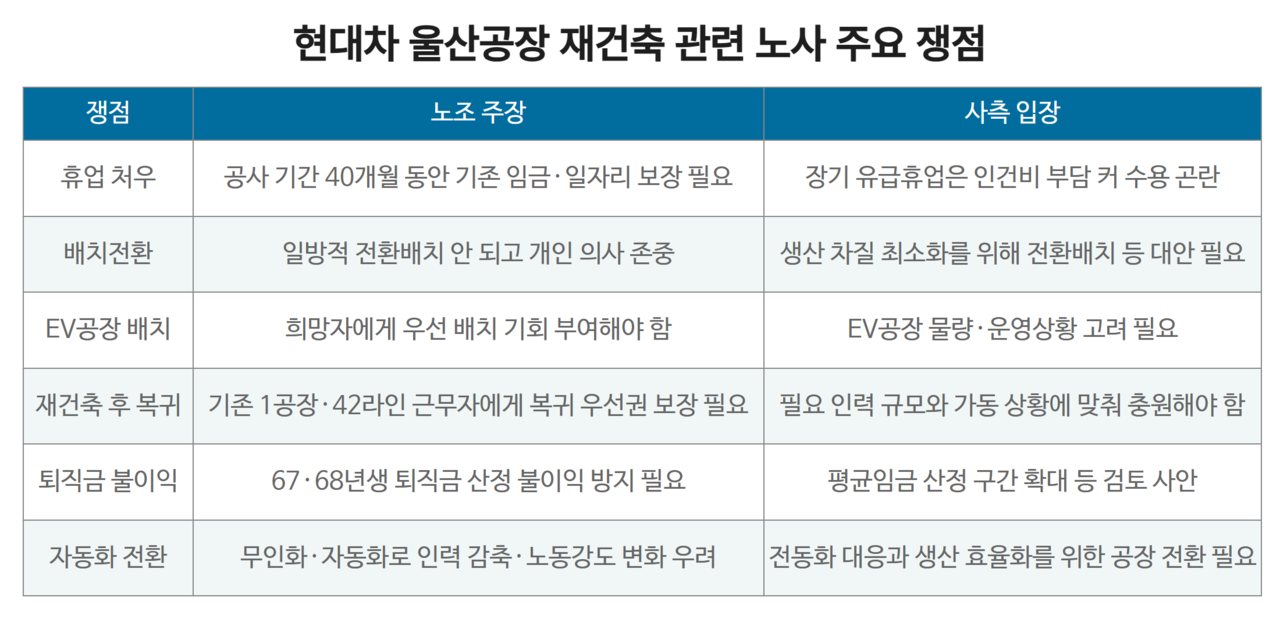
The Ulsan plant reconstruction remains another unresolved issue. Hyundai Motor plans to begin rebuilding Plants 1 and 4 in Ulsan in September next year, with construction expected to take about 40 months — roughly three years and four months. Both sides agree on the need to rebuild the aging facilities; they reached an agreement in 2022 collective bargaining to pursue a phased reconstruction.
The sticking point is how to manage the existing workforce during construction. The union's position is that members must retain their current jobs and wages throughout the rebuild. It is demanding paid leave for the full 40 months and has said it will not accept unilateral reassignments or layoffs.
Management, however, argues that fully absorbing 40 months of paid leave would simultaneously drive up labor costs and disrupt production, making it impractical. The company says it needs to find alternatives — such as shortening the leave period or using reassignments — rather than accepting the union's demands in full.
![Overview of Hyundai Motor's Ulsan plant [provided by Hyundai Motor]](https://wimg.heraldcorp.com/news/cms/2026/06/25/news-p.v1.20260625.5ad94c071c13463e9dc3d5dc12cf2b7d_P1.jpg)
How the rebuilt plant will operate is also a point of contention. The planned reconstruction of Ulsan Plants 1 and the Porter truck plant goes far beyond replacing worn-out equipment — it amounts to a fundamental transformation of the production model. Once rebuilt, the facilities are to become flexible, multi-model automated plants capable of producing internal combustion engine vehicles, hybrids and electric vehicles in response to shifting market demand.
The production system itself will shift from a worker-driven, on-site adjustment model to a data- and software-based operating framework, integrating robots, conveyors, inspection equipment, and logistics and production management systems to adjust processes in real time using live production data. Management frames the changes as necessary for production efficiency and electrification readiness, but the union warns that expanding automation and unmanned operations will inevitably lead to workforce reductions, reassignments and changes in workload intensity.
![The Ioniq 5 production line at Hyundai Motor's Ulsan plant [provided by Hyundai Motor]](https://wimg.heraldcorp.com/news/cms/2026/06/25/news-p.v1.20260527.4b02c322b71341549f64e78d963831ad_P1.jpg)
Labor battle expands beyond wages to job security
This year's labor dispute at Hyundai Motor is evolving beyond the traditional agenda of base pay increases and performance bonuses into a broader confrontation over how to preserve the domestic production base and guarantee employment through the transition to future mobility. If the union bundles wage demands with the US production transfer and Ulsan reconstruction issues in a single strike campaign, a prolonged standoff cannot be ruled out.
"Hyundai Motor's production restructuring is a necessary response to electrification and North American localization, but it inevitably touches on domestic plant volumes and employment — making a clash between labor and management structurally unavoidable," an industry official said. "If the strike drags on, the burden will grow not only for wage negotiations but also for next year's production plans and the factory reconstruction schedule."
kwater@heraldcorp.com




