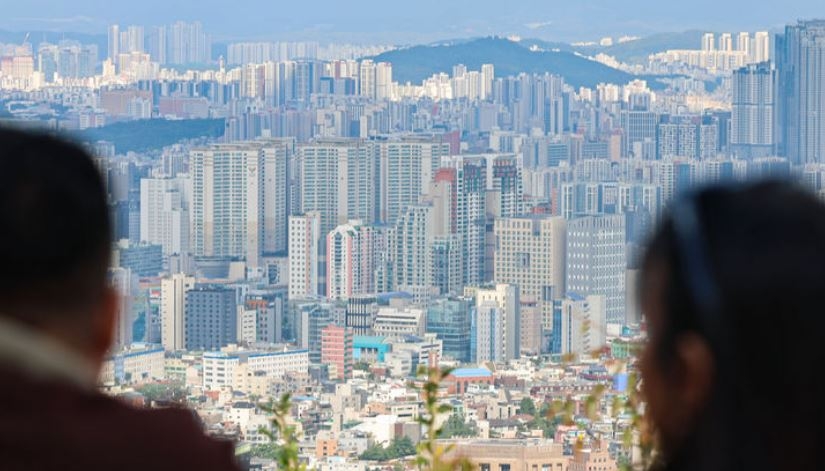
Hwaseong's Dongtan new town in Gyeonggi Province, riding a semiconductor boom, is emerging as the epicenter of the Greater Seoul real estate market. Buyers in their 20s and 30s have flooded in, driving a sharp surge in transactions — and prices are now spiking so fast that contract cancellations are multiplying, raising concerns about an overheating market.
Buyers in their 20s and 30s accounted for 10,534 of all purchases of collective buildings — apartments, villas and officetels — in Gyeonggi Province in May, up 37.3 percent from 7,673 in the same month last year, according to the Court Registry Information Plaza. That age group made up 38.0 percent of all buyers.
Dongtan stood out sharply. Purchases by buyers in their 20s and 30s in Hwaseong's Dongtan District reached 1,132 in May, 3.7 times the 309 recorded in the same period last year. On a cumulative 12-month basis, the district logged 7,732 such transactions — the highest of any city or district in Gyeonggi Province.
Areas drawing heavy young-buyer interest have also seen the steepest price gains. Dongtan apartment prices rose 9.6 percent in the roughly five months since the district was separated from Hwaseong as a standalone general district. Other areas with high concentrations of young buyers — Suwon's Yeongtong, Anyang's Dongan, Yongin's Suji and Gwangmyeong — all posted double-digit gains over the past year, far outpacing the Gyeonggi Province average.
Analysts say policy-backed financing and instability in the jeonse market are pushing young buyers toward purchase. Government loan programs — including a 70 percent loan-to-value ratio for first-time homebuyers and the newborn special loan — have expanded purchasing power. A shrinking supply of jeonse listings and a rapid shift toward monthly rent are also steering end-users to buy instead.
The numbers bear this out. In May, 7,949 people in their 20s and 30s acquired real estate in Gyeonggi Province for the first time, up 45.0 percent from the same month last year. Buyers in their 30s alone numbered 6,837, a 49.6 percent increase year on year.
The buying frenzy is also stoking overheating in the Dongtan market. Apartment sale contracts in Dongtan District reached 1,355 in May so far — already surpassing the previous month's total of 1,001 — according to the Ministry of Land, Infrastructure and Transport's actual transaction price system. That figure exceeds even the volume seen during the balloon-effect period that followed the area's deregulation last year.
Contract cancellations are rising as prices spike in a short period. Cancellations on May contracts numbered 82, up 74 percent from the previous month. The cancellation rate in Cheongye-dong, home to the Dongtan Station transit-oriented area, hit 10.9 percent — well above Dongtan's overall average of 6.1 percent.
Industry insiders attribute the heat to the semiconductor sector's strong performance and expanded bonuses at Samsung Electronics. A licensed real estate agent in Dongtan described one telling case: a seller who had sold a home for 1.6 billion won ($1,040,000) returned the buyer's 10 percent deposit, paid an additional 160 million won in double-deposit compensation, and relisted the property at 1.9 billion won — 300 million won higher. "Even after paying the double compensation, the seller still comes out 140 million won ahead, which is why cancellations are more common than usual," the agent said.
The 84-square-meter unit at Dongtan Station Lotte Castle, a flagship complex near Dongtan Station, sold for 2.225 billion won earlier this month and is now listed at an asking price of 2.4 billion won — roughly 400 million to 500 million won higher than just a month ago.
The price surge is spreading beyond the Dongtan Station transit-oriented area to mid- and lower-priced complexes around the lake park in southern Dongtan, with investment demand flowing in on expectations surrounding the planned Dongtan urban railway (tram) construction.
The government is reviewing whether to designate Dongtan and other unregulated areas in the Greater Seoul region as regulated zones and to expand land transaction permit zones, leaving the market split between buyers waiting on the sidelines and those rushing to get in. End-users are holding off in hopes of a price correction after further regulation, while investors are trying to enter before any restrictions take effect.
Ham Young-jin, head of Woori Bank's real estate research lab, said most 30-somethings buying homes now are first-time buyers, and that a combination of factors — the 70 percent loan-to-value ratio for first-time purchases, a shortage of jeonse listings, rising pre-sale prices and the difficulty of winning apartment subscription lotteries — is pushing more people to simply buy outright. "Buying demand is concentrating in Seoul's Nowon, Dobong and Gangbuk areas and in Gyeonggi Province's southeastern corridor — Yeongtong, Suji, Dongtan, Pangyo, Hanam and Gwangmyeong," he said.
Ham added a note of caution. "During the 2021 'stretch-to-buy' frenzy, interest rates were extremely low and home prices rose nationwide amid the pandemic. Now rates are higher, and uncertainties remain — including a possible tax reform package in July and the potential expansion of regulated zones," he said. "Prices won't rise everywhere. The upward trend this year will be limited to areas with strong pent-up demand, such as Seoul and Gyeonggi Province's southeastern corridor."
rainbow@heraldcorp.com