Redevelopment gaining momentum near Gongdeok Station in Mapo-gu
Asking prices rising, investment inquiries picking up
Experts warn against betting solely on development expectations
![Community briefings on redevelopment options have recently been held for residents of the area around 184 Dohwa-dong in Mapo-gu. [Street view of the 184 Dohwa-dong area, captured via Naver Street View]](https://wimg.heraldcorp.com/news/cms/2026/06/23/news-p.v1.20260623.3d8f8b68f28f449e8665070984640770_P1.png)
"With the promotion committee driving active discussions on the development approach, asking prices for plots with a land share of five to six pyeong have climbed to the 600 million to 700 million won range. There are even cases of buyers from Gangnam coming in with a mindset of holding for 10 to 20 years or more." (A real estate agent near Gongdeok-dong, Mapo-gu)
Redevelopment is gaining momentum around Gongdeok Station in Seoul's Mapo-gu, specifically in the area around 184 Dohwa-dong. Urban renewal projects are under way across Dohwa-dong and Gongdeok-dong, and the prospect of improved transit access following the opening of the Sinansan Line is pushing villa asking prices higher.
According to industry sources on Tuesday, community briefings have been held in succession for residents of the 184 Dohwa-dong area to decide among three redevelopment approaches: fast-track integrated planning, transit-oriented long-term jeonse housing, and a transit area revitalization project. A second briefing, led by the Gongdeok Station Transit Area Integrated Promotion Council (tentative name), was held June 18 to compare the business viability, profitability, development effects and procedures of each option. About 100 residents attended.
The 184 Dohwa-dong area is largely flat and sits within a three-minute walk of Gongdeok Station. Four subway lines pass through — lines 5 and 6, the Gyeongui-Jungang Line and the Airport Railroad — putting key destinations such as Yeouido, Seoul Station and Yongsan within roughly 10 minutes. The site is currently zoned as a Class 2 general residential area, with a total area of approximately 30,000 square meters (subject to adjustment depending on legal limits and project progress). About 470 people are believed to own land or other property in the area.
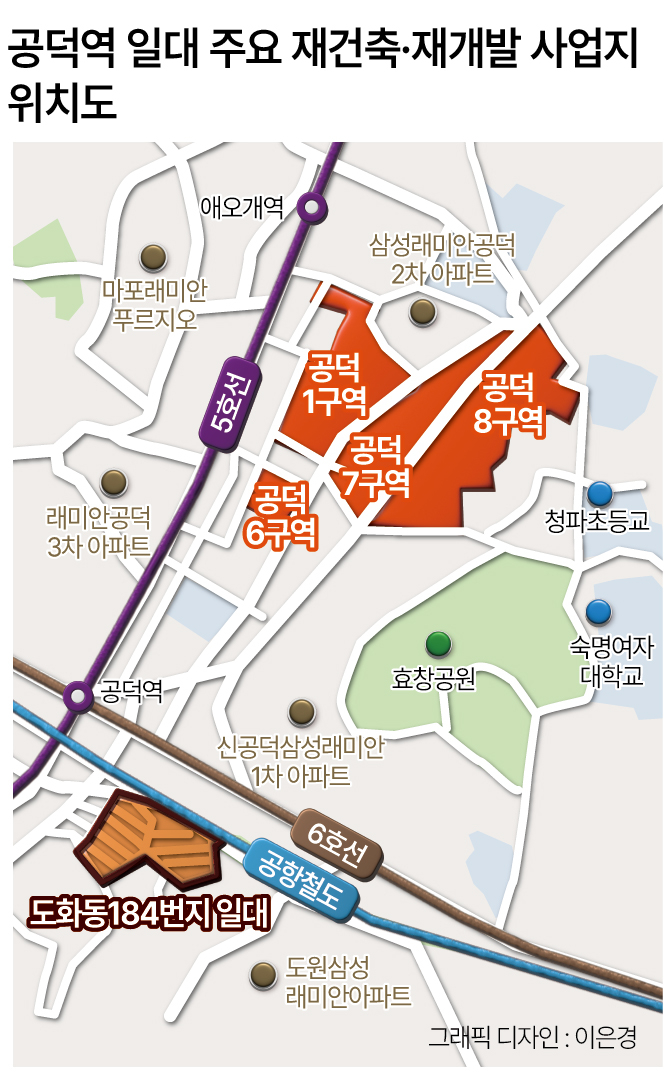
Residents are said to be split between two broad camps: those favoring the fast-track integrated planning approach, in which the Seoul Metropolitan Government provides guidelines during the maintenance plan formulation stage, and those preferring options that leverage the site's transit-oriented location — namely the transit-oriented long-term jeonse housing scheme and the transit area revitalization project.
A person involved in promoting redevelopment in the area said the fast-track integrated planning method has the advantage of speed, with the city covering the costs of the district designation process, but noted that the floor-area ratio is capped at 300 percent and competition for candidate site selection is fierce. The transit-oriented long-term jeonse housing scheme can secure a floor-area ratio of up to 500 percent, enabling the formation of a large residential complex, but the rental unit share would exceed 30 percent, the person said.
The transit area revitalization project allows for high-density development and mixed-use projects combining residential, office and leisure facilities, but has historically struggled with low business viability, the person added. More recently, however, the Seoul Metropolitan Government has announced a series of measures to accelerate transit-area mixed development, including expanding the commercial zoning upgrade to 325 transit areas across the city.
Although the project is still in its early stages — community briefings have only just begun — interest has grown as the initiative aligns with the Seoul Metropolitan Government's broader push to support urban renewal, according to people familiar with the area. As redevelopment discussions have picked up in earnest, asking prices for villas in the area have been rising. Local real estate agents say villas in the area had been trading at around 70 million to 80 million won per pyeong of land share, but asking prices have recently been climbing toward 100 million won per pyeong.
Larger-scale urban renewal projects in Dohwa-dong and Gongdeok-dong are also advancing. The Gongdeok District 1 reconstruction project is set to be completed next year as Mapo Xi Hillstate La Chels, while redevelopment is under way in Gongdeok districts 6, 7 and 8. Once the Sinansan Line opens on top of the ongoing renewal activity near Gongdeok Station, the area could become a "penta transit hub" served by five lines — subway lines 5 and 6, the Gyeongui-Jungang Line, the Airport Railroad and the new Sinansan Line.
Each zone is at a different stage of development, however, meaning full buildout of the area will take time. Experts caution against investing based solely on development expectations.
Ham Young-jin, head of the real estate research lab at Woori Bank, said row houses and multi-family homes are not subject to land transaction permit zone restrictions, and because the area has not yet reached the management and disposal authorization stage, resale restrictions do not apply either — factors that will draw buyer interest. He cautioned, however, that additional contributions upon redevelopment could be substantial and the project could drag on for years, making it important for prospective buyers to closely monitor how each stage of the project progresses.
![“한달 만에 20억 올랐다” 국평 호가 72억원 부른 반포 ‘래미안트리니원’ [부동산360]](https://wimg.heraldcorp.com/news/cms/2026/06/22/news-p.v1.20260622.7e4ad4167a084437b3a64dff00d0ab88_T1.png)
lucky@heraldcorp.com