Card loan balances rebound after one-month dip
Average rate ceiling rises to 14.33%
Experts warn of outsized risk if leveraged investing continues to grow
![An advertisement for card loans is posted in an alley in Myeong-dong, Seoul. [Yonhap]](https://wimg.heraldcorp.com/news/cms/2026/06/23/news-p.v1.20260420.460abf4d8152412f8b1ef9b1fb9904ee_P1.jpg)
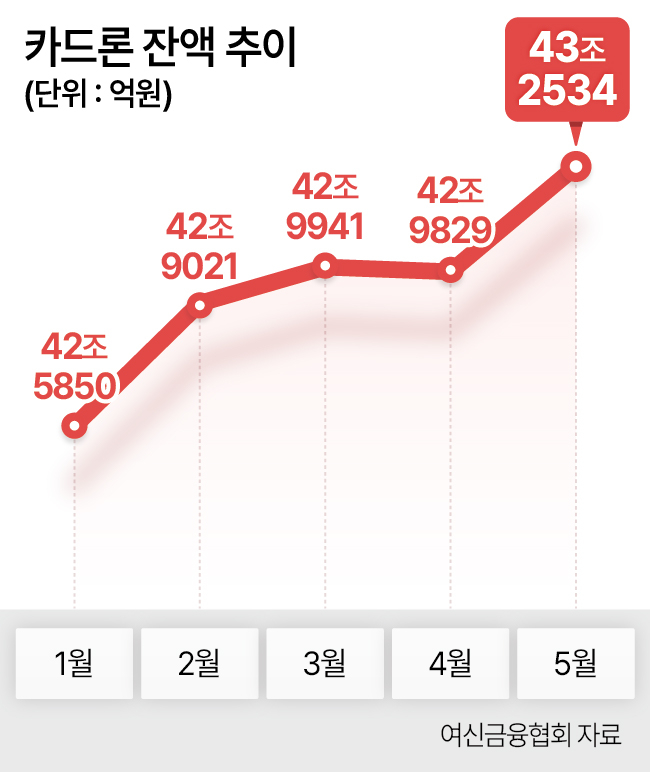
A stock market rally has stoked demand for investment capital, drawing funds that had been concentrated in bank personal loans toward card loans. Outstanding card loan balances have broken a new all-time high this year, surpassing 43 trillion won.
Experts warned that as leveraged investing — borrowing to fund market positions — grows in scale, any sudden market correction could expose both investors and financial institutions to sharply amplified risk.
According to the Credit Finance Association, outstanding card loan balances at nine credit card companies — Lotte, BC, Samsung, Shinhan, Woori, Hana, Hyundai, KB Kookmin and NH Nonghyup — stood at 43.25 trillion won at the end of May, up 270.4 billion won from 42.98 trillion won at the end of April.
Tighter aggregate lending controls by financial authorities had pushed balances into decline in April for the first time in four months, but renewed demand driven by the stock market rally sent them rebounding in May.
Behind the record card loan balance is a tightening of household lending rules that has raised the bar for bank borrowing. As personal loans at banks surged, lenders moved to cap individual unsecured credit loans at 100 million won per person, combining balances across all banks. The measure effectively made it impossible even for high earners — those with annual incomes of several hundred million won — to borrow more than 100 million won in unsecured credit from banks. With bank lending cut off just as stock market demand was surging, a "balloon effect" emerged, pushing borrowers toward card companies.
Card loans are also classified as unsecured credit and subject to aggregate lending caps. Under current rules, unsecured credit is limited to 100 percent of annual income, and a debt service ratio cap of 40 percent — which bars annual principal and interest repayments from exceeding 40 percent of income — applies equally.
Financial authorities are also keeping a close watch on the rise in household lending. In May, the Financial Supervisory Service summoned six card companies — Samsung, Hyundai, KB Kookmin, Lotte, BC and NH Nonghyup — whose card loan growth had been particularly pronounced, and ordered them to tighten household debt and risk management. The companies that received the warning moved into active management mode from late May. Among them, NH Nonghyup Card posted the highest month-on-month growth rate at the end of May at 1.65 percent, followed by Lotte Card at 1.15 percent and Hana Card at 1.05 percent. Samsung Card, by contrast, saw balances fall 0.31 percent from the previous month.
Adding to the pressure, rising funding costs for card companies — driven by an upward interest rate trend — are set to increase the interest burden on borrowers. The average card loan rate at eight dedicated card issuers ranged from 11.16 percent to 14.33 percent, with the upper end edging up from the previous month's range of 11.24 percent to 14.31 percent.
Card companies have begun pulling back on lending activity. KB Kookmin Card has temporarily suspended the display of its personal loan products on loan comparison platforms, limiting the intake of new customers. Other card companies are also internally recalibrating their risk management strategies, including adjusting the share of loans extended by credit tier. To curb new lending, companies are considering scaling back marketing and reducing promotional benefits such as rate discounts to raise the effective borrowing cost. Tightening creditworthiness assessment criteria to shrink loan limits outright is also under consideration.
"In line with the financial authorities' management stance, we are maintaining supply for borrowers with genuine needs while operating strictly within our annual targets," an official at one card company said.
As risk management pressure mounts from the expansion of card loans, concerns are also emerging that regulation-heavy measures could create a "genuine-demand cliff" — cutting off ordinary people who urgently need short-term funds. "There are clearly vulnerable borrowers who need to raise emergency cash through card loans," an official at another card company said. "If regulators keep tightening rules simply because loan balances are piling up, people who desperately need funds could end up shut out of the lending market entirely."
Kim Jeong-sik, an emeritus professor of economics at Yonsei University, advised that "rather than mechanically capping the total volume of household loans, focusing on targeted measures that can preemptively prevent loan defaults would be a far more effective approach."

won@heraldcorp.com