Credited with underpinning two decades of the Great Moderation, Greenspan also played a behind-the-scenes role in resolving South Korea's currency crisis; his faith in market self-correction and deregulation drew sharp criticism after the 2008 financial meltdown
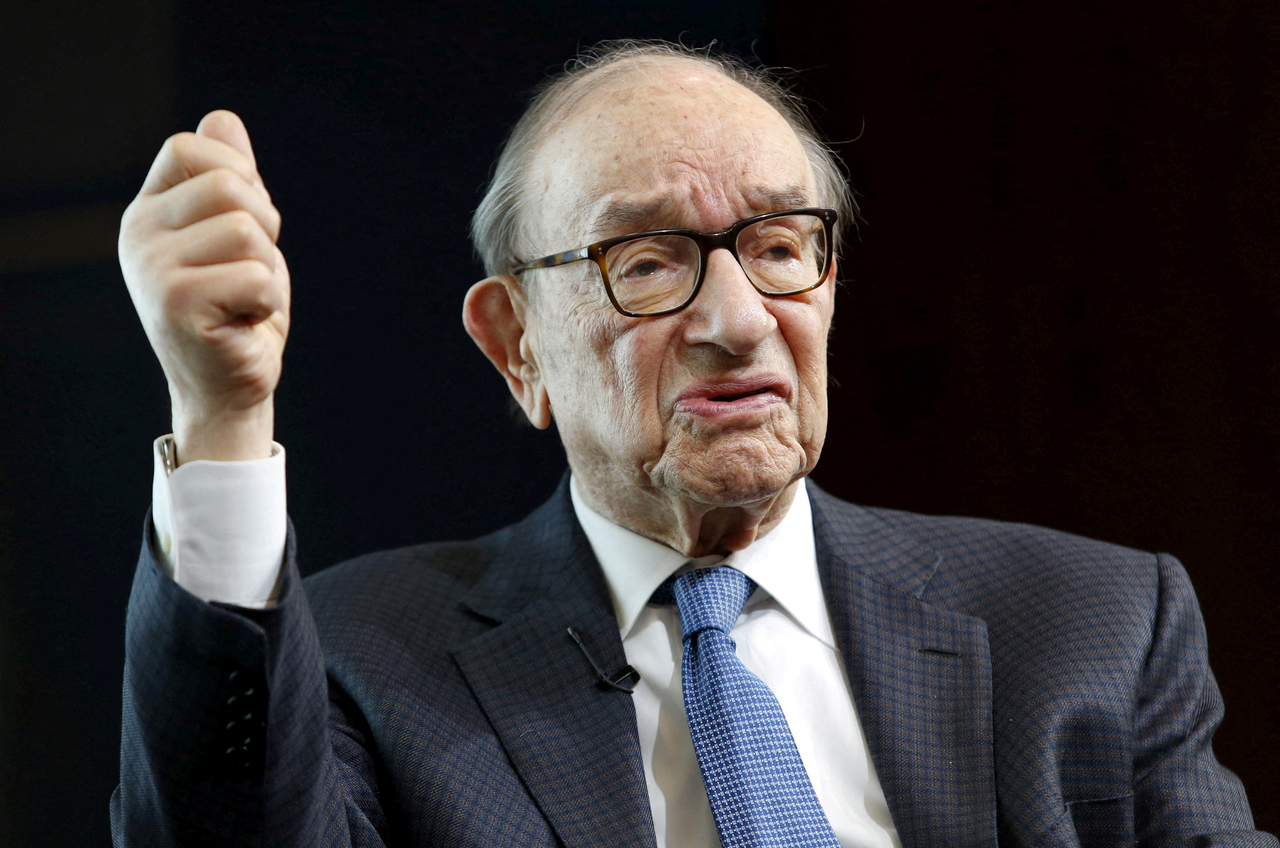
Alan Greenspan, the former chairman of the US Federal Reserve who led the central bank for nearly 19 years from 1987 to 2006, died Sunday. He is widely regarded as a master of monetary policy who steered the American economy through the era known as the Great Moderation.
Yet his deep faith in the market's ability to self-correct, and his embrace of deregulation, have also drawn lasting criticism for laying the groundwork for the global financial crisis of 2007–2008 and the Great Recession that followed.
Maestro of the Great Moderation
![Alan Greenspan (left) attends President Ronald Reagan's Social Security bill signing ceremony on the South Lawn of the White House in April 1983. [AP]](https://wimg.heraldcorp.com/news/cms/2026/06/23/rcv.YNA.20260623.PAP20260623003401009_P1.jpg)
Greenspan succeeded Paul Volcker as Fed chair in 1987 and is credited with achieving simultaneous growth and price stability, presiding over a prolonged American economic boom.
The Economist marked his passing with an obituary calling him the "Maestro of Monetary Policy."
"As Fed chairman, he became the most powerful figure in the world of economics, tuning the vast and complex machinery of the American economy so that it performed at its best and played its most beautiful music," the magazine said.
The New York Times offered a similar assessment, writing that "most of his tenure coincided with an era of prosperity, and he became an iconic figure of American-style capitalism triumphant after the Cold War."
Changes in how the Fed communicated monetary policy also contributed to greater stability during his tenure.
It was in 1994 — while Greenspan was chair — that the Federal Open Market Committee first began publicly releasing a policy statement after each interest rate decision.
Before that, the Fed did not publicly announce changes to monetary policy, and Wall Street had to infer shifts by monitoring open market operations at the Federal Reserve Bank of New York.
The 'Greenspan Put' — and a role in South Korea's currency crisis
![Then-Federal Reserve Board Chairman Alan Greenspan (right) watches President Clinton deliver a speech in the Oval Office at the White House in January 2000. [AP]](https://wimg.heraldcorp.com/news/cms/2026/06/23/rcv.YNA.20260623.PAP20260623003101009_P1.jpg)
The Fed under Greenspan consistently acted as a backstop for financial markets, responding swiftly to each crisis — a pattern that gave rise to the term "Greenspan Put."
Investors came to believe that whenever share prices plunged or financial markets turned turbulent, the Fed would cut interest rates and flood the system with liquidity to prop up markets. The "put" in the phrase refers to a put option, a financial instrument that limits losses when markets fall.
His crisis management credentials were established almost immediately after taking office. When the Dow Jones Industrial Average collapsed 22.6 percent in a single day during the "Black Monday" crash of October 1987, Greenspan signaled a bold willingness to supply liquidity, helping stabilize markets.
He responded to the 1998 Russian financial crisis and the collapse of Long-Term Capital Management with a surprise interest rate cut, containing the spread of a global credit crunch.
His ties to South Korea run deep. During the 1997 currency crisis, Greenspan worked behind the scenes alongside then-Treasury Secretary Robert Rubin to contain the fallout.
Even after South Korea secured an IMF bailout, the crisis showed no signs of abating toward the end of 1997, prompting US authorities to coordinate with the Korean government on accelerating the disbursement of IMF funds.
In addition, Washington moved to persuade major US and other advanced-economy financial institutions to roll over their short-term loans to Korean companies and banks.
The Federal Reserve Bank of New York convened a meeting with major Wall Street banks on Christmas Eve — Dec. 24, 1997 — after which the US banks agreed to extend the maturities on South Korea's short-term debt. The Fed then spent several months overseeing the conversion of predominantly short-term loans into medium-term obligations.
That restructuring and rollover of short-term debt is widely credited as having been decisive in helping South Korea avert a sovereign default at the end of 1997.
Criticism: sowing the seeds of financial crisis
![Former Federal Reserve Board Chairman Alan Greenspan [AFP]](https://wimg.heraldcorp.com/news/cms/2026/06/23/rcv.YNA.20260622.PAF20260622247301009_P1.jpg)
Assessments of Greenspan's legacy became sharply divided after the global financial crisis of 2007–2008.
In 1996 he warned of "irrational exuberance" in the technology-stock frenzy gripping US markets, but took no aggressive action to deflate the bubble. Stocks continued to climb for years, ultimately inflating into the dot-com bubble.
When the broader US economy avoided a serious downturn after that bubble burst, Greenspan concluded that minimizing the damage after a collapse was more effective than preemptively suppressing bubble formation.
His belief in the market's capacity for self-correction led to lax oversight of risky lending practices such as subprime mortgages, critics argue.
When Greenspan stepped down in January 2006, the US economy still appeared sound. But as the housing market slowed, mortgage delinquency rates surged, ultimately triggering the 2007 subprime mortgage crisis and the subsequent collapse of Bear Stearns and Lehman Brothers.
The Wall Street Journal noted that "Greenspan's critics argue that his asymmetric approach — taking small steps to restrain bubble growth while deploying large measures to clean up afterward — actually encouraged greater risk-taking."
The New York Times said Greenspan's biographer, Sebastian Mallaby, concluded that "his biggest mistake — one he didn't have to make — was failing to give more weight to financial stability."
mokiya@heraldcorp.com