Backed by KHIDI support, Korean AI biotech Galux launches joint research with global pharma giant AstraZeneca; uses 'de novo' platform to generate proteins with pre-defined functionality; AZ global executives attend as 13 Korean innovators join partnering sessions
The AI-driven drug development collaboration between Korean biotech Galux and multinational pharmaceutical company AstraZeneca drew wide attention on the global stage Monday as a standout example of public-private partnership. Backed by full support from the Korea Health Industry Development Institute, the two companies launched their joint research ahead of schedule and are now on track toward developing next-generation antibody drugs.
KHIDI held the "KHIDI-AstraZeneca Project NOVA Global Connect" technology cooperation seminar Monday (local time) in San Diego, on the sidelines of the 2026 Bio International Convention (BIO USA), to help Korean biotech companies break into global markets.
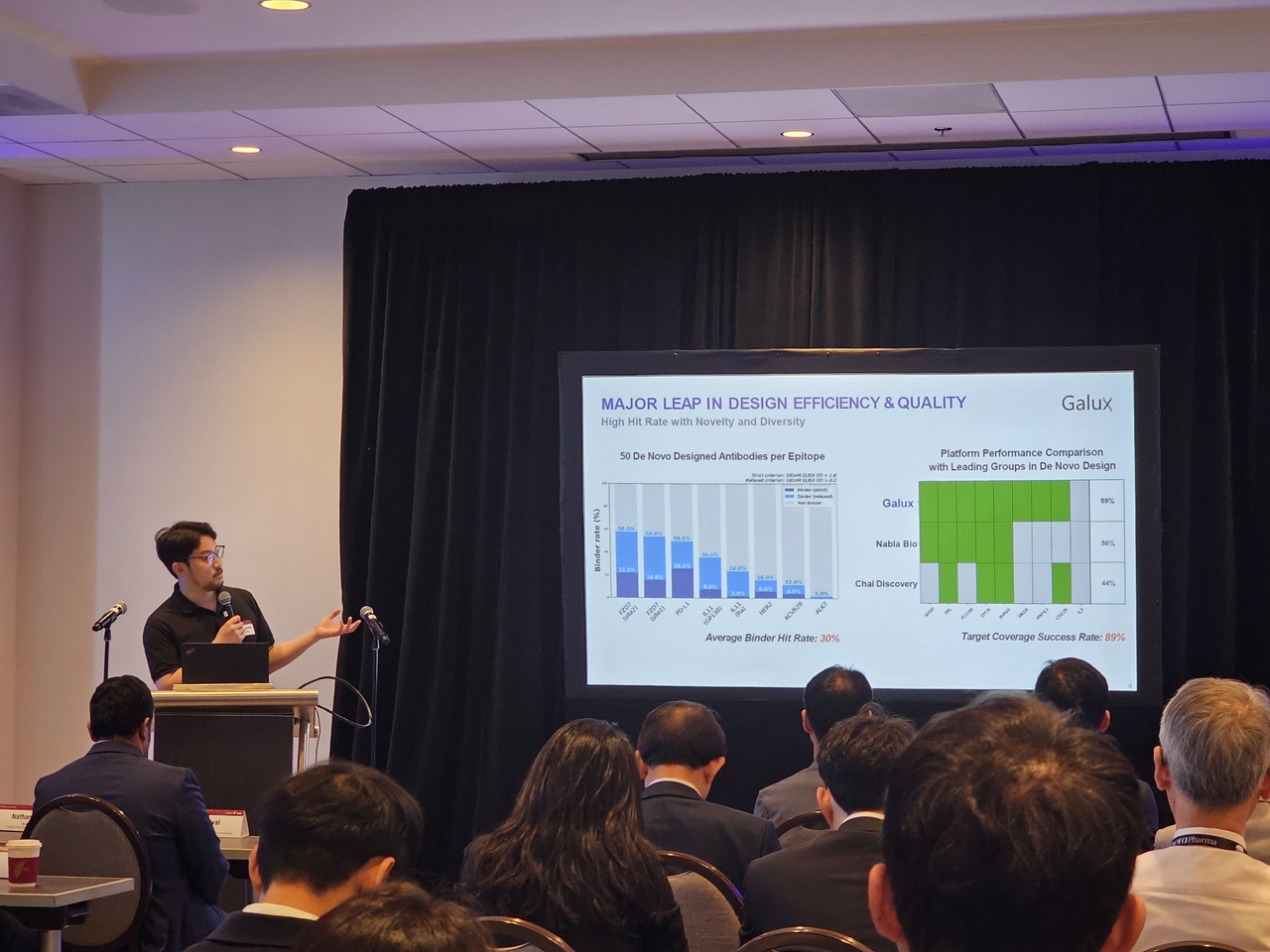
Galux, an AI-based drug development venture, drew the most attention at the event. Park Tae-yong, executive vice president of Galux, said in an on-site presentation that the company had officially launched a collaboration with AstraZeneca based on its proprietary AI antibody design platform, "de novo" technology.
At the heart of the partnership is Galux's use of its AI technology to design and generate proteins with "pre-defined functionality" as specified by AstraZeneca. The two companies plan to jointly validate, through their respective R&D teams, whether the AI-generated protein candidates actually perform the intended target functions.
Galux was founded in 2020 by Seok Cha-ok, a professor at Seoul National University's College of Pharmacy, and holds AI-based antibody generation technology capable of precisely identifying only mutated target sites. Park said internal validation showed the antibodies the company designed achieved a 30 percent target-binding success rate. He added that only three or four groups worldwide can achieve that level of accuracy, and that compared with Invensity of the United States — a global leader in the field — Galux found binders for eight out of nine shared targets, confirming a target coverage advantage of 89 percent.
Galux was selected for KHIDI's technology cooperation acceleration support program for growth-stage companies and will receive 400 million won ($261,000) in matching government funding to support its global expansion.
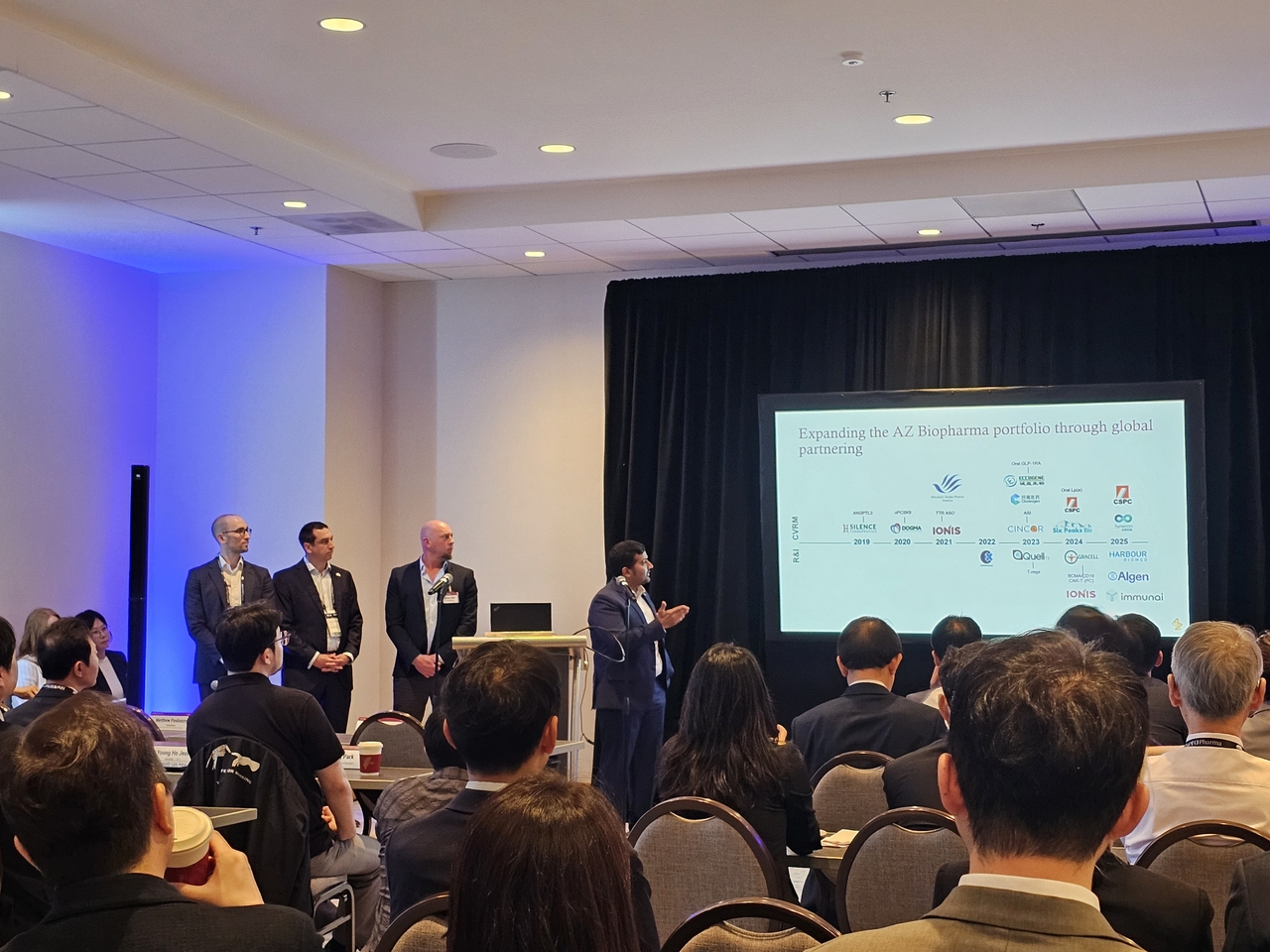
Key executives from AstraZeneca's global headquarters Search & Evaluation team attended in force, signaling strong interest in Korean technology. Senior figures including Nikhil Mutyal (respiratory and immunology), Matthew Posluszny (oncology), Gayatri Varma (global transactions) and Christopher Church (head of technology) reviewed the core technologies of Korean companies firsthand.
Through roundtable discussions and seminar sessions, the executives shared in detail AstraZeneca's most pressing areas of interest: early drug discovery using AI and machine learning, next-generation antibody-drug conjugates (ADCs), radioligand conjugates (RJCs) and off-the-shelf cell therapies.
The executives then held a series of one-on-one partnering meetings with 13 pre-screened Korean biotech companies — including Novorex, OliX Pharmaceuticals, Intocell, Fin Therapeutics and IMBiologics — to explore technology cooperation opportunities.
Jeong Yeong-hun, KHIDI's planning director, said Project NOVA serves as a bridge for outstanding Korean biotechs to reach the global stage at a time when open innovation — rapidly securing cutting-edge technology — has become a core survival strategy. "We will continue to support follow-up communications so that AstraZeneca's infrastructure and the innovation of Korean companies combine to generate genuine mutual business growth," he said.
silverpaper@heraldcorp.com