Democratic Party reviews plans to phase in extension from 2028 or 2029; youth employment falls for 25th straight month; KDI finds each older worker hired displaces 0.2 young workers
Debate over raising the mandatory retirement age to 65 is gaining momentum even as South Korea's youth job market deteriorates sharply, with the youth employment rate falling for 25 consecutive months, deepening concerns that expanding older workers' tenure could crowd out young job seekers.
Calls for extending the retirement age have grown louder amid an aging population and a planned increase in the national pension eligibility age. Many warn, however, that broader employment of older workers could erode young people's chances of entering the labor market at a time when youth unemployment is already worsening. Analysts say the debate risks inflaming generational tensions over jobs.
According to political sources Monday, the Democratic Party of Korea's special committee on retirement age extension is reviewing a plan to raise the mandatory retirement age to 65 in stages. The committee is considering several options, including raising the retirement age by one year every two years starting in 2028 or 2029, reaching 65 between 2036 and 2037. Depending on when the measure takes effect, it would apply to workers born in 1968 or 1969.
The push to extend the retirement age is driven in large part by a scheduled increase in the national pension eligibility age. The age at which Koreans can begin drawing national pension benefits is being raised incrementally and will reach 65 in 2033, while the statutory retirement age has remained at 60 since 2016. That gap creates an income void of up to five years between retirement and pension eligibility, lending force to arguments for extending the retirement age.
The special committee is also discussing wage structure reform and the introduction of a continued-employment system alongside the retirement age extension, reflecting concern that simply raising the retirement age without such changes could sharply increase the burden on businesses.
Labor unions, however, oppose a phased approach or any extension conditioned on wage restructuring. They argue that wage system reform or the introduction of a continued-employment system should not be set as preconditions for raising the retirement age.
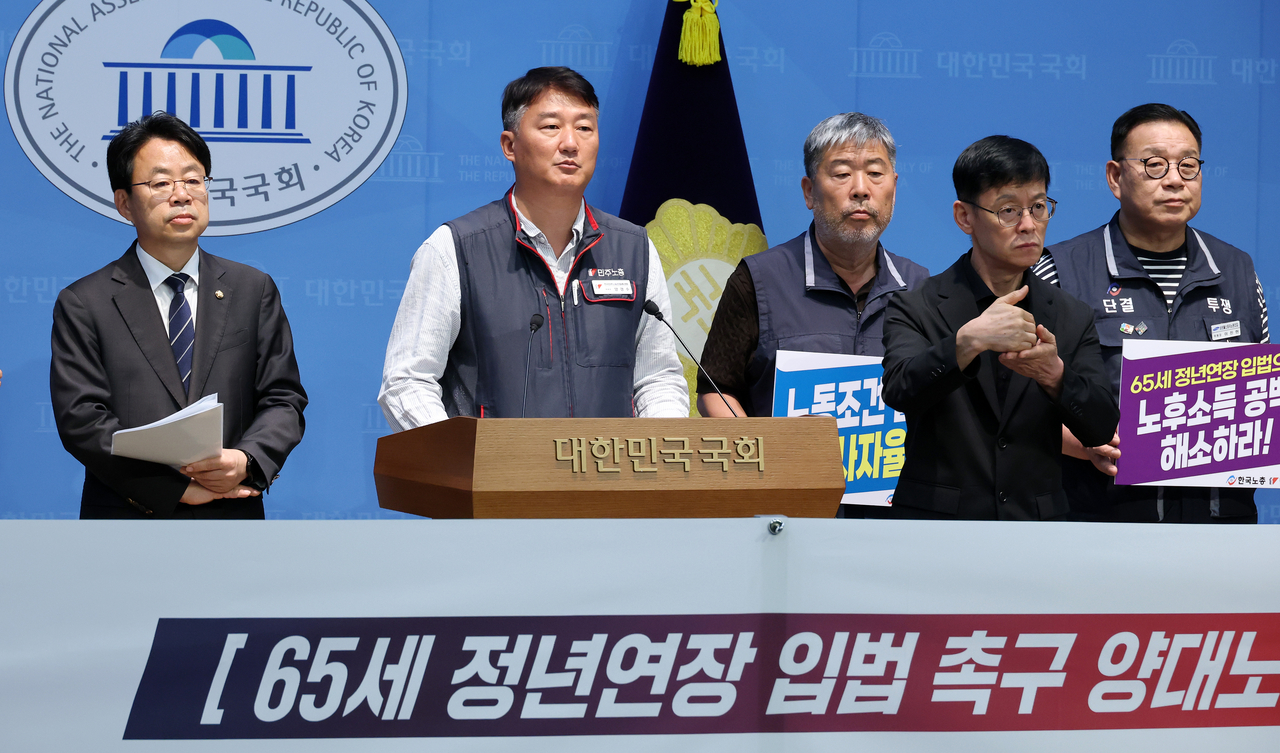
The Korea Federation of Trade Unions and the Korean Confederation of Trade Unions held a joint press conference recently, urging the government to "immediately pursue full legislation raising the retirement age to 65 without any poison-pill provisions."
The concern is that the youth job market has already entered a serious slump.
According to the Ministry of Statistics' employment trends for May, the number of employed people aged 15 to 29 stood at 3.677 million, down 255,000 from the same month last year — the steepest decline since 2021.
The youth employment rate fell 2.4 percentage points to 43.8 percent, marking 25 consecutive months of decline. The youth unemployment rate stood at 7.2 percent, while the broader rate reflecting underemployment reached 16.6 percent.
Analysts say quality jobs favored by young workers are disappearing rapidly, with manufacturing employment down 140,000 and a prolonged slump in the construction sector. The scaling back of large companies' open recruitment cycles in favor of rolling hiring is also cited as a factor making it harder for young people to enter the labor market.
Research has examined how raising the retirement age affects youth hiring.
A Korea Development Institute analysis of employment effects following the mandatory introduction of a retirement age of 60 found that in the private sector, each additional older worker retained was associated with a decrease of about 0.2 in youth employment. The finding suggests that keeping older workers on can lead some companies to reduce new hiring.
The effect was found to be relatively pronounced at large companies and workplaces with high levels of employment protection.
Business groups cite these findings to argue that retirement age extension and wage structure reform must be discussed together.
At a recent academic policy seminar on retirement age extension, the Korea Employers Federation said that extending the retirement age without reforming a seniority-based wage system could significantly increase the burden on companies.
The Korea Enterprises Federation estimated that raising the retirement age to 65 would add about 30.2 trillion won (about $19.7 billion) per year in labor costs for businesses — enough to hire roughly 900,000 new workers aged 25 to 29.
Experts agree that extending the retirement age is unavoidable given the aging population and the rising national pension eligibility age. They said, however, that the costs of the extension should not be shifted onto any single generation, particularly as youth employment deteriorates rapidly.
"Extending the retirement age is a task that can no longer be delayed, but pushing it through without measures to support youth employment and reform the wage system could translate the added burden on businesses into fewer new hires," one labor market expert said. "A social consensus that addresses retirement age extension, continued employment and structural labor market reform together is needed."
fact0514@heraldcorp.com