Tax breaks leave landlords with no incentive to sell after rental period ends, National Tax Service chief says; calls for reform to unlock supply exceeding government's own housing plan
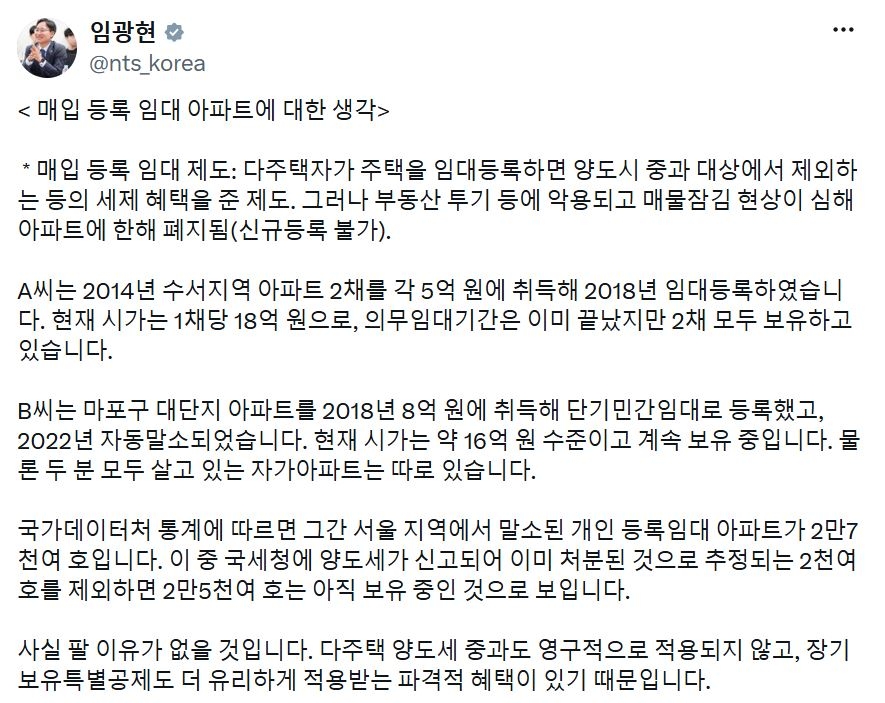
National Tax Service Commissioner Lim Gwang-hyeon has publicly called for an overhaul of the tax regime governing registered rental apartments, saying the current system is locking up as many as 68,000 Seoul units. The remarks reignite a debate that President Lee Jae-myung raised in February over whether multi-home landlords should continue to receive capital gains tax exemptions on registered rental housing.
Lim made the comments Saturday in a post on X, formerly Twitter, titled "Thoughts on purchased registered rental apartments."
Under the registered rental system, landlords who register their properties for rental are exempt from the heavier capital gains tax surcharge applied to multi-home owners when they sell. New apartment registrations under the system have been suspended due to concerns about speculative abuse and a resulting shortage of listings on the market.
Lim said that according to Ministry of Statistics data, of the roughly 27,000 individually registered rental apartments in Seoul that have already been deregistered, about 2,000 appear to have been sold based on capital gains tax filings — leaving an estimated 25,000 units still held by multi-home owners.
"Even after the rental period ends, the exemption from the multi-home capital gains tax surcharge continues, deepening the listing shortage," he said. Without policy changes, he added, a similar pattern is likely to repeat for the 43,000 registered rental apartments in Seoul set to be automatically deregistered by 2028.
"There is frankly no reason to sell," Lim said. "The multi-home capital gains tax surcharge is not applied permanently, and owners also benefit from more favorable long-term holding deductions — an extraordinary set of advantages."
He said there was a persuasive case being made on the ground that the current benefits are excessive, and that tax relief during the rental period, plus a limited window of benefits after it ends, should be sufficient.
"A review of the rental market would of course be needed, but how welcome it would be if registered multi-home landlords were given an exit opportunity — allowing the roughly 68,000 Seoul apartments already deregistered or set to be deregistered to come onto the market and add to supply," he said.
Lim noted that the government's Jan. 29 real estate measures targeted a supply of 60,000 homes in the Greater Seoul area, suggesting that a reform of the rental tax regime could unlock more supply than the government's own housing plan.
President Lee raised the issue in February, questioning whether it was fair for registered rental properties to continue receiving the multi-home capital gains tax exemption after the rental period expires. "Shouldn't the tax treatment of registered rental housing after the rental period ends be the same as for ordinary rental housing?" he said.
Lee also said that abolishing the exemption immediately would impose too heavy a burden, and suggested phasing it out over time or limiting it to apartments only.
oskymoon@heraldcorp.com