Median buyer income hits 65.27 million won, highest in 18 years; semiconductor belt property market heats up; Dongtan tops national price-gain rankings with standard units crossing 2 billion won; analysts warn high earners will keep pushing prices up as loans tighten
The median annual income of households that bought apartments in Gyeonggi Province in the first quarter of this year rose nearly 10 percent from a year earlier, surpassing 65 million won, data showed. Amid growing expectations of liquidity inflows into the semiconductor belt in southern Gyeonggi — fueled by performance bonuses at Samsung Electronics and SK Hynix — analysts say sale prices could climb further if buying by large-company employees continues.
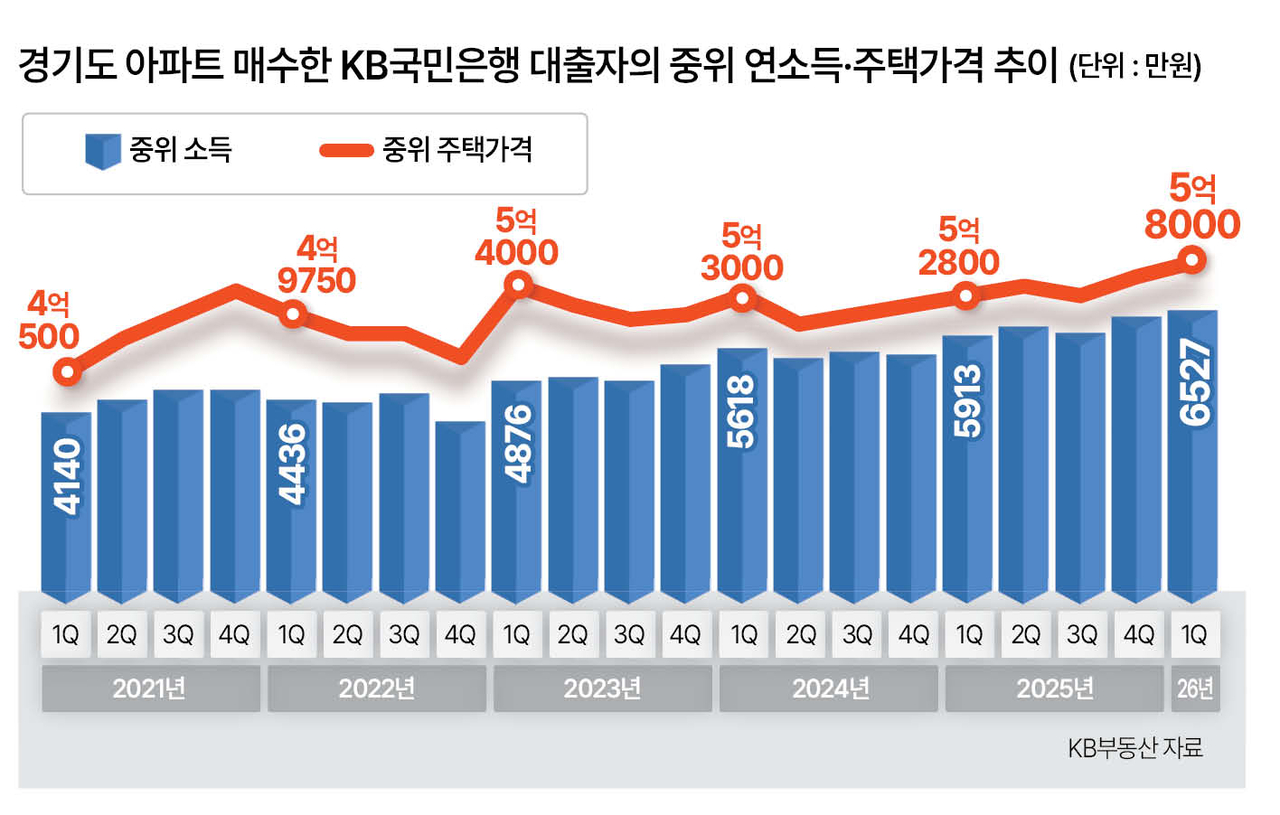
According to KB Kookmin Bank's monthly housing time-series data released Tuesday, the median annual income of households that took out apartment-backed mortgage loans from KB Kookmin Bank to buy apartments in Gyeonggi Province in the first quarter (January–March) was 65.27 million won. That is the highest figure since the data series began in 2008, up 10.4 percent, or 6.14 million won, from a year earlier (59.13 million won). It also rose 2.3 percent, or 1.49 million won, from the previous quarter (October–December 2025), when the figure stood at 63.78 million won. The income gain is exceptional by any measure: according to the Ministry of Statistics' household trend survey, real household income in the first quarter averaged 4.628 million won per month — just 0.4 percent higher than a year ago.
The median annual income of KB Kookmin Bank mortgage borrowers who bought apartments in Gyeonggi Province held in the 40 million won range in 2021 before dipping into the 30 million won range in 2022. It then began surging from the fourth quarter of 2024, crossing 60 million won in the second quarter of last year.
Housing prices have risen in tandem. The median price of Gyeonggi apartments financed through KB Kookmin Bank mortgage loans hit a record 580 million won in the first quarter, up 9.8 percent, or 52 million won, from 528 million won a year earlier. The figure is based on KB Kookmin Bank's collateral appraisal values; actual market prices are generally higher.
The Dongtan Station Lotte Castle, a flagship transit-oriented apartment complex, saw its 84-square-meter unit trade hands on May 7 for 2.08 billion won, joining what the market calls the "national standard-unit 2 billion won club." That came less than a month after the complex set a new record high of 1.94 billion won in April — a jump of 140 million won in under a month. The Dongtan Station Sibeom The Sharp Central City's 97-square-meter unit also set a new record, changing hands at 1.8 billion won on May 13.
The string of record transactions has pushed Dongtan-gu in Hwaseong to the top of the national apartment price-gain rankings. KB Real Estate data for the fourth week of May showed Dongtan-gu's apartment sale prices rising 0.5 percent — outpacing Dongdaemun-gu in Seoul, which posted the capital's highest gain at 0.44 percent, and far exceeding the 0.01 to 0.08 percent increases recorded across the three Gangnam districts of Gangnam, Seocho and Songpa-gu.
Market observers attribute the trend to a confluence of factors: the presence of Samsung Electronics' Pyeongtaek and Hwaseong campuses, the development of the Yongin semiconductor cluster, and the resulting influx of semiconductor industry workers earning annual salaries in the hundreds of millions of won. With government regulations limiting bank lending, high-income earners with cash on hand are actively buying apartments in Gyeonggi areas that offer both proximity to their workplaces and strong living conditions, analysts say.
Some analysts expect that once large performance bonuses from chipmakers are paid out in earnest, property prices in Dongtan and the broader southern Gyeonggi region will accelerate even further.
Kim Hyo-seon, chief real estate adviser at KB Kookmin Bank, said interest in what the market calls "shuttle-zone" complexes — those within reach of shuttle buses serving Samsung Electronics' Giheung and Hwaseong campuses and SK Hynix's Icheon campus — has become a recognized trend. "The factors that determine housing prices are demand and household income," Kim said. "With both population and income converging in these areas, prices have no choice but to rise."
Securities industry estimates suggest that based on consensus operating profit forecasts for Samsung Electronics and SK Hynix this year, a single employee in each company's memory chip division could receive performance bonuses of 701.4 million won and 750.31 million won, respectively, in early next year. Taking last year's average base salaries into account, total annual income per employee at both companies is projected to reach around 900 million won.
Adding to the outlook, Samsung Electronics and its union agreed in their latest negotiations to introduce a housing stability loan program for employees without homes — offering up to 500 million won for home purchases and up to 300 million won for jeonse deposits, both at an annual interest rate of 1.5 percent. The deal has prompted expectations that other semiconductor companies will compete to offer similar welfare benefits.
"Right now, particularly because it is difficult to secure loans from financial institutions, the factors pushing up housing prices will be asset accumulation through capital market investment, access to in-house loans, and income," Kim said.
hss@heraldcorp.com