Truce, Strait of Hormuz reopening and $90 oil were the three conditions set for lifting caps
Domestic price pressures expected to persist even as crude falls
Seventh round of price caps to proceed as scheduled on Wednesday
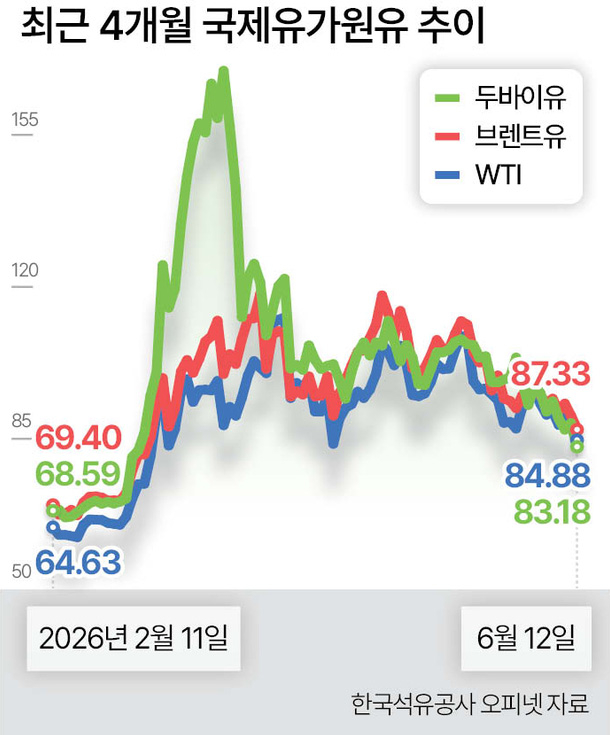
The settlement of US-Iran truce negotiations has set the stage for a full debate over ending South Korea's petroleum price cap program, which has been in effect for more than three months.
The three conditions the government set for lifting the caps — an end to the war, normalization of the Strait of Hormuz, and international crude prices falling to around $90 per barrel — have now effectively been met, and calls to withdraw the market intervention are growing louder. However, the government says it will weigh the timing carefully, noting that oil price changes feed through to domestic prices with a lag and that exchange rate instability remains a concern.
On Monday, the day the United States and Iran announced plans to sign a cease-fire memorandum of understanding, Brent crude fell to around $83.80 per barrel on international markets and West Texas Intermediate dropped to about $81 per barrel. Dubai crude, the benchmark for South Korea's oil imports, fell $4.50 per barrel from the previous week to $89.70.
According to Opinet, the oil price information system run by the Korea National Oil Corporation, the national average retail price of gasoline at filling stations during the second week of June (June 7–11) was 2,009.9 won per liter, down 0.5 won from the previous week. The average retail price of diesel fell 0.3 won to 2,004.8 won per liter.
All three conditions the government had set for ending the petroleum price cap program have in effect been met. Minister of Trade, Industry and Energy Kim Jung-kwan said at a press briefing on May 27 that the government would consider lifting the price caps "once the war ends, the Strait of Hormuz returns to normal, and international oil prices reach an appropriate level of around $90 per barrel."
The Ministry of Trade, Industry and Energy plans to assess whether to maintain the caps after observing the cease-fire signing ceremony scheduled for Friday local time. However, the seventh round of petroleum price caps, set to be announced on Wednesday, is expected to proceed as planned, given that the decision will be made before the signing takes place.
A ministry official said Wednesday's announcement of the seventh petroleum price cap "comes before the cease-fire signing ceremony, so we cannot say the Middle East war has ended and the Strait of Hormuz has been fully reopened," adding that the caps would "most likely proceed as scheduled."
The petroleum price cap program has been in effect for roughly three months since its introduction on March 13, shortly after the Middle East war broke out. The government has set the domestic retail price ceiling for petroleum products below the crude import cost on six separate occasions. The gasoline price cap has been held at 1,934 won per liter for four consecutive rounds — the third through sixth — while the diesel cap has been fixed at 1,923 won per liter.
With the program now past the three-month mark, critics argue that it is distorting market price signals and increasing the fiscal burden on the government. When drafting its supplementary budget, the government set aside 4.2 trillion won (about $2.76 billion) in contingency reserves on the assumption that the price caps would remain in place for six months. The refining industry has estimated that its cumulative losses have exceeded 4 trillion won.
Even so, many analysts expect that ending the petroleum price cap program will be difficult given inflation concerns, even if the Middle East war concludes.
A report on international oil and natural gas import price outlooks published last month by the Korea Energy Economics Institute said that even if a truce or peace agreement is reached, oil prices are likely to remain above $90 per barrel for now.
The impact of higher oil prices is already showing up in domestic price data. South Korea's producer price index for April stood at 128.43, up 2.5 percent from the previous month — the highest monthly gain since February 1998, during the Asian financial crisis. The domestic supply price index, which includes imported goods, surged 5.2 percent month on month.
It typically takes two to three weeks for a drop in crude prices to be reflected in petroleum product prices at the pump. International oil prices remain well above the roughly $60 per barrel seen before the Middle East war. Despite the price caps, domestic petroleum prices surged 24.2 percent last month, pushing overall consumer prices up by 0.92 percentage point. If accumulated price pressures are released all at once when the caps are lifted, the inflationary shock could be even greater.
The exchange rate adds another layer of uncertainty. With the won-dollar rate surging into the 1,500-won range, much of the potential benefit from lower crude prices has been offset by higher import costs. There is hope that reduced Middle East war risk could stabilize the foreign exchange market, but analysts note that the won's recent weakness has been driven largely by net selling of South Korean equities by foreign investors, which could limit any currency recovery.
If the won continues to weaken, the burden of higher energy and raw materials costs is likely to pass through to consumer prices once again. Even if oil prices fall, a high exchange rate will inevitably reduce the relief domestic consumers feel in import prices.
oskymoon@heraldcorp.com