A visit to the Pyeongtaek factory
Founded in 2024, annual production capacity of 50 MW
Global market projected at 27 trillion won (about $17.8 billion) by 2030
Land-based SOFC for AI demand to be core focus
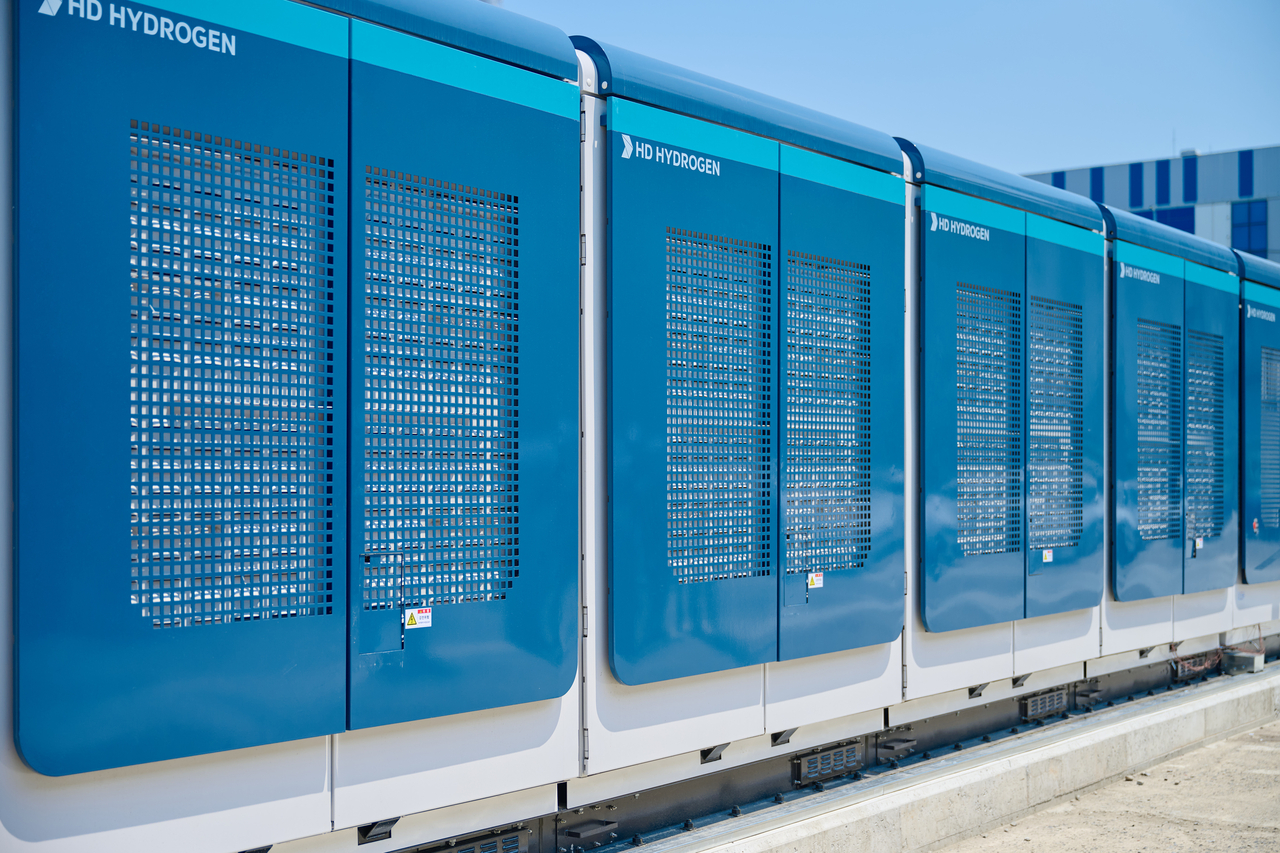
![The HD250 fuel cell unit made by HD Hydrogen (top), and an employee at HD Hydrogen's Pyeongtaek factory inspecting the quality of a cell stack, the core component of a solid oxide fuel cell. [HD Hyundai]](https://wimg.heraldcorp.com/news/cms/2026/06/15/news-p.v1.20260612.bf785d168cf54e61a60439592e656d96_P1.jpg)
"The top priority for global big tech companies right now is building data centers. They have been in early contact with HD Hydrogen to secure the power solutions needed to run those facilities."
The HD Hydrogen factory in Pyeongtaek, Gyeonggi Province, spans 10,000 square meters (about 3,000 pyeong, where 1 pyeong equals 3.3 square meters). During a visit on June 10, a solid oxide fuel cell, or SOFC, the size of a large shipping container sat outside the building. Standing 2.7 meters tall and stretching 14 meters long, the unit ran with barely a sound.
An SOFC is a type of fuel cell that generates electricity through a chemical reaction between hydrogen and oxygen. What sets it apart from other fuel cells is its use of a solid oxide electrolyte, which gives it relatively high power efficiency — around 60 percent.
The unit installed at the factory that day was the HD250, a 249-kilowatt model capable of powering 500 four-person households for an entire month. HD Hydrogen also produces the HD60, a 60-kilowatt model.
The Pyeongtaek factory was completed last year. Still barely a year old, the facility was spotless. The first thing that caught the eye upon entering was the cell stack — the fuel cell's core component, made up of thin H-shaped metal plates. HD Hydrogen currently imports cell stacks but is also preparing to produce them domestically depending on business conditions.
Workers were stacking quality-inspected cell stacks in sequence. Once that step is complete, the process moves on to assembling key modules including heat exchangers, followed by testing under actual operating conditions. Assembling the components inside a single fuel cell unit takes about 25 hours.
HD Hydrogen participated in South Korea's general hydrogen power generation tender last year and was awarded a contract for 855 kilowatts. The company is currently undergoing product and manufacturing facility inspections by the Korea Electrical Safety Corporation. After clearing those inspections, HD Hydrogen plans to begin fuel cell production as early as next month. The Pyeongtaek factory has an annual production capacity of 50 megawatts.
HD Hyundai entered the fuel cell business in 2018, when HD Korea Shipbuilding — the parent company of HD Hydrogen — established a fuel cell research institute and began developing SOFC technology. In 2024, the company acquired Convion, a Finnish firm specializing in SOFC system technology, and used that foundation to establish HD Hydrogen.
HD Hyundai moved into the fuel cell market because of its strong growth potential. The surge in electricity demand driven by AI data center construction is placing mounting pressure on existing transmission and distribution infrastructure. Fuel cells have emerged as one answer to that problem.
As a distributed power source, fuel cells are safe enough to install in urban areas and can be delivered far faster than other generation sources. According to HD Hydrogen, the current time to power for its fuel cells — the period from order to electricity delivery — is about 18 months, less than half the lead time of gas turbines at 60 months and well below gas engines at 36 months. "Lead times for gas turbines, which are in high demand because of data center construction, are getting longer," said Byeon Jun-yeong, a senior engineer at HD Hydrogen. "Customers are paying close attention to fuel cells as an alternative power source."
Market research firm MarketsandMarkets projects the global fuel cell market will more than triple from 8.5 trillion won last year to 27 trillion won (about $17.8 billion) by 2030, driven in part by the expansion of data centers.
Growing demand for eco-friendly vessels also drew HD Hyundai into the market. Global shipping companies including Maersk and HMM signed memorandums of understanding with HD Hydrogen last year and are in discussions on areas of cooperation.
HD Hydrogen is considered a latecomer in the global fuel cell market. Bloom Energy of the United States leads the field, while Doosan Fuel Cell stands out domestically. Doosan Fuel Cell completed its own SOFC factory last year as it works to move beyond its traditional reliance on phosphoric acid fuel cells. "HD Hydrogen has solid technological capabilities, having acquired Convion, which was founded in the early 2010s," said Oh Seung-hwan, a managing director at HD Hydrogen.
HD Hydrogen plans to strengthen its technological competitiveness and break into overseas markets by 2030. In line with the growth of AI, the company is targeting the supply of land-based SOFC units for data centers. It also plans to release a combined SOFC and solid oxide electrolysis cell model in the future.
yeongdai@heraldcorp.com