
R&D mobilized from filter development stage
'Ceramic ball' enables selective filtration of harmful substances
Minimal design tailored to interior trends
Bubble-separation technology and large-capacity ice room
Air purifiers and bidets integrated into production and rental
Global sales up 21% in Thailand, Hong Kong and beyond
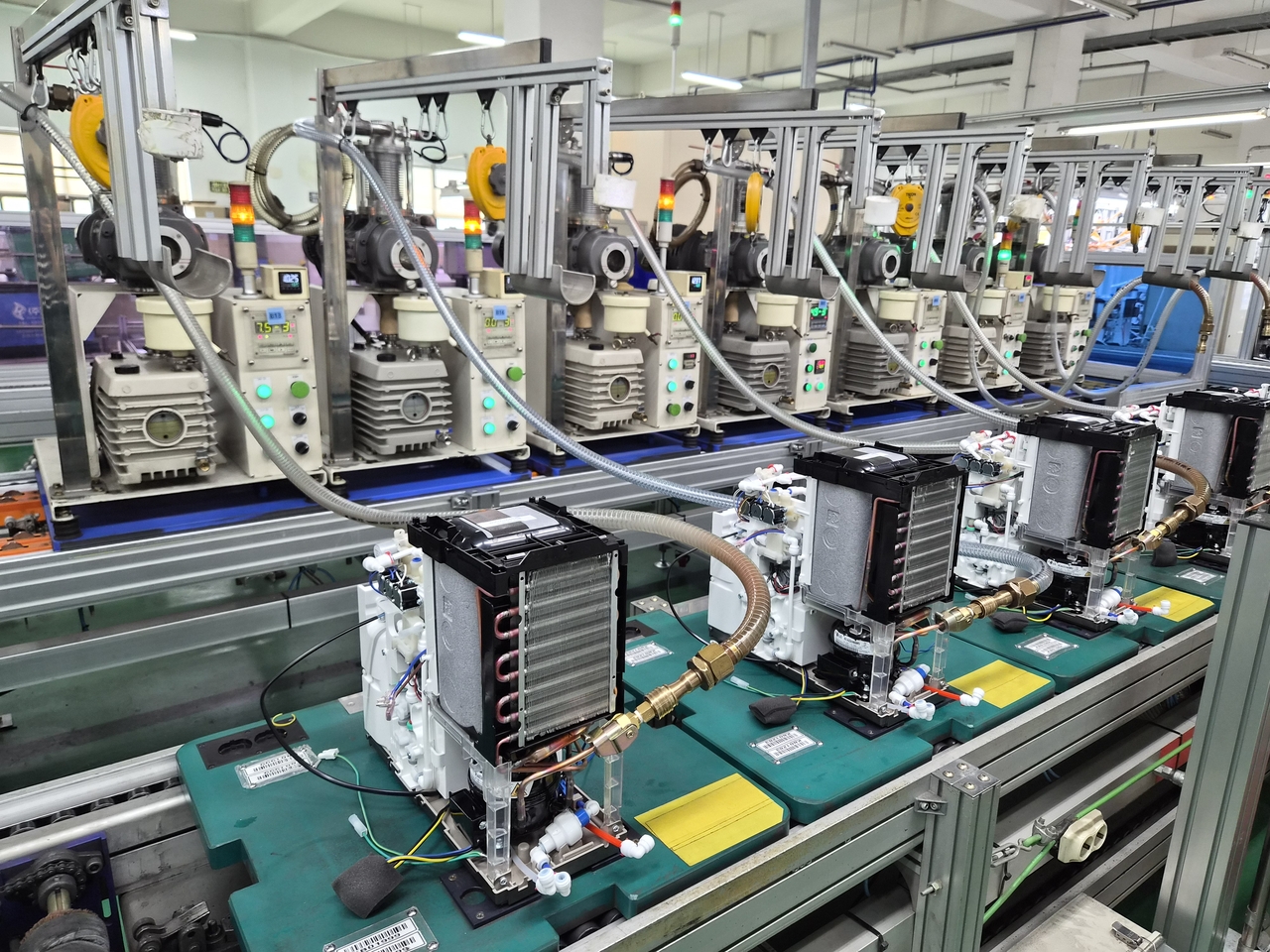
Not all purified water tastes the same. Body, crispness and finish vary from one glass to the next. In a world where clean, cold water from a purifier has become a given, one company is competing on flavor and health benefits. That company is Kyowon Wells, the home appliance brand of Kyowon Property — a subsidiary of Kyowon Group, widely known for its Bbalgan Pen and Kumon education programs. Kyowon Wells rents and sells water purifiers under the Wells brand, a name meant to evoke "a well brimming with water that is good for the body." The company's Incheon factory, which opened in 2009, has consistently produced water purifiers for nearly two decades.
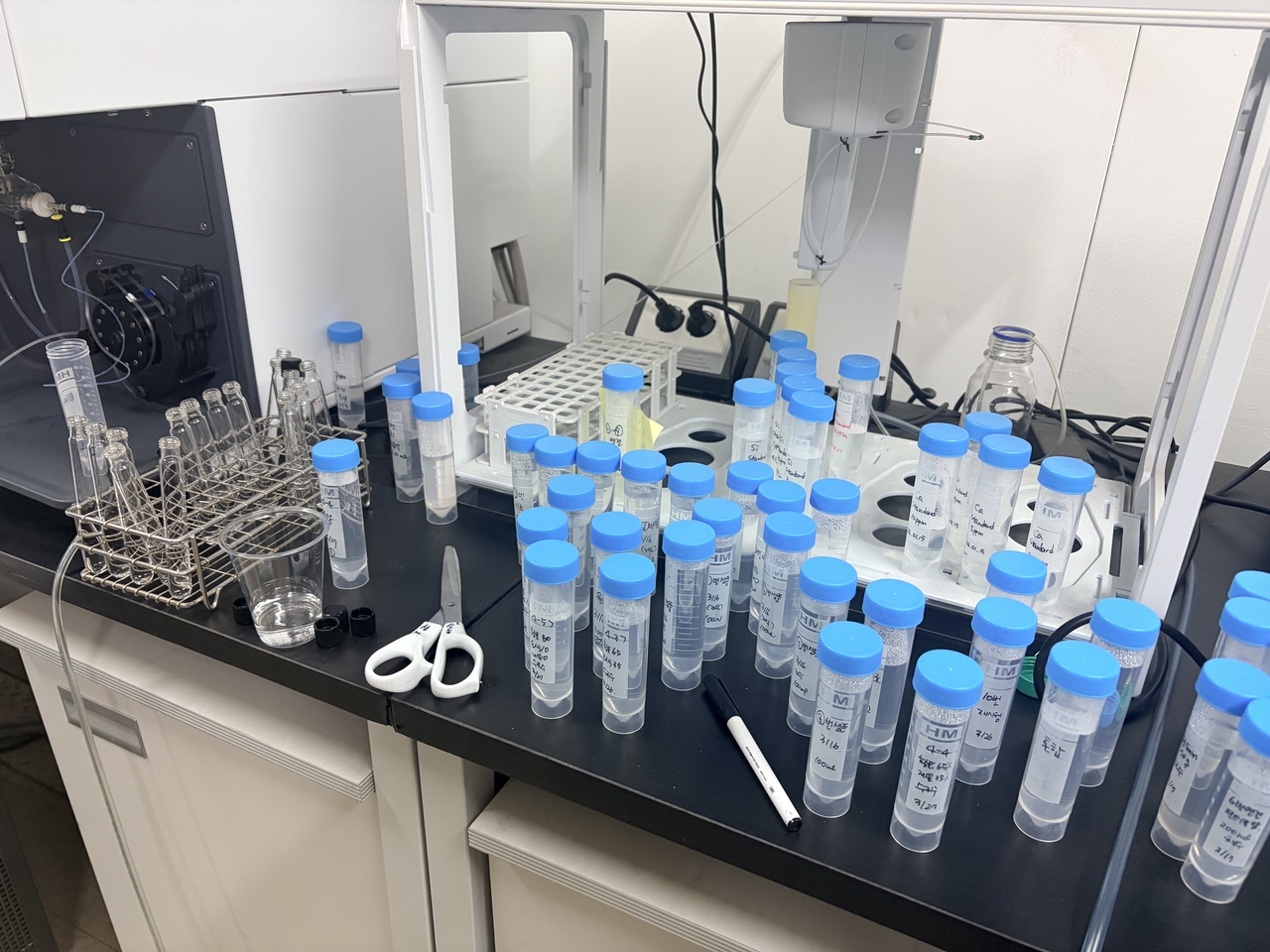
Water taste as a competitive edge: spring water from a purifier
"Every time we develop a new filter, employees who hold water sommelier certifications gather to evaluate the taste."
On the third floor of the 2,000-pyeong (6,600-square-meter) Incheon factory sits the Water Taste Laboratory, the company's research and development hub. The lab is not the most modern, but it carries the quiet authority of years of accumulated expertise. Six certified water sommeliers based at the factory convene there each time a new filter is developed, debating and refining the result. The water sommelier credential is recognized by the Korea International Sommelier Association, and domestic purifier makers take pride in having their products validated at the association's tasting competitions. "There is no objective standard for water taste," said Kim Jun-su, head of the Wells production team. "Because we have employees with water sommelier certifications, we develop our filters using their palates as the benchmark."
Just as every celebrated restaurant has its secret recipe, Kyowon Wells' formula for water taste lies in its ceramic balls. The filters inside Wells purifiers contain ceramic balls that impart specific mineral components to the water as it passes through. Tap water naturally contains beneficial minerals, but conventional purifiers strip them out entirely. Wells uses a selective filtration method that removes harmful substances while preserving those minerals — and by adding ceramic balls, the purifier delivers water enriched with calcium, magnesium and potassium.
The Incheon factory, which opened in June 2009, is the core production base for Kyowon Wells purifiers. The first floor handles filter production; the second floor handles assembly and processing. The facility runs eight production lines configured for high-mix, low-volume manufacturing. Purifiers are built on two dedicated assembly lines, where key components are first modularized and then assembled in sequence. Production begins with installation of the compressor — the heart of the purifier — which chills the water. From there, the remaining components are assembled and wiring is routed until the unit is complete. Based on the Slim One model, each unit takes about 25 minutes to build, and roughly 300 purifiers roll off the line every day.
On the day of the visit, the factory was running at full pace producing the Slim One direct-flow purifier. The Slim One is a renewed direct-flow hot-and-cold water purifier, the first redesign in four years. Aimed at one- and two-person households, it is the smallest purifier in its category. Riding the minimalist trend, it accounted for 25 percent of Kyowon Wells' purifier sales last year. The model incorporates third-generation dual-pipe cooling technology, which made it possible to build a purifier roughly the size of a hand span. Despite its compact footprint, it carries three mineral filters. "While the existing mineral filter system focused on balancing minerals through calcium, magnesium and potassium, the Slim One adds a silica filter that supports metabolism," said Lee Dae-seop, head of Wells Development Team 1. Silica is widely known for its benefits in slowing aging, boosting immunity and supporting brain health.
Smaller and smaller: a 1-kilogram ice room in the industry's most compact unit
Compact size is another hallmark of Kyowon Wells purifiers. In line with the current interior design trend of maximizing space, the company has pushed hard to shrink its products without disrupting a room's aesthetic. The key technology enabling this is the dual-pipe system — a refrigerant pipe that chills the water, wrapped by a water pipe, both housed inside the unit. As smaller purifiers became the market norm, Kyowon Wells upgraded its dual pipe, using food-safe plastic to maintain hygiene while reducing overall dimensions. Routing the dual pipe along the side of the unit also preserved the purifier's slim profile. Building on this engineering, the company recently unveiled a renewed Ice One ice-making purifier — just 23 centimeters wide and 48 centimeters deep, among the smallest in the industry, yet fitted with a large-capacity ice room that holds up to 1 kilogram of ice.
One of the most common complaints about hot-and-cold purifiers is that hot water splatters when dispensed, posing a burn risk. Kyowon Wells addresses this with bubble-separation technology. When hot water is drawn, rising temperatures reduce flow volume; if air bubbles mix into that flow, the stream becomes erratic and splashes. "Bubbles are buoyant and light, while water falls downward," Lee explained. "We applied that principle so that water exits from the bottom while bubbles are separated and vented upward."
Beyond purifiers, the factory was also busy that day producing the Wells Air Garden air purifier, the Torneino air purifier and bidets. Kyowon Wells has been expanding into broader lifestyle categories, adding air purifiers, bidets and plant cultivators to its lineup. Air purifiers in particular have gained traction in the business-to-business segment: last year the company supplied roughly 28,000 units to about 950 kindergartens, elementary schools, middle schools and high schools under regional education offices, and in January it installed 9,000 air purifiers in schools across Jeju. Kwon Seung-hwan, head of the development team overseeing air purifiers and bidets, said a new bidet model is set to launch in June.
Wells Manager sales network and expanding overseas footprint
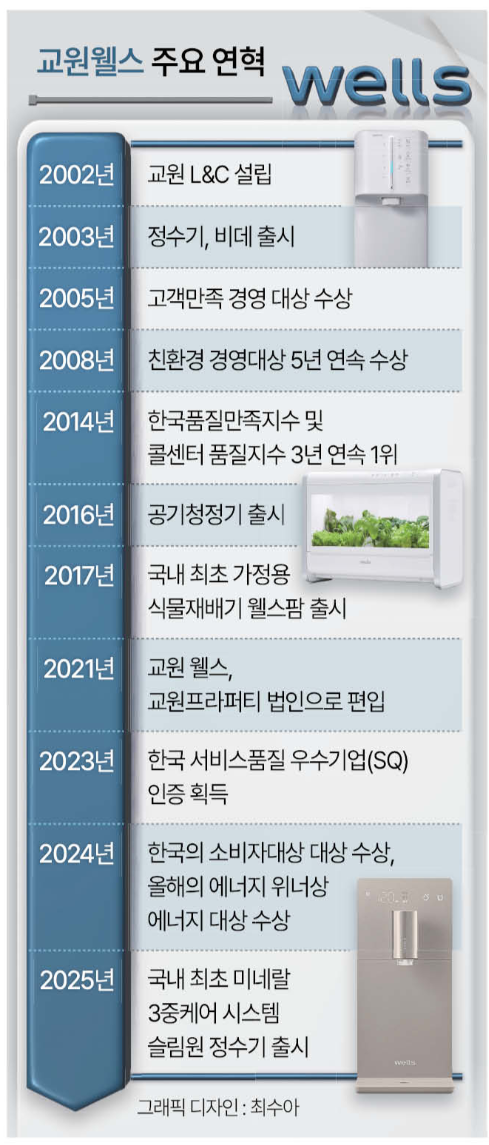
Kyowon Group, long focused on education through brands such as Bbalgan Pen and Kumon, entered the home appliance rental business in 2002 by establishing a subsidiary called Kyowon L&C (Living & Care). As customers grew more familiar with the Wells brand name, the business expanded under the Kyowon Wells identity. In 2021, Kyowon Wells was folded into Kyowon Property, which generates cash through hotels and home appliance rentals — with the majority of Kyowon Property's revenue coming from Kyowon Wells. Underpinning that revenue is a network of roughly 3,000 "Wells Managers," who handle in-home service and sales visits. With no physical retail stores, Kyowon Wells relies on Wells Managers for the bulk of its sales.
Since 2019, the company has entered eight countries including Singapore, Malaysia, Thailand and Hong Kong, steadily growing its overseas business. By targeting high-income consumers in those markets, it posted 21 percent year-on-year growth in overseas sales. At the Incheon factory, dark-colored Slim One units — the shade preferred by customers in Singapore — were being assembled at a brisk pace.
Kyowon Group's push into home appliances is closely tied to the decline in the school-age population. According to the Ministry of Education, the number of first-grade elementary school students fell from 713,500 in 1999 to 699,032 in 2000, dropping below the 700,000 mark. The figure has since fallen to 401,752 in 2023, 353,713 in 2024 and 324,040 last year — roughly half the 1999 total in just 30 years.
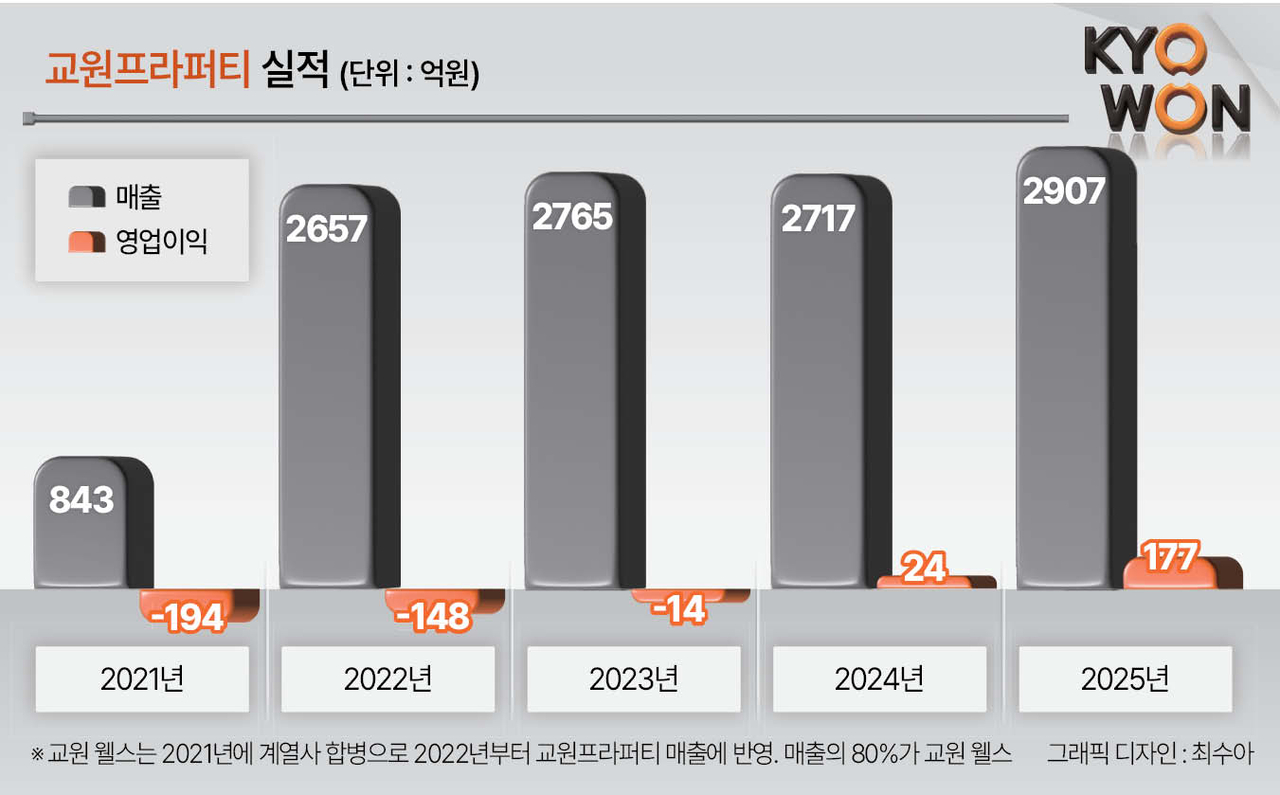
The financial results tell the same story. The combined operating loss of Kyowon Group's education units — Kyowon, Kyowon Kumon and Kyowon Wiz — reached 23.1 billion won (about $15.2 million) last year. Kyowon Property, by contrast, is growing: its sales rose about 7 percent year on year to 290.7 billion won, while operating profit surged 637 percent to 17.7 billion won.
By Boo Ae-ri from Incheon
boo@heraldcorp.com



