Full leadership walkout demanded ahead of Wednesday or Thursday assembly
Yang Hyang-ja, Woo Jae-jun call for successors to take over
Jang Dong-hyeok faction effectively refuses to step down
Realmeter: PPP at 44.3%, Democratic Party at 38%
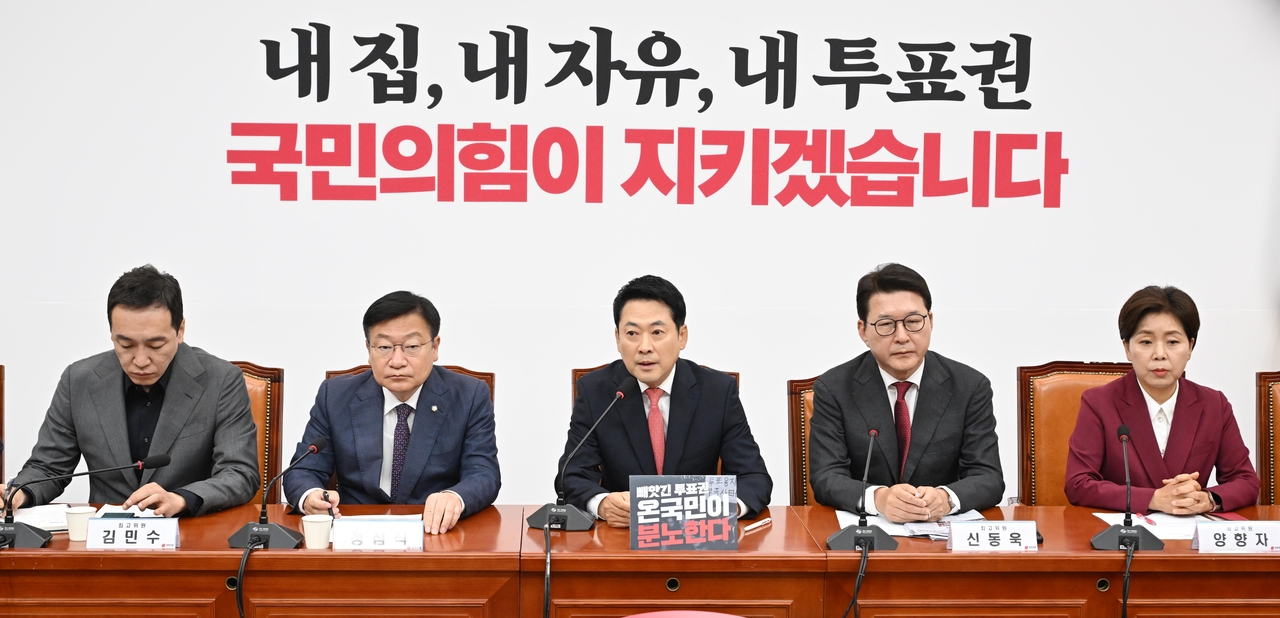
Internal turmoil within the People Power Party is intensifying, with fresh calls for a full leadership resignation over accountability for the June 3 local election results. This week is shaping up as a turning point for the fate of party leader Jang Dong-hyeok, the issue at the center of the dispute.
PPP Supreme Council member Yang Hyang-ja called for the entire leadership to resign at Monday's supreme council meeting. "Politics is ultimately about accountability, and a leader is someone who takes responsibility," she said, formally proposing a collective walkout. The demand follows a similar call from fellow council member Woo Jae-jun, marking the second time in quick succession that a resignation push has emerged from within the leadership itself.
Yang pressed the case further, saying the current PPP leadership had come to be called a "zombie leadership." "We must step aside as quickly as possible so that a successor leadership can set things right and guide the party," she said.
Under the PPP's party charter, if four or more of the five elected supreme council members resign, the existing council is dissolved and the party shifts to an emergency committee structure.
However, three of the five elected council members — Kim Min-su, Shin Dong-uk and Kim Jae-won — are aligned with the ruling faction, making an immediate dissolution unlikely, analysts say.
Jang made clear he has no intention of stepping down, saying in additional remarks at the same meeting that "now is the time to focus on the voices of citizens gathered at Olympic Park, calling on us to act." Supreme Council member Jo Gwang-han, an appointee of Jang's, also came to his defense, saying that if the party leader fails to win the hearts of party members after working hard through his term, "the members can pass judgment then."
Floor leader Jeong Jeom-sik, seen as holding the key to the standoff, said his office plans to convene a general assembly of lawmakers on Wednesday or Thursday morning, before the National Assembly plenary session. If the assembly convenes, calls for Jang's resignation are expected to pour in, led by younger-generation lawmakers and those aligned with former President Han Duck-soo.
Amid the internal strife, a new poll showing the Democratic Party of Korea hitting its lowest approval rating since the Lee Jae Myung government took office — and falling behind the PPP — is drawing attention for its potential effect on Jang's position.
A Realmeter survey conducted June 11-12 for the Energy Economy newspaper found the Democratic Party's support at 38 percent, down 3.8 percentage points from the previous week's poll, while the PPP rose 3.2 percentage points to 44.3 percent. The survey covered 1,002 people aged 18 and older nationwide.
The poll used a fully automated wireless response method. The margin of error was plus or minus 3.1 percentage points at the 95 percent confidence level, with a response rate of 3.8 percent. Further details are available on the National Election Survey Deliberation Commission website.
Realmeter attributed the PPP's gain to its aggressive response to the election fraud controversy, including pushing for a parliamentary investigation into the National Election Commission and introducing a special prosecutor act. The firm said the party appeared to have drawn support from progressive and centrist voters as well as young people in their 20s.
bigroot@heraldcorp.com
thanks@heraldcorp.com