MOU signed with Hushi Partners to advance citizen-participation 'Energy Moa' project; solar reduction credits to be converted into tradable carbon allowances, expanding public engagement in carbon reduction
The launch of the fourth phase of South Korea's greenhouse gas emissions trading regime has tightened corporate carbon-reduction obligations and pushed up carbon credit prices, making the task of securing verified emission reductions more critical than ever.
The government has been working to promote external reduction projects that allow citizens to participate directly, but the carbon-cutting efforts of ordinary people have not been fully recognized within the formal system due to complex certification procedures.
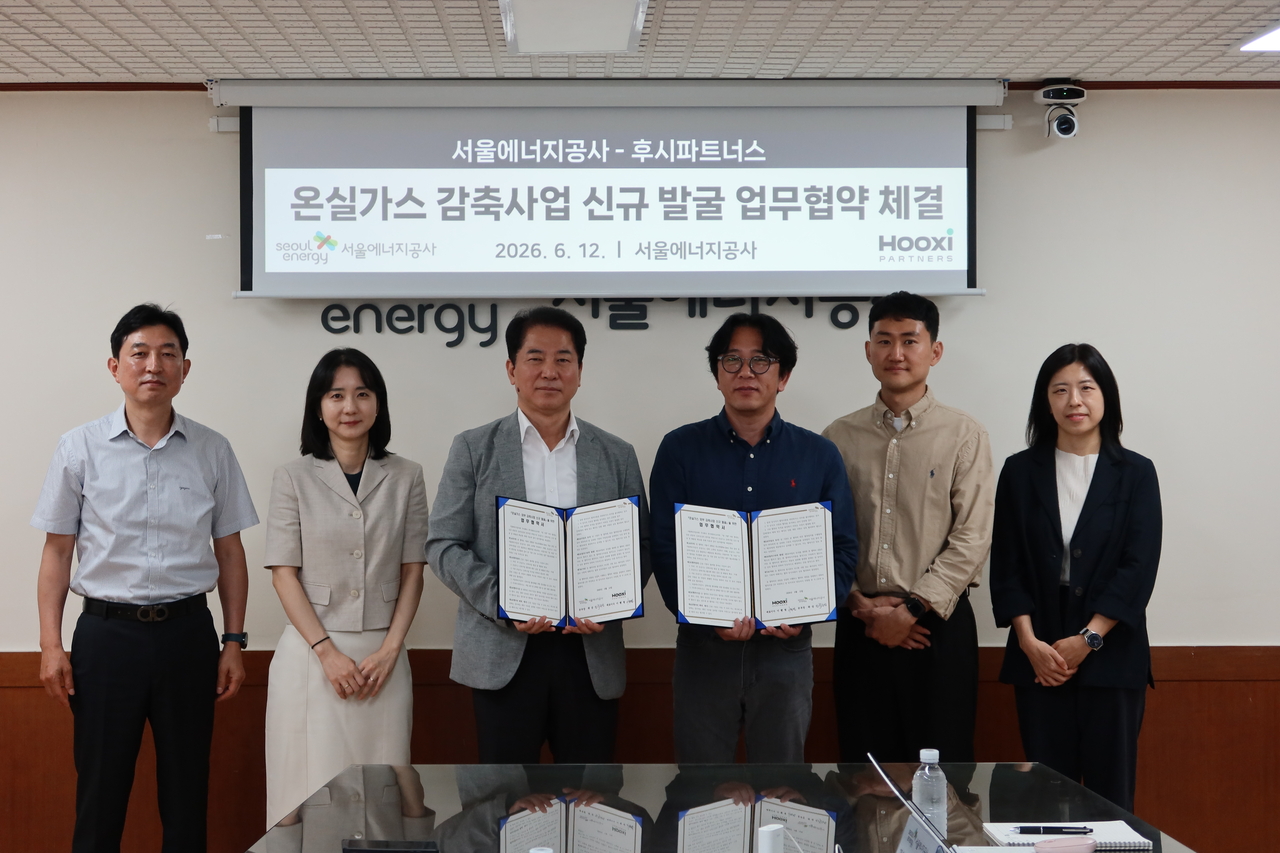
Seoul Energy Corp. (president Hwang Bo-yeon) has signed a memorandum of understanding with climate fintech firm Hushi Partners Co. (co-CEOs Lee Haeng-yeol and Jo Seong-hun), a specialist in carbon credits, to address these barriers and link citizens' greenhouse gas reduction activities to tradable carbon allowances. The MOU is titled "Business Agreement for the Discovery of New Greenhouse Gas Reduction Projects."
Under the agreement, the two organizations will cooperate on identifying and securing credits from domestic and international greenhouse gas reduction projects, reviewing measures to promote such projects and handling credit acquisition and trading, and other matters necessary to advance greenhouse gas reduction initiatives.
The centerpiece of the agreement is "Energy Moa," a citizen-participation external reduction project that converts greenhouse gas emission reductions generated by solar and other energy installations owned by citizens and businesses into tradable carbon credits. The name combines the Korean words for "gather" and "sprout," evoking the idea of collecting the seeds of carbon reduction that citizens have planted and growing them together into monetizable credits.
Under the arrangement, Seoul Energy Corp. will handle promotion and participant recruitment, while Hushi Partners will support all operational work — including project approval and reduction certification — through its AI carbon platform, Carbon AI. Participating citizens and businesses can receive reduction earnings simply by entering their facility data, with no complex administrative procedures required.
The Energy Moa project will initially target self-consumption solar installations. The model converts emission reductions generated by rooftop solar panels on underutilized buildings into certified carbon credits, creating an additional revenue stream for participants. The program plans to expand in stages to cover zero-energy buildings in apartment complexes and refrigerant recovery, among other areas.
"This agreement is the first step toward building a circular carbon-reduction ecosystem — one where Seoul's citizens and businesses can convert the carbon they have personally reduced into a carbon credit asset and receive the proceeds back," said Kwak Seung-shin, head of the corporation's district energy division. "We will leverage the energy infrastructure and citizen touchpoints the corporation holds to lead a public-private cooperation model."
seouldream01@heraldcorp.com