Health minister holds policy briefing marking one year since government took office; national health insurance coverage for hair loss treatment to be first topic at 'Everyone's Forum'; tiered basic pension reform and emergency transport overhaul also on agenda
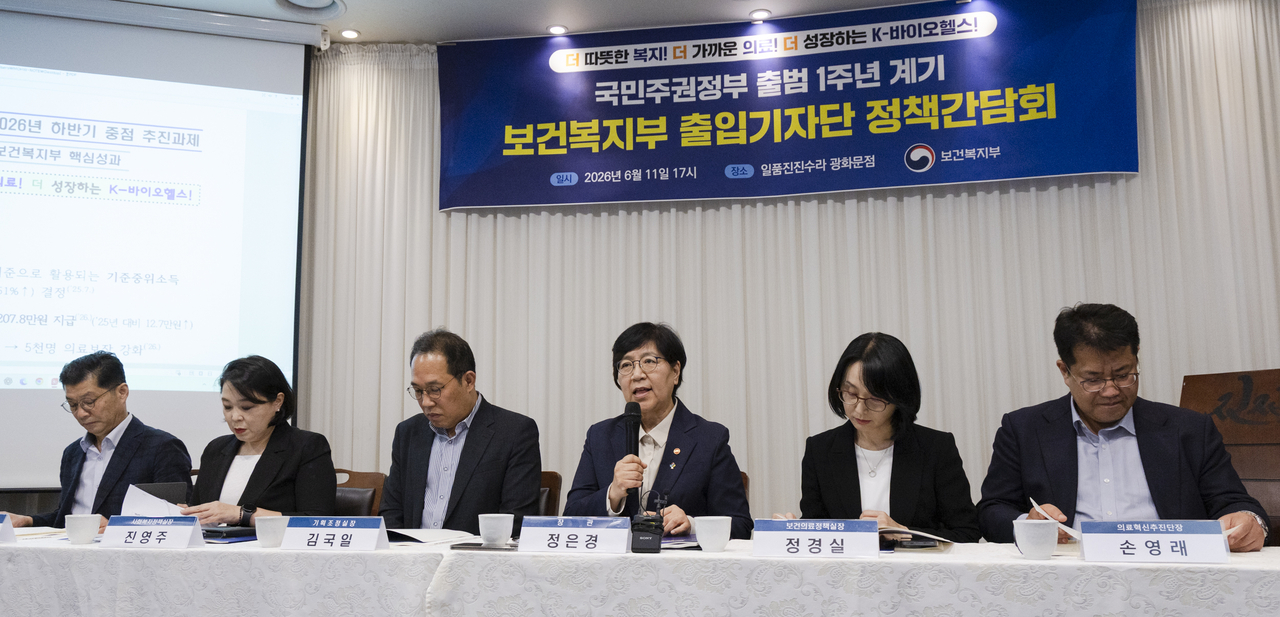
Minister of Health and Welfare Jeong Eun-kyeong said Thursday that the government plans to consider extending national health insurance coverage to hair loss treatment after gathering public input at the Ministry of Interior and Safety's "Everyone's Forum" scheduled for July.
Jeong made the remarks at a policy briefing held in Jongno-gu, Seoul, on June 11, marking one year since the current government took office, where she outlined the ministry's key priorities for the second half of the year.
The Ministry of Health and Welfare has completed a preliminary review of the proposal and plans to pursue coverage after a public consultation process in the second half of the year.
"There are diverse views — some say coverage is necessary because hair loss significantly affects young people's health and daily lives, while others argue the focus should remain on serious conditions," Jeong said. "We determined that public input was needed, so we commissioned a survey of 1,000 people through the National Health Insurance Service, and the results came back positive."
The government also plans to release a proposal in the second half of the year for a tiered basic pension reform — one that provides more support to lower-income recipients and less to higher-income ones — aimed at reducing the elderly poverty rate, with phased implementation under consideration.
"Various discussions are underway, but we want to set a direction within the second half of the year," Jeong said. "We also need to amend the relevant legislation and go through National Assembly review, including the pension special committee, so we are trying to move as quickly as possible."
She added that fiscal projections had been run under multiple scenarios and that there was broad agreement in principle on strengthening support for low-income recipients. "An across-the-board overhaul all at once would be difficult," she said. "The reform plan will be drawn up in the second half, but the actual changes will likely proceed in stages."
Jeong also noted that expert reviews had flagged concerns about sharply cutting the share of recipients eligible for the pension. "The government will develop a proposal on what targets, content and pace to use in adjusting eligibility criteria and benefit amounts, and there will be a public forum to explain it and build social consensus," she said.
The ministry will also push to overhaul the emergency patient transport system and strengthen critical care capacity at hospitals, particularly outside the Greater Seoul area, where emergency rooms repeatedly turning away patients have been a persistent problem.
Under a pilot transport innovation project, local governments will work with regional medical institutions and fire departments to revise transport protocols suited to local conditions. When transport is delayed, regional coordination centers or designated priority-admission hospitals will step in. The pilot will expand nationwide in September after regional trials.
"The issue with emergency medicine is not facilities, equipment or staffing — it is the capacity to deliver definitive treatment in an emergency, and that is why we are currently revising the designation criteria," Jeong said. "In the second half of the year, we will also make liability insurance mandatory and ease criminal liability for high-risk essential medical services in cases without gross negligence. That should help reduce the burden on medical staff."
thlee@heraldcorp.com