Applications for the 2026 energy voucher program open Monday at local community welfare centers and the Bokjiro website
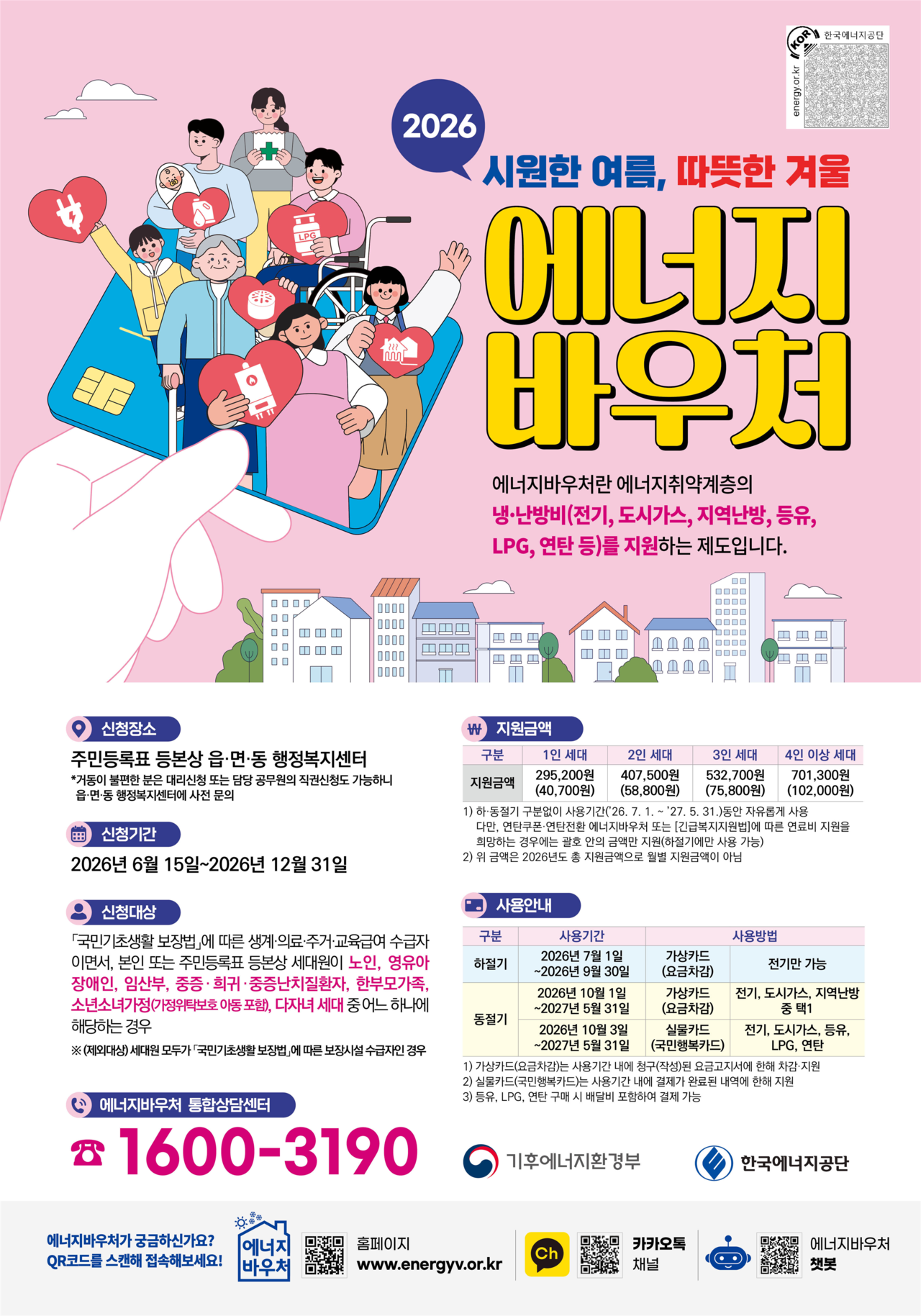
South Korea's 2026 energy voucher program, designed to help low-income households cover heating and cooling costs without financial strain, will launch July 1.
The Ministry of Climate, Environment and Energy announced Sunday that applications for new enrollments will be accepted from Monday through Dec. 31 at community welfare centers in towns, townships and neighborhoods nationwide, as well as through the Bokjiro website.
To qualify, a household must receive benefits under the National Basic Living Security Act — covering livelihood, medical, residential or education assistance — and include at least one member in one of the following categories: seniors aged 65 or older, infants and toddlers aged 7 or younger who have not yet started school, people with disabilities, pregnant women, patients with severe, rare or intractable diseases, single-parent families, youth-headed households (including foster children), or families with two or more children under 19 where at least one parent is present.
Households that received energy vouchers last year and whose eligibility has not changed will be automatically re-enrolled. Those who received vouchers in 2025 can verify their current eligibility at their local community welfare center or by contacting the Energy Voucher integrated counseling center.
Eligible households can have electricity, city gas and district heating charges automatically deducted from their bills, or use a voucher card — the National Happiness Card — to purchase other energy sources such as kerosene and liquefied petroleum gas directly.
New this year is a "pre-exception payment" scheme, under which recipients whose energy costs are bundled into rent or other fees — making direct voucher payment impractical — will receive cash support for energy expenses during the program period.
Also new is a "coal briquette conversion energy voucher," administered through the Korea Energy Foundation. It will replace existing coal briquette boilers with non-briquette boilers for marginalized households that currently rely on briquette coupons, and provide funds to cover the cost of switching heating fuels.
An outreach welfare service that sends workers directly to households struggling to use their vouchers will be expanded to cover up to 122,000 households. The Korea Energy Agency, the program's dedicated administrator, will also work with local governments to monitor voucher usage among vulnerable groups and proactively identify households facing energy hardship.
Households seeking details on eligibility, application procedures or voucher use can contact their local community welfare center or the Energy Voucher integrated counseling center. Additional information is available on the Energy Voucher website.
Those interested in replacing a coal briquette boiler or applying for the coal briquette conversion energy voucher can contact the Korea Energy Foundation's integrated counseling center for coal briquette conversion inquiries.
"We will actively support timely applications and smooth use of energy vouchers so that vulnerable groups can effectively cope with climate change — including extreme heat — amid the energy crisis stemming from the war in the Middle East and other factors," said Lee Gyeong-su, climate and energy policy director at the Ministry of Climate, Environment and Energy.
thlee@heraldcorp.com