Gallup Korea survey puts Cho at 7%, third overall; Kim Min-seok at 5%, Kang Hoon-sik at 2%
Song Young-gil, Kim Boo-kyum and Jung Chung-rae each at 1%
Cho draws 21% in Gwangju and Jeolla regions, boosted by sympathy after defeat and resignation
By Joo So-hyun, The Herald Business
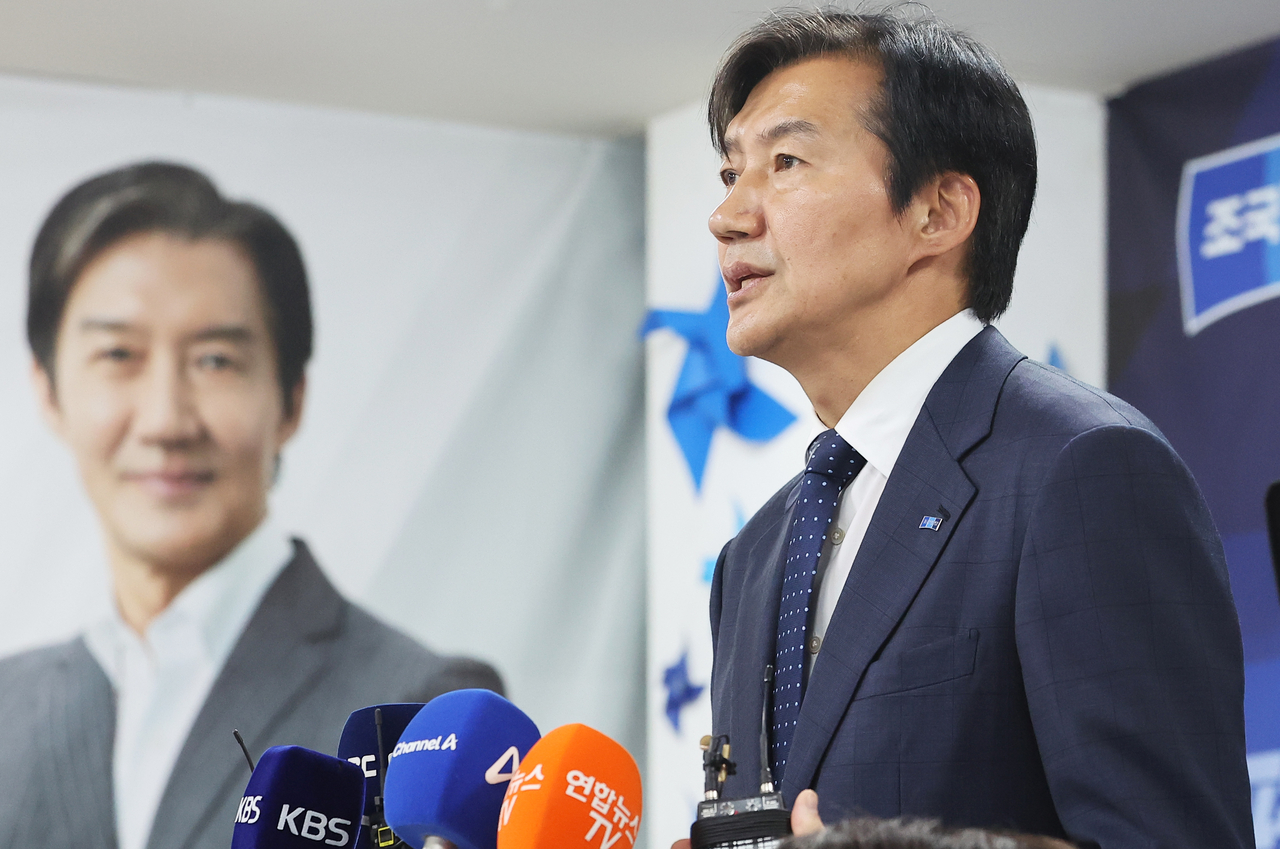
Cho Kuk, the former Rebuilding Korea Party leader who lost his National Assembly seat in the June 3 by-election, has emerged as the top preferred future political leader among pro-government bloc contenders, outpolling Democratic Party Prime Minister Kim Min-seok and party leader Jung Chung-rae.
In a Gallup Korea survey conducted June 9 through June 11 among 1,002 adults aged 18 and older nationwide, 7 percent of respondents named Cho as the political leader they would most like to see guide the country. That placed him third overall, behind Seoul Mayor Oh Se-hoon — who secured a fifth term in the election — at 9 percent and independent lawmaker Han Dong-hoon, who won the Busan Buk-gu-gap by-election, at 8 percent.
Prime Minister Kim Min-seok followed at 5 percent, People Power Party leader Jang Dong-hyeok at 3 percent and presidential chief of staff Kang Hoon-sik at 2 percent. Democratic Party lawmaker Song Young-gil, Reform Party leader Lee Jun-seok, former Prime Minister Hwang Kyo-ahn, PPP lawmaker Lee Jin-suk, former Prime Minister Kim Boo-kyum, Democratic Party leader Jung Chung-rae and former Daegu Mayor Hong Joon-pyo each received 1 percent. Six percent of respondents named one of roughly 30 other figures, while 52 percent did not name anyone.
Cho's lead over current and former Democratic Party prime ministers and the party leader is largely attributed to strong support from the Honam region. Among respondents in Gwangju and the Jeolla provinces, 21 percent named Cho as their preferred future leader, followed by Prime Minister Kim at 12 percent, lawmaker Song at 4 percent, Chief of Staff Kang at 2 percent and party leader Jung at 1 percent. Eight percent named someone else, while 56 percent did not name a specific person.
The figure actually rose compared with before the election. In a Gallup Korea survey of 1,001 eligible voters nationwide conducted March 3 through March 5, 17 percent of respondents in Gwangju and the Jeolla provinces named Cho as their preferred future leader. (Telephone interview method; 95 percent confidence level; margin of error ±3.1 percentage points; response rate 11.9 percent) Lawmaker Song followed at 10 percent, Prime Minister Kim at 9 percent, party leader Jung at 3 percent and Chief of Staff Kang at 1 percent.
Political observers say sympathy for Cho has grown in Honam, a traditional stronghold of the pro-government bloc. In the five-way race for the Pyeongtaek-eul seat in Gyeonggi Province, the pro-government camp failed to unite behind a single candidate, leaving Cho to finish third while PPP lawmaker Yoo Eui-dong won the seat. Facing intense calls to take responsibility, Cho stepped down as party leader.
Cho also topped the preferences of Democratic Party supporters and independents. Among respondents who support the Democratic Party, 12 percent chose Cho — the same share as Prime Minister Kim. Chief of Staff Kang and lawmaker Song each drew 3 percent, while former Prime Minister Kim Boo-kyum and party leader Jung each received 2 percent. Among self-described moderates, 7 percent preferred Cho and 5 percent preferred Prime Minister Kim. Among progressives, 13 percent named Prime Minister Kim and 10 percent named Cho.
However, Cho was outpaced in the overall survey by conservative-bloc figures who survived the election. Gallup Korea noted that Oh Se-hoon and Han Dong-hoon "re-emerged among PPP supporters with preference ratings of around 20 percent each," while "Cho Kuk and Kim Min-seok draw attention among Democratic Party supporters but have not pulled significantly ahead of the others." Lee Jun-han, a professor of political science and diplomacy at Incheon National University, said "there is still a great deal of time before the next election, and the variables are significant — more than half of respondents declined to name any specific future leader."
With Cho, the face of his party, failing to win a seat in the Assembly, momentum for merger talks with the Democratic Party has faded. Throughout the campaign, Cho had argued that his own victory was a prerequisite for building "a strong bridge connecting solidarity and integration across the pro-democratic camp," as he put it on June 2. Democratic Party Secretary-General Cho Seung-rae said June 9 that "fundamental reflection is needed on whether integration should take the form of a full party merger or whether institutionalizing cooperation at the level of an alliance would be more appropriate."
With the Rebuilding Korea Party struggling to find momentum to rebuild its support base, it is expected to focus on internal consolidation for the time being. Cho completed a post-defeat meet-and-greet tour in the Pyeongtaek area of Gyeonggi Province between June 8 and June 11. The party will hold a regional lawmakers' workshop in Gwangju on June 17.
The survey was conducted via telephone interviews using randomly selected virtual mobile numbers. The margin of error was ±3.1 percentage points at a 95 percent confidence level, with a response rate of 11.3 percent. Further details are available on the website of the National Election Survey Deliberation Commission.
addressh@heraldcorp.com