From office workers to people in their 60s — ordinary fraud hiding in everyday life
Insurance fraud detections hit 1.1571 trillion won — fewer people caught, but bigger amounts
'Free treatment' bait can make you an unwitting accomplice
Self-correction means a mistake; ignoring it means criminal charges
South Koreans pay an average of about 4.9 million won (about $3,210) per person in annual insurance premiums (2022, Korea Insurance Development Institute). "Iboso" is a column dedicated to helping you get the most out of every won you pay.

A man in his 30s — identified only by his surname Lee — received a two-week diagnosis after a minor traffic accident last year. When a friend told him, "You have insurance anyway, so you might as well stay in longer," he checked in without much thought and remained hospitalized for more than a month. After discharge, he filed claims under both his indemnity insurance and his fixed-benefit policy, collecting nearly 7 million won in total. The trouble surfaced six months later. His insurer had reviewed his outings and credit card activity during the hospitalization and notified him that the stay had exceeded what his treatment required — demanding repayment and referring the case for investigation. Lee, who had assumed he would never be looked into, only then realized he had taken part in insurance fraud.
A woman in her 40s identified as Kim had a similar experience. After seeing a post in an online community suggesting that inflating the number of sessions when claiming non-covered manual therapy could yield a larger payout, she tried it without much hesitation. It slipped through once or twice, but as the claims accumulated, her insurer's review system flagged an anomaly. All her past claims were reopened for re-examination, and she ended up repaying a substantial sum. Her defense — "everyone was doing it" — offered no protection.
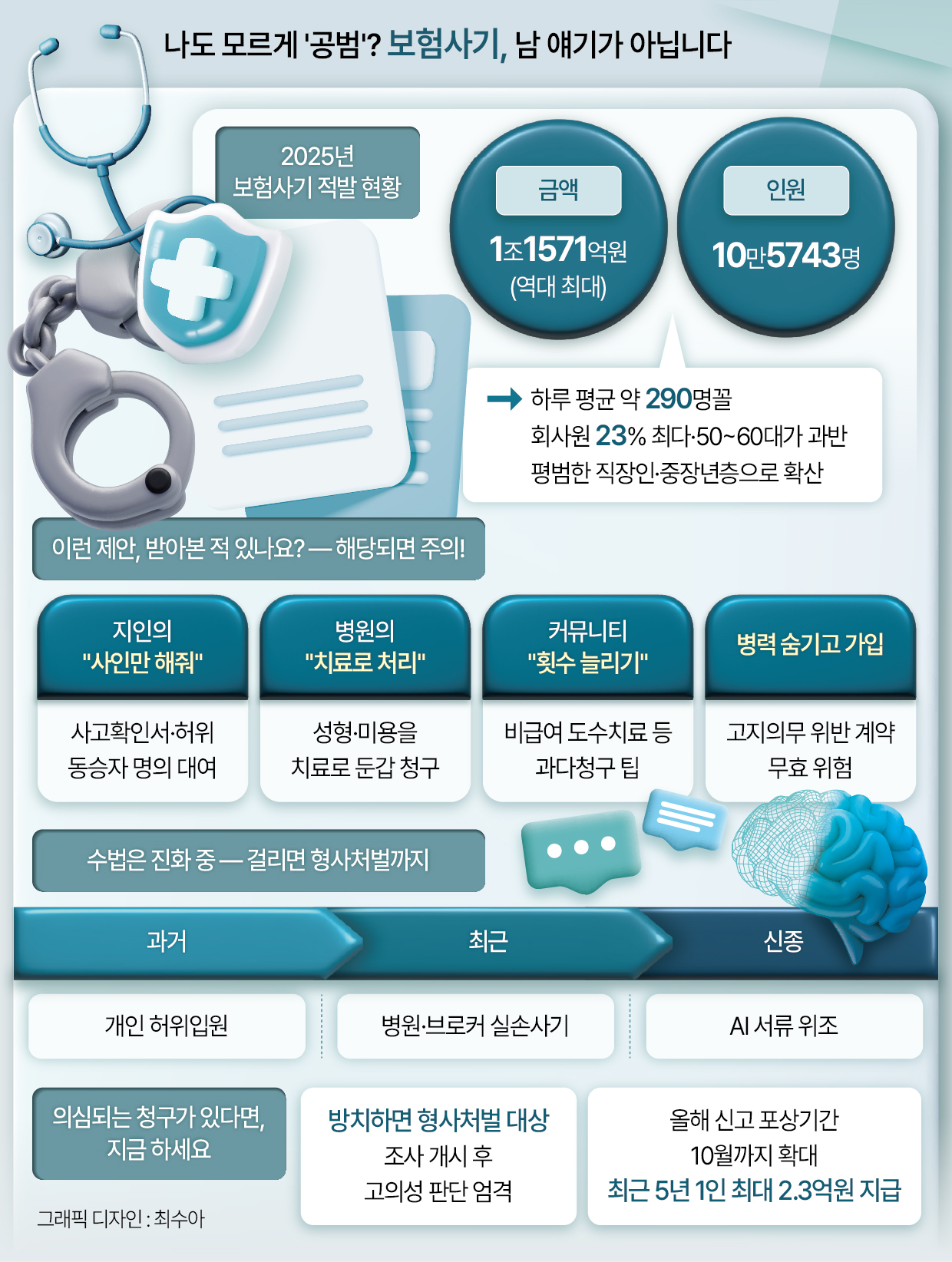
Insurance fraud is no longer the exclusive domain of professional con artists. According to the Financial Supervisory Service, fraud detections in 2025 totaled 1.1571 trillion won and involved 105,743 people. The number of individuals caught fell 3 percent from the previous year, yet the total amount rose — meaning each case is getting more lucrative. The most common type was "accident-content manipulation," which includes inflating claims through falsified medical documents, accounting for 54.9 percent of all detected cases.
Equally striking is who is getting caught. By occupation, office workers made up the largest share at 23 percent. By age, people in their 50s (22.1 percent), 60s (19.9 percent) and 40s (19.1 percent) together accounted for more than half of all cases. Organized fraud rings are not the main story — ordinary workers and middle-aged people are increasingly showing up in the statistics. The risk has grown further as hospitals and brokers have begun running schemes that disguise cosmetic and aesthetic procedures as medical treatment, drawing in ordinary policyholders as unwitting "patients."
The consequences extend well beyond the individuals involved. Leaked insurance payouts translate into premium increases that every honest policyholder must absorb. Detected fraud alone already exceeds 1 trillion won, and estimates suggest the true annual figure — including undetected cases — could reach 9 trillion won. Insurance fraud is not a minor infraction; it is a serious crime. To understand exactly where the line is drawn, and how to prevent and respond to it, we consulted an expert.
What are the defining traits of insurance fraud today?
Surprisingly, a large share of insurance fraud is deeply embedded in everyday life. The fact that office workers make up the largest occupational group among those caught illustrates this clearly. Common patterns include stretching out treatment after a traffic accident beyond what is medically necessary, reclassifying a pre-existing condition as an accident-related injury, or claiming hospitalization benefits without actually being admitted. In many cases, it all starts with the casual thought: "What's the harm in getting a little more?"
What types of fraud are detected most often?
There are three broad categories. The first and largest is false or inflated claims — manipulating accident details to collect more. This includes padding medical certificates or admission and discharge records, or billing for treatment never received. Last year, 54.9 percent of all detected fraud by value fell into this category. Typical examples include prolonged hospitalization after a minor traffic accident and claims for physical therapy sessions that never took place. A newer variation, known as "fee splitting," has also emerged: policyholders structure their treatment across multiple days to stay within the daily outpatient benefit cap, creating the appearance of separate visits to maximize their indemnity insurance payouts.
The second category is deliberate accidents — staging incidents specifically to collect insurance money. The third is broker- and clinic-linked fraud, in which hospitals, repair shops and brokers work together to recruit patients or claimants and file false claims on their behalf. In these schemes, ordinary people are sometimes pulled in to play the role of "patient" without fully understanding what they have become part of.
How have the methods been changing recently?
In the past, the dominant forms were false hospitalization and fabricated disability claims carried out by individuals or family groups. More recently, fraud driven by clinics and brokers — including insurance agents — seeking profit has been on the rise, particularly targeting indemnity insurance. A common approach involves reclassifying cosmetic surgeries as medically necessary procedures, or billing obesity treatments and aesthetic skin procedures as manual therapy or extracorporeal shock wave treatment.
The methods are growing more organized and sophisticated. A typical scheme works as follows: a broker first checks a customer's indemnity insurance coverage and benefit details, then coordinates with a clinic to fabricate medical records for treatment that was never provided, files the claims, and splits the proceeds. Some networks have gone further — sharing lists of fake patients over Telegram, manipulating surgical records using diagnoses such as gynecomastia or hyperhidrosis, and circulating manuals that explain how to file complaints with the Financial Supervisory Service when an insurer refuses to pay. In one case, a clinic that falsified medical records to bill cosmetic procedures as manual therapy was caught along with roughly 1,000 patients after defrauding insurers of about 4 billion won.
The danger for ordinary policyholders is that it is easy to think, "I just got a free procedure." Typical lures include offers such as "We'll bill it to your indemnity insurance — you get it for free" or "We'd like to feature you as a promotional model." As insurance products have multiplied, fraud has also spread into dental insurance, caregiver insurance and other lines. If you receive an offer of "free treatment" that makes no obvious commercial sense, that offer itself may be a warning sign of insurance fraud.
Can simply signing a document at a friend's request get you in trouble?
Absolutely. Insurance fraud laws cover not only the primary perpetrator but also anyone who participates in or facilitates the act. If a friend asks you to "just sign" an accident confirmation form, or to lend your name to a false medical certificate, doing so with knowledge of the contents can be treated as conspiracy.
Cases have been detected in which someone was falsely listed as a passenger in a friend's traffic accident to claim treatment costs, or was registered as an employee of a business where they never worked in order to collect workers' compensation. Under the Special Act on the Prevention of Insurance Fraud, penalties can reach up to 10 years in prison or a fine of up to 50 million won. No matter how close the relationship, firmly declining such requests is the best way to protect yourself.
What happens if you don't disclose a pre-existing condition when applying for insurance?
The key question is whether you knew. The duty of disclosure requires applicants to accurately report their health status and medical history before taking out a policy, with the subscription form's questionnaire serving as the standard. Typical questions cover whether you have received a medical examination or treatment within the past three months, whether you have been hospitalized or had surgery within the past two years, and whether you have been diagnosed with a serious illness within the past five years. Forgetting about treatment received long ago is treated very differently from deliberately concealing a recent cancer diagnosis.
Particularly clear-cut fraud involves obtaining a diagnosis or treatment in advance, hiding it when applying for coverage, and then filing a claim as soon as the exclusion period expires. When in doubt about any item on the application, do not simply mark "no" — contact your insurance agent or the customer service center first. Checking your own treatment history on the National Health Insurance Service website before applying can significantly reduce the risk of an inadvertent omission.
Should cancer insurance claims be handled with extra care?
In life insurance, lump-sum diagnosis benefits for cancer and serious illnesses involve large payouts, making them a frequent target for fraud. The most common form is a violation of the duty of disclosure — applying for coverage while already diagnosed or symptomatic, concealing that fact, and then filing a claim. This can result in the policy being voided entirely and may lead to criminal prosecution for fraud.
Cases have also been detected in which policyholders obtained false medical certificates listing a more serious diagnosis than the actual one, or colluded with certain medical institutions willing to "adjust" a diagnosis to meet the payout threshold. Because insurers review medical records and treatment histories when processing claims, accurate disclosure and claims grounded in fact are essential.
I'm worried about a claim I've already filed — what should I do?
Proving intent is the central issue. For insurance fraud to be established under the law, there must be a deliberate intention to deceive. If the error was a genuine mistake, the matter may be resolved through repayment of the benefit alone. That said, the same type of claim becomes far more likely to be judged intentional if it is repeated, involves a large amount, or is supported by circumstantial evidence such as records of outings or credit card use during a hospital stay.
That is why the most important step is to contact your insurer as soon as you become aware of the problem. Voluntarily correcting the claim before an investigation begins is much more likely to be treated as a simple error. Once an investigation is underway, the standard for judging intent becomes significantly stricter. Correction requests can be submitted through each insurer's customer service center or a nearby branch, and if an overpayment is confirmed, a repayment process will follow.
If you suspect you were drawn into a fraudulent claim through the encouragement of a broker or clinic without fully realizing it, start by preserving any relevant materials. Messages exchanged with the clinic, recordings that document how you were solicited, and the claim documents themselves can all serve as evidence that you were not the driving force. Bringing these materials to the FSS Insurance Fraud Reporting Center or to your insurer proactively can affect the severity of any penalty, depending on the degree of your involvement and whether intent can be established.
Starting in July this year, insurance fraud will be formally incorporated into the sentencing guidelines for fraud offenses. Notably, simply depositing the fraudulently obtained insurance money with a court will no longer be sufficient to qualify as a mitigating factor. The guidelines now make clear that actual compensation — delivered in a form the victim explicitly agrees to receive — is required for leniency to be considered.
Is there a reward for reporting insurance fraud?
A joint insurance fraud reporting reward program operated by the FSS and insurers is available. Once a report leads to a confirmed fraud finding through investigation and trial, a reward is paid out. Over the past five years, the largest single reward paid to one informant reached approximately 230 million won.
This year, a special reporting and reward period has been extended through the end of October, under which medical institution staff who come forward can receive a special reward of up to 50 million won. Reports can be submitted to the FSS or to individual insurers' customer service centers. A suspicion alone is generally not enough — submitting concrete evidence such as falsified medical records speeds up the process considerably.
A new method has also emerged in which generative AI is used to forge medical certificates and hospital receipts. In one case, a person in their 20s used AI to falsify admission and discharge records and collected 150 million won from 11 insurers before being caught and sentenced to prison.

![부품·렌트비 부풀리고 사진 조작하고…보험금 줄줄 샌다 [사기공화국의 민낯]](https://wimg.heraldcorp.com/news/cms/2026/05/22/news-p.v1.20260520.f7c2672a456f49a6942a66a73e70c186_T1.png)
Inflated parts costs, rental fees, doctored photos — insurance money keeps leaking: Auto insurance fraud, rampant in the repair industry and widely cited as a key driver of premium increases for financial consumers, often involves repair shops setting up shell companies to siphon off payouts.
psj@heraldcorp.com