BOK opens trading accounts, revises internal rules to enable gold ETF purchases

The Bank of Korea has completed preparations to invest in overseas-listed gold spot exchange-traded funds, including opening the necessary trading accounts. The move comes amid a 13-year halt in the central bank's gold purchases and a broader global trend of central banks rapidly increasing their gold holdings, raising questions about whether the BOK will meaningfully expand its gold-related assets.
In a written response to People Power Party lawmaker Park Sung-hoon of the National Assembly's Finance and Economy Planning Committee, the BOK said it had "reviewed diversifying investment products beyond physical gold to include gold ETFs as part of efforts to improve the efficiency of foreign reserve management, and has put in place the necessary conditions to do so."
Specifically, the central bank said it had completed internal procedures for gold ETF investment — opening a trading account, revising internal regulations and building the required systems — meaning it could invest in gold ETFs at any time depending on market conditions. On whether it had already traded gold ETFs, the BOK declined to elaborate. It said it does not disclose trading activity for foreign currency assets, including gold ETFs, out of concern that revealing its investment strategy could negatively affect the stable management of those assets.
Until now, the BOK had only said it was "reviewing" gold ETF investment — most recently at the confirmation hearing for Governor Shin Hyun-song. Friday's statement that it has "put in place the necessary conditions" marks the first time the bank has gone further.
The BOK also signaled it may buy more physical gold, saying it is "reviewing an expansion of the gold allocation as part of foreign asset diversification." It added that "specific operational direction and investment instruments will be decided while monitoring the principles governing foreign reserve management, trends in reserve levels and conditions in international financial markets."
The BOK's push to expand gold holdings reflects the metal's status as a safe asset and its potential to reduce the central bank's reliance on the dollar. Gold ETFs in particular track the price of physical gold while offering high liquidity — they can be bought and sold on the market immediately — and carry lower storage and custody costs than holding bullion directly.
The BOK last purchased gold in 2013, when it acquired 20 metric tons, and has made no additional purchases in the 13 years since, citing the metal's low liquidity and high volatility.
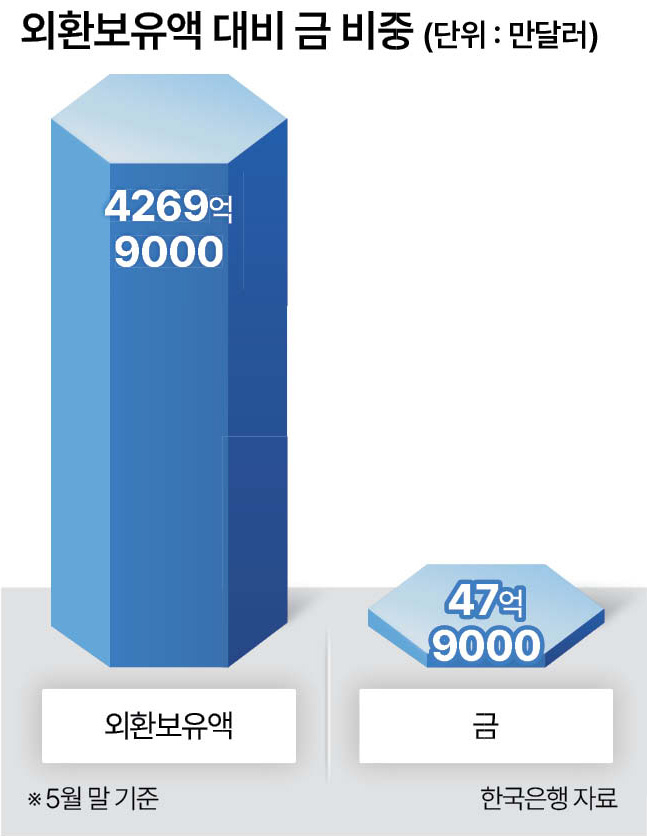
According to the World Gold Council, the BOK held 104.4 metric tons of gold as of end of last year, ranking 39th among central banks worldwide. As of end of May, gold ($4.79 billion) accounted for just 1.1 percent of the BOK's total foreign reserves of $426.99 billion. Because gold is recorded at its original purchase price rather than current market value, the BOK's gold holdings have shown no change in value since 2023.
As gold prices surged in recent years and other central banks moved to increase their gold allocations, criticism — particularly from political circles — mounted that the BOK had been standing by without acting.
According to Investing.com, gold futures prices hovered around $2,000 per ounce in 2023 before surging past $5,000 in February this year. Prices have since retreated to just above $4,000, weighed down by concerns over US inflation stemming from the Iran war.
Central banks globally have been raising gold's share of their reserve assets. According to a report on the international role of the euro recently published by the European Central Bank, gold accounted for 27 percent of global central bank reserves as of end-2025, up 7 percentage points from 20 percent a year earlier. That surpassed the share held in US government bonds (22 percent) for the first time since 1996, a span of 29 years.
By Kim Byeo-ri
kimstar@heraldcorp.com