
Only 730 of 1,819 listed companies received research notes in the past year; coverage skews heavily toward Kosdaq 150 constituents as analyst headcount falls from 600 to 400 over a decade
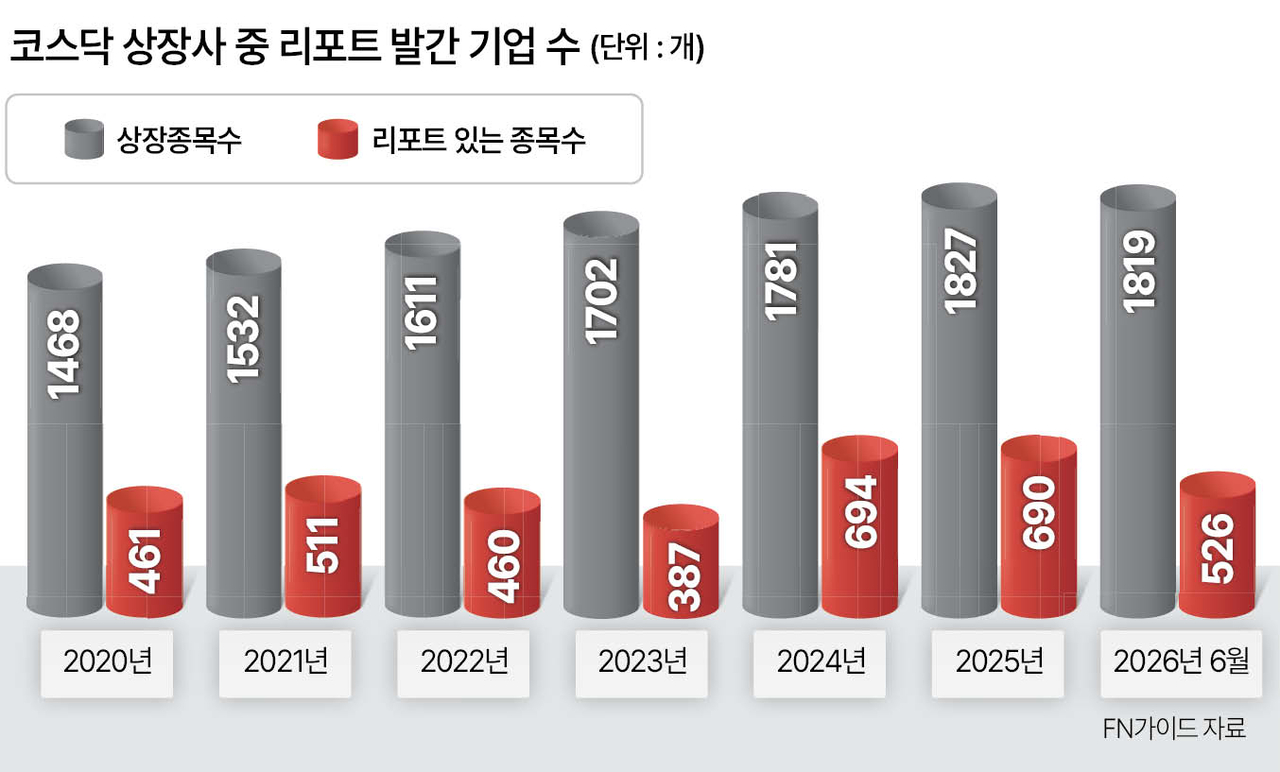
More than 1,800 companies are now listed on the Kosdaq, yet only about 40 percent received even a single brokerage research note in the past year. The majority of stocks are in effect left in an information blind spot, as analyst headcount and research teams continue to shrink even as listings grow.
According to financial data provider FnGuide, 730 Kosdaq-listed companies received at least one brokerage research note over the past year, representing just 40.1 percent of the market's 1,819 listed firms. The remaining 1,089 companies went without a single note during that period. Brokerage research notes are among the primary tools investors use to assess a company's earnings, growth potential and fair value, meaning a large share of Kosdaq stocks are in effect left without adequate information coverage.
The data also revealed a sharp concentration of research activity among a handful of stocks. Of the 730 companies that received coverage, the 126 constituents of the Kosdaq 150 index averaged 24 research notes each over the past year. By contrast, the 604 covered companies outside the Kosdaq 150 averaged just five notes each — a gap that points to a widening disparity in analyst coverage between blue-chip names and small- and mid-cap stocks.
Analyst research notes are a key source of information for investors, providing assessments of corporate earnings, industry outlook and the competitive landscape. Their importance grows for companies with limited public disclosure or complex business structures, yet a significant number of small- and mid-cap Kosdaq firms remain outside brokerage coverage, leaving investors without sufficient information.
A decline in research staffing has compounded the information gap. Kim Jun-seok, a senior researcher at the Korea Capital Market Institute, found that the number of domestic equity analysts fell from roughly 600 in 2015 to around 400 in 2024. Over the same period, the number of brokerages publishing listed-company research dropped from 36 to 30.
Kim attributed the contraction to falling demand for analyst reports, driven by the expansion of passive investment and the diversification of information sources. Because brokerages distribute research notes largely free of charge in South Korea, direct revenue generation is difficult, reducing the business case for maintaining large research operations. As a result, analyst coverage has concentrated further on large-cap listings, leaving smaller companies increasingly on the margins.
"The more analyst activity shrinks, the wider the investment information gap becomes — and the weaker the market's ability to monitor corporate management," Kim said. "This deepens information asymmetry, prevents companies from being properly valued, and can act as a discount factor on share prices."
Efforts to address the coverage gap are underway. The Korea IR Consultants Association's research center and the Korea Exchange are in discussions on expanding coverage to companies that have not yet received any research notes, according to Jin Seong-hun, a group leader at the Korea Kosdaq Association. "The IR Consultants Association's research center is in talks with the Exchange about rotating coverage so that companies without any research notes can be covered in turn," Jin said.
hajun825@heraldcorp.com




