
FOMC benchmark interest rate decision due Wednesday morning
98.4% chance of hold forecast; hawkish message expected
Korea-US rate gap weighs on won; pressure mounts for BOK hike
All indicators point same direction; July hike seen likely
![Fed Chair Kevin Warsh will preside over his first FOMC meeting, with a rate decision expected around 3 a.m. Korean time on Wednesday. [Reuters]](https://wimg.heraldcorp.com/news/cms/2026/06/13/news-p.v1.20260613.314dd48d19154b40a74b2ed7bc7b7304_P1.jpg)
By Kim Byeo-ri, The Herald Business
The US Federal Reserve is expected to hold its benchmark interest rate for a fourth consecutive meeting at next week's Federal Open Market Committee gathering while sending a stronger hawkish signal favoring monetary tightening. Analysts say the message from that meeting could expand the Bank of Korea's room to raise its own benchmark interest rate. A clear signal of future US rate hikes would strengthen the case for a BOK increase to defend the won against the burden of the Korea-US interest rate gap.
The FOMC, which Fed Chair Kevin Warsh will preside over for the first time, is scheduled to announce its benchmark interest rate decision around 3 a.m. Korean time on Wednesday. Markets widely expect the Fed to hold rates for a fourth consecutive meeting, keeping them in the 3.50–3.75% range. According to the CME Group's FedWatch tool, the probability of a hold at this FOMC stood at 98.4% as of Friday — up 1.1 percentage points from the previous day's 97.3% and 0.3 percentage points above the reading from a month ago at 98.1%.
Market attention is focused less on the rate level itself and more on what signals the Fed will send through its dot plot and post-meeting press conference. The dot plot reflects the individual rate projections of all 19 Fed officials — the 12 voting board members and seven non-voting regional Fed presidents.
Observers are watching how much more hawkish this dot plot will be compared with the March edition. The median rate projection for this year in the March dot plot, released early in the Middle East war, stood at 3.4% — implying roughly one additional cut. Compared with the December dot plot, three more dots had shifted toward a hold and three fewer pointed to a hike, reflecting a more cautious neutral stance amid uncertainty from the Middle East situation, though the overall tone was seen as relatively more hawkish.
With inflationary pressure having grown since then, the dots are expected to cluster at higher rate levels this time. The US consumer price index rose 4.2% year-on-year in May, the largest increase in three years and one month. Minutes from the last FOMC meeting chaired by former Fed Chair Jerome Powell in April showed that several officials said rate hikes "may be necessary if inflation persistently exceeds the target." There is growing talk that the median dot, which had previously pointed to one cut, could shift to signal a hold or even a hike.
Markets have increasingly priced in at least one rate hike this year. According to FedWatch, the probability that the Fed funds rate will stand at 3.75–4.00% at the final FOMC of the year on Dec. 9 reached 41.3%, while the 4.00–4.25% range drew 13.3%. The 4.25–4.50% and 4.50–4.75% ranges drew 1.7% and 0.1%, respectively. Combined, the probability of at least one hike this year stands at 56.4% — a majority, and up 20.7 percentage points from a month ago at 35.7%.
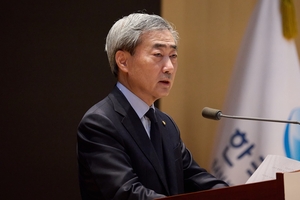
![Bank of Korea Gov. Shin Hyun-song delivers a speech at the central bank's 76th anniversary ceremony held at the BOK annex Friday morning. [Bank of Korea]](https://wimg.heraldcorp.com/news/cms/2026/06/13/news-p.v1.20260612.8c3c3ca235584060878531c0821e4aac_P1.jpg)
A more hawkish signal from this FOMC is expected to give the Bank of Korea greater room to raise its benchmark interest rate. The current gap between Korean and US policy rates stands at 1.25 percentage points based on the upper bound — an inversion that has persisted for roughly four years since US rates surpassed Korean rates in 2022. The Korea-US rate differential is widely cited as a root cause of the persistently high exchange rate, and the argument that Korea must at minimum prevent the gap from widening further is gaining traction.
The won-dollar exchange rate has settled into a pattern where 1,500 won has become the "new normal." The rate closed above 1,500 won for the 19th consecutive trading day Friday — the second-longest such streak on record, trailing only the 49 consecutive trading days seen during the financial crisis in late 1997 and early 1998.
Beyond the exchange rate, indicators across economic growth, inflation and financial stability are all pointing toward greater room for a BOK rate hike. Gov. Shin Hyun-song has publicly called for a rate increase on three separate occasions over the past two weeks. The probability of a benchmark rate hike at the Monetary Policy Board meeting on July 16 is seen as growing.
Gov. Shin has called for monetary tightening three times in two weeks, reinforcing expectations of a July benchmark rate hike, as economic conditions across the board are pointing in the same direction.
kimstar@heraldcorp.com




