
Manufacturers push for regional talks after tentative deal rejected
Transport fee hike, union status disputes spill over to Pyeongtaek, Yongin sites
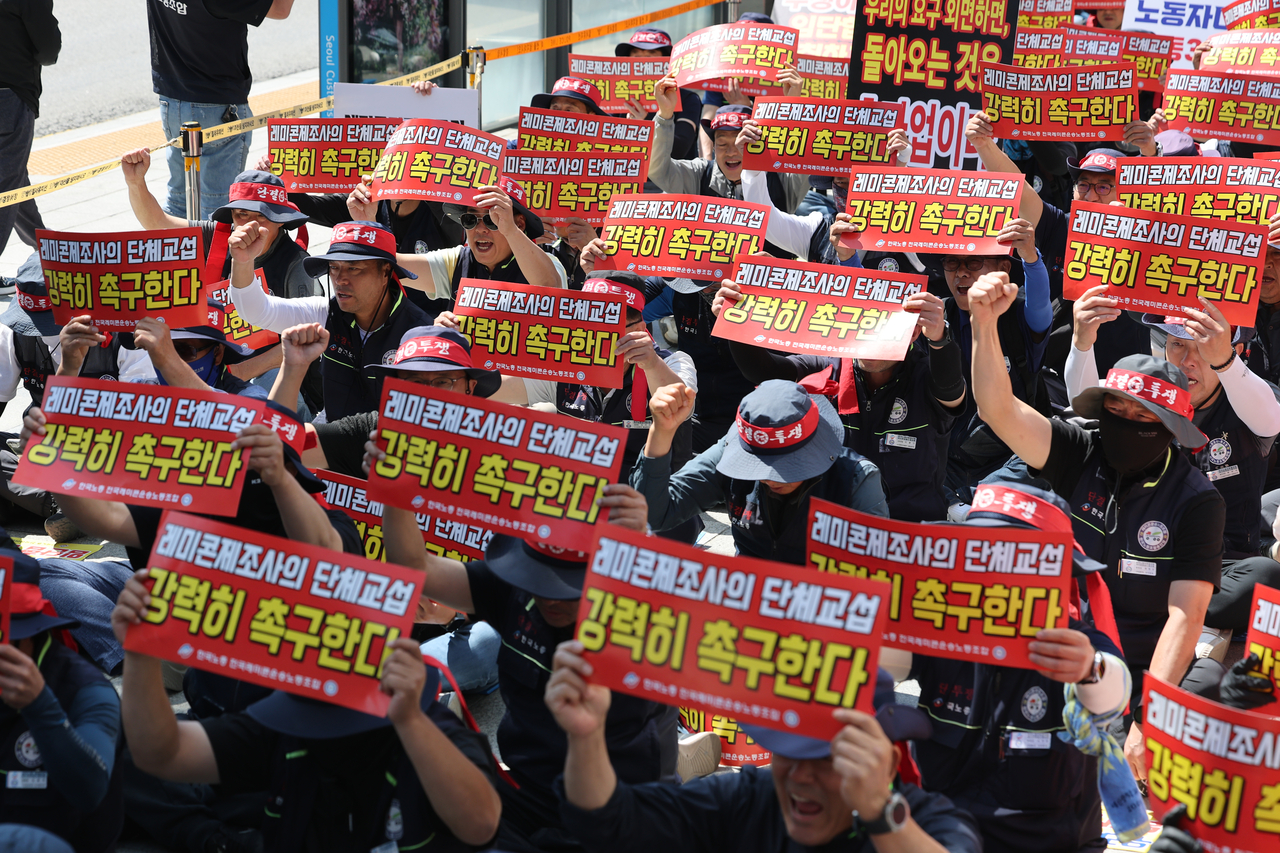
A ready-mix concrete transport strike in the greater Seoul area shows signs of dragging on after union members voted down a tentative agreement that had been seen as a turning point toward resolution. Manufacturers have notified the National Ready-Mix Concrete Transport Federation, known as Jeonunryeon, that future negotiations will shift to a regional format. The federation has begun blocking concrete shipments destined for semiconductor construction sites in the metropolitan area. With disputes over both transport fee increases and union recognition now intertwined, the supply chain for ready-mix concrete across Greater Seoul is once again in turmoil.
According to industry sources Friday, ready-mix concrete manufacturers collectively sent a letter to Jeonunryeon on Thursday expressing "deep regret" that the federation had refused to call off its transport boycott and was demanding fresh talks after rejecting the jointly agreed final proposal. "We cannot continue negotiations with your organization without a prior withdrawal of the transport refusal," the letter stated. "Future transport fee negotiations for 2026 will be conducted on a regional basis."
The letter squarely placed responsibility for the collapse on Jeonunryeon. Manufacturers said the two sides had reached agreement on June 9 — under mediation by the Ministry of Land, Infrastructure and Transport — on a per-trip rate increase of 4,200 won, only for union members to vote it down. The tentative deal would have raised the metropolitan-area transport fee, excluding fuel costs, from the current 75,800 won (about $55) per trip to 80,000 won. The proposal was rejected after 68.3 percent of union members voted against it.
![A black van believed to belong to Jeonunryeon blocks the loading point at a ready-mix concrete plant in Pyeongtaek, Gyeonggi Province, on Thursday morning. The concrete had been scheduled for delivery to Samsung Electronics' Pyeongtaek campus, but Samsung canceled its order after federation members physically blocked the shipment. [Provided by reader]](https://wimg.heraldcorp.com/news/cms/2026/06/12/news-p.v1.20260611.d53f8cb4745d4b9fa2b1fc5f442ad2a3_P1.jpg)
The strike's reach has now extended beyond ordinary construction sites to critical semiconductor projects. On Thursday morning, shortly after the tentative agreement was voted down, Jeonunryeon members blocked shipments from two ready-mix concrete plants in Pyeongtaek, Gyeonggi Province, that had been bound for the Samsung Electronics Pyeongtaek campus construction site. Attempts to dispatch company-owned mixer trucks also failed, and the day's scheduled concrete pouring was abandoned.
Ready-mix concrete must be poured within a set window after production, making it nearly impossible to source replacement supplies once a shipment is blocked. When deliveries from a given plant are stopped, construction sites have no choice but to cancel that day's pour. For large industrial facilities like the Samsung Electronics Pyeongtaek campus, where each phase of construction is tightly sequenced, even a single day's disruption can create downstream pressure on subsequent work. Industry insiders warn that repeated blockades could transform what began as a transport fee dispute into a threat to the schedules of nationally strategic industrial projects.
The disruption is not confined to Pyeongtaek. Concrete pouring at SK Hynix's Yongin semiconductor cluster has also halted because of the metropolitan-area strike. The Samsung Electronics Pyeongtaek campus and the SK Hynix Yongin cluster are considered the twin pillars of South Korea's domestic semiconductor supply chain investment. With both sites affected simultaneously, the industrial pressure from a prolonged strike stands to intensify considerably.
At the heart of the dispute is also the question of bargaining structure. Jeonunryeon has insisted that the entire metropolitan area be treated as a single bargaining unit for collective negotiations, while manufacturers have argued for talks divided across 12 regional zones covering Seoul, Gyeonggi Province, Incheon and other areas. The June 9 agreement had proceeded under the unified bargaining format — a concession manufacturers made under pressure from the Ministry of Land, Infrastructure and Transport. Immediately after the tentative deal was rejected, however, manufacturers reverted to their call for regional negotiations, making clear they hold Jeonunryeon responsible for the breakdown.
Union recognition is a separate flashpoint. Jeonunryeon argues that court rulings and a union registration certificate issued by labor authorities establish that ready-mix concrete drivers are entitled to bargain collectively under labor law. Manufacturers counter that most mixer truck drivers operate as individual contractors, that appeals are still pending in court, and that the varied contractual structures across companies and regions make it unreasonable to treat all drivers as a single collective bargaining unit. If the transport fee dispute expands into a full labor relations negotiation, reaching a settlement is likely to become significantly harder.
Construction companies working on semiconductor projects in the metropolitan area have accelerated concrete pouring work in anticipation of a prolonged strike and are currently keeping schedules intact by advancing other phases of construction. If the strike extends beyond a week, however, the risk of delays will grow sharply given how essential ready-mix concrete is to the work. As the situation has escalated, six major business lobby groups including the Korea Enterprises Federation issued a joint statement expressing "deep concern over the collective transport refusal by the metropolitan-area ready-mix concrete transport union, which is causing enormous disruption across industry," and warning that a prolonged supply disruption could halt construction of key infrastructure and spread economic damage throughout the broader economy.
"After the tentative agreement was voted down, the core issues have shifted from transport fees to bargaining format and union status," an industry official said. "With actual cases of abandoned pours now emerging — as at the Samsung Pyeongtaek site — a prolonged strike could spread the damage across construction sites throughout the greater Seoul area." Some observers are calling on the government to step in again as mediator, given that semiconductor facility construction is a nationally strategic undertaking.
![A black van believed to belong to Jeonunryeon blocks a mixer truck waiting to be loaded at a ready-mix concrete plant on Thursday morning. The concrete had been scheduled for delivery to Samsung Electronics' Pyeongtaek plant, but the order was reportedly canceled after federation members physically obstructed the shipment. [Provided by reader]](https://wimg.heraldcorp.com/news/cms/2026/06/12/news-p.v1.20260611.d613dfcbf7c94038add14501b55a3d3f_P1.jpg)
hong@heraldcorp.com




