Capital gains surcharge revival drives 32% drop in May land transaction permit applications; prices up 1.55% as Gangnam, non-Gangnam zones both advance
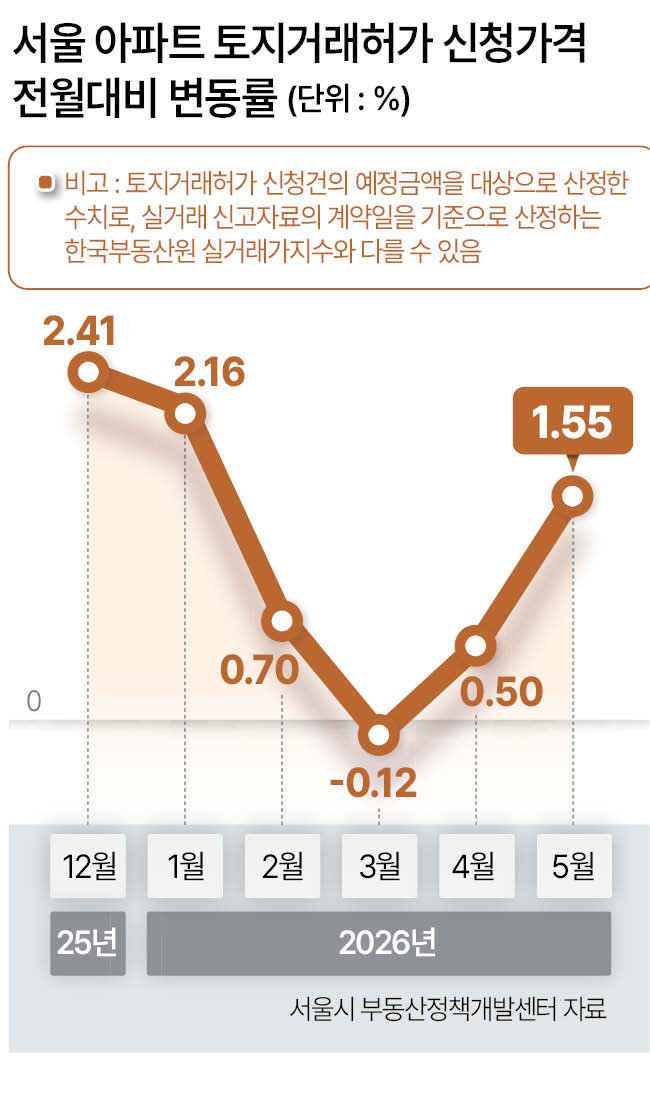
Applications for land transaction permits for Seoul apartments fell more than 30 percent in May from the previous month, the Seoul Metropolitan Government said Thursday. The drop came after a surge of applications in April ahead of the expiration of a temporary suspension of the capital gains tax surcharge on multi-home owners. Although transaction activity slowed, apartment prices accelerated — particularly in the three Gangnam districts of Gangnam, Seocho and Songpa-gu and in Yongsan-gu, where distressed listings from multi-home sellers had been absorbed, pushing those areas from decline into positive territory.
New land transaction permit applications for Seoul apartments stood at 6,087 as of the end of May, down 32.0 percent from 8,952 the previous month, the Seoul Metropolitan Government said. Applications had surged to a monthly record in April as owners rushed to sell before the capital gains surcharge suspension expired May 9. Even in the first week of May — which included the final deadline for applications under the suspension — 3,213 permit applications were filed across Seoul, averaging 642.6 per day. Once the surcharge resumed in the second through fourth weeks of May, the daily average fell to 205.3.
By zone, the share of applications from the high-end Gangnam three districts and Yongsan-gu, as well as the Han River belt, temporarily expanded in the first week of May as last-minute tax-saving demand concentrated in those areas. The combined share of the Gangnam three districts and Yongsan-gu in total land transaction permit applications rose to 20.7 percent, nearly double the 10.9 percent recorded three months earlier. The seven Han River belt districts — Gwangjin, Seongdong, Mapo, Dongjak, Yangcheon, Yeongdeungpo and Gangdong — also increased their share, from 21.6 percent to 24.2 percent over the same period.
After the surcharge suspension ended, however, the share of applications from the Gangnam three districts and Yongsan-gu fell back to 12.2 percent from the second week of May onward.
So-called "tenanted listings" — apartments sold with existing lease contracts in place — accounted for roughly one in three transactions and were concentrated in high-end areas. The government had granted an owner-occupancy requirement waiver to buyers who purchased such tenanted properties within land transaction permit zones ahead of the capital gains surcharge revival. From April through the first week of May, 3,311 of the 12,165 apartment land transaction permit applications — or 27.2 percent — were filed under the owner-occupancy requirement waiver for multi-home seller listings, up 9.8 percentage points from 17.4 percent the previous month.
By zone, the seven Han River belt districts recorded the highest share of owner-occupancy waiver applications at 38.2 percent, followed by the Gangnam three districts and Yongsan-gu at 25.5 percent, the 10 northern Seoul districts at 23.6 percent, and the four southwestern districts at 22.6 percent.
Price gains broadened. The average declared transaction price across all Seoul land transaction permit applications filed from May 1 through May 31 rose 1.55 percent from the previous month.
The Seoul Metropolitan Government said that after the announcement of the surcharge suspension's expiration, a simultaneous influx of tax-motivated sellers and genuine buyers caused price growth to slow in February and turn negative in March. Prices recovered in April, and the pace of gains widened further in May.
The rebound was broad-based, with Gangnam reversing course and non-Gangnam areas posting wider gains at the same time. The Gangnam three districts and Yongsan-gu rose 0.81 percent in May from the previous month, swinging from negative to positive. The seven Han River belt districts gained 1.36 percent, a larger increase than the month before.
The 10 northern Seoul districts rose 1.72 percent in May, while the four southwestern districts climbed 2.08 percent — the highest gain among all Seoul zones. The Seoul Metropolitan Government said areas with a higher proportion of mid- to low-priced apartments continued to attract end-user buyers facing relatively lighter financing burdens, and that prices accelerated as the overhang of multi-home seller listings was worked through.
Among individual districts, Nowon-gu recorded the highest cumulative application count at 5,191, followed by Gangseo-gu with 2,963, Songpa-gu with 2,807, Seongbuk-gu with 2,739 and Guro-gu with 2,572.
Since the land transaction permit system was extended citywide last October through the end of May this year, a cumulative total of 43,266 applications have been filed across Seoul. Of those, 41,453 have been processed, a completion rate of 95.8 percent. The Seoul Metropolitan Government publishes monthly data on land transaction permit application volumes and price movements across all 25 districts to reduce information gaps in the real estate market during the permit review period before housing contracts are finalized.
By Yoon Sung-hyun
quq@heraldcorp.com