Youth employment posts biggest post-pandemic drop; employment rate falls 2.4 percentage points in a year; extended unemployment rate tops 16%; fewer quality jobs threaten long-term growth potential
Youth employment fell by more than 250,000 last month, marking the steepest decline since the COVID-19 pandemic. An extended unemployment rate that captures workers in precarious or marginal employment surpassed 16 percent, meaning more than one in six young people was effectively unemployed or underemployed. The number of young people who are neither working nor looking for work — tracked under the "resting" category — also remained elevated, setting off serious alarm bells in the youth labor market.
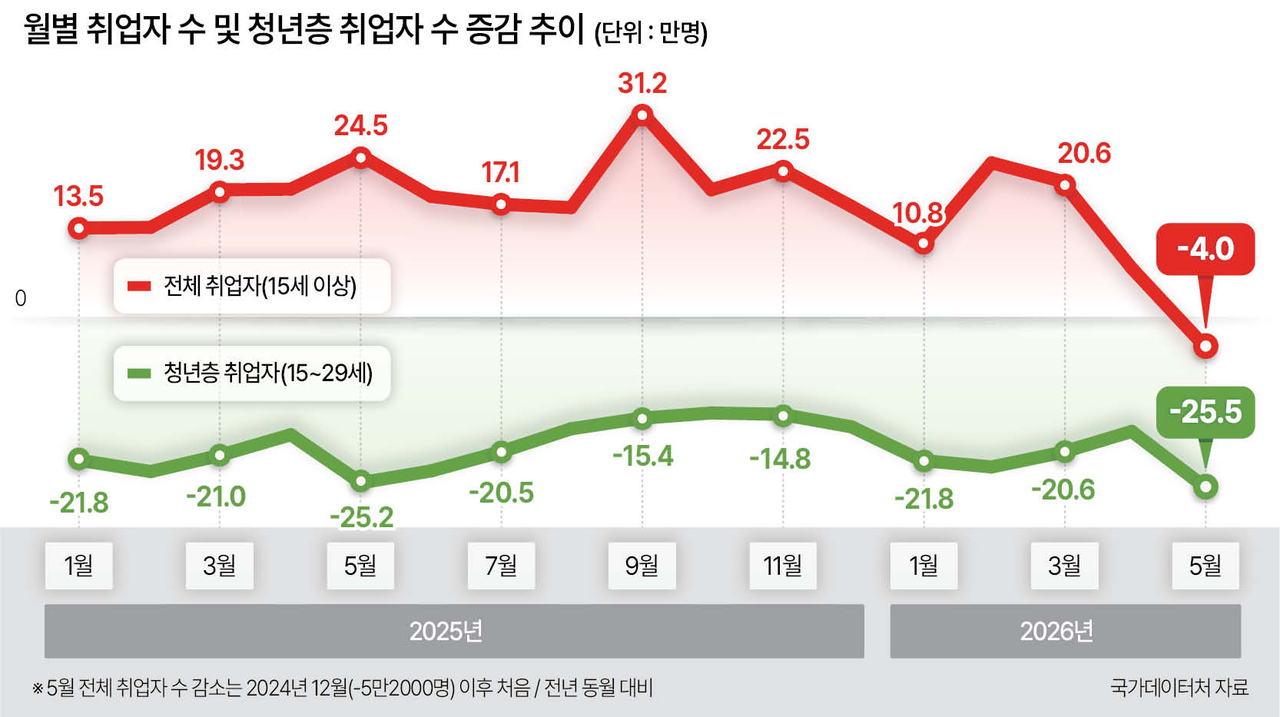
According to the Ministry of Statistics' "May 2026 Employment Trends" report released Thursday, the number of employed people aged 15 to 29 stood at 3.677 million last month, down 255,000 from a year earlier. That is the largest year-on-year drop since January 2021, when the impact of COVID-19 was at its most severe.
Youth employment has now fallen for 43 consecutive months since November 2022, and the pace of decline accelerated sharply from the previous month's drop of 194,000. The contrast with overall employment — which fell by just 40,000 — underscores how heavily the recent jobs shock has landed on young people.
By age group, workers in their 20s accounted for the largest decline, shedding 251,000 jobs — more than any other cohort. Workers aged 60 and older, by contrast, added 171,000 jobs, while those in their 30s gained 62,000 and those in their 50s gained 25,000. The employment gap between young and older workers continues to widen.
The youth employment rate in May stood at 43.8 percent, down 2.4 percentage points from a year earlier — five times the overall employment rate decline of 0.5 percentage points. The youth unemployment rate also rose 0.6 percentage points year-on-year to 7.2 percent.
The job-market hardship young people actually feel is far more severe than the official unemployment rate suggests.
The extended unemployment rate for youth — which includes job seekers, discouraged workers and those seeking additional work — reached 16.6 percent, up 0.3 percentage points from a year earlier. That is more than double the official youth unemployment rate of 7.2 percent, meaning more than one in six young people is in effect unemployed or underemployed.
A deepening sense of social exclusion has pushed more young people to stop working and stop looking for work altogether.
The total "resting" population in May reached 2.437 million, up 47,000, or 2.0 percent, from a year earlier. Of that total, 384,000 — or 15.8 percent — were young people aged 15 to 29. The figures reflect a growing exodus from the labor market among youth who see no quality jobs worth pursuing.
A breakdown by industry shows that manufacturing — which tends to offer higher wages and greater job security — continues to shed workers. Manufacturing employment fell by 140,000 last month, the steepest drop since February 2019 and the 23rd consecutive monthly decline. Construction, battered by the economic slowdown, posted its 25th straight month of falling employment.
Meanwhile, export data released Thursday told a starkly different story. According to the Korea Customs Service, exports from June 1 to 10 reached $28.6 billion, up 85.9 percent from the same period a year earlier — the highest level ever recorded for that 10-day window. Imports rose 35.6 percent. Semiconductor exports surged 205.8 percent, accounting for 38.7 percent of total exports.
The Bank of Korea reported that nominal GDP grew 10.5 percent quarter-on-quarter in the first quarter of this year — the first double-digit growth rate since 1976. Leading chipmakers SK Hynix and Samsung Electronics posted such large profit gains that they paid performance bonuses worth hundreds of millions of won.
Yet experts say the fruits of that growth have failed to reach the labor market, particularly young workers.
Economists warn that weak youth employment is not simply a generational issue but a structural problem that threatens South Korea's long-term growth potential.
Kim Jeong-sik, an emeritus professor of economics at Yonsei University, said the recent export and growth surge is being driven by capital-intensive industries such as semiconductors, which no longer generate the broad employment gains they once did. "If the number of quality private-sector jobs that young people can enter keeps shrinking, consumer spending and domestic demand will be slow to recover, and over the long term, growth potential itself could decline," he said.
He also said the government should use taxes on the "excess profits" of chipmakers to fund investment and secure more quality private-sector jobs for young workers.
President Lee Jae-myung has weighed in on how to deploy surplus tax revenue, pushing back against calls to use it for debt repayment. "Some people think paying off debt is the best thing to do, but having no debt is not an absolute truth — it's one of the more foolish things you can do," he said, adding that the funds should be directed toward raising the country's potential growth rate and investing in future generations.
fact0514@heraldcorp.com