Second-quarter loan growth already exceeds annual target; regulators order tighter controls; spillover to other major banks a concern
![Financial regulators recently ordered NH NongHyup Bank to strengthen its household loan management, industry sources said Thursday. Pictured are bank ATM machines in Seoul. [Yonhap]](https://wimg.heraldcorp.com/news/cms/2026/06/11/rcv.YNA.20260308.PYH2026030807080001300_P1.jpg)

NH NongHyup Bank is moving to sharply tighten its household lending controls after a surge in loans — concentrated outside the Greater Seoul area — pushed second-quarter growth past the annual ceiling set by financial regulators. With a buoyant stock market continuing to fuel debt-financed investing, industry observers expect loan demand to shift toward the remaining four major banks.
Financial regulators recently ordered NH NongHyup Bank to strengthen its household loan management, sources in the banking industry said Thursday. Household lending had declined year-on-year through the first quarter but accelerated sharply in the second quarter. As of the end of May, the bank's year-on-year increase in household loans had already exceeded its full-year target, sources said.
A surge in mortgage lending by borrowers outside major metropolitan areas appears to have contributed significantly to the increase.
In April, NH NongHyup Bank announced a "regional financial consumer support program" aimed at encouraging settlement outside the capital region and promoting local reinvestment. The package — capped at 1 trillion won (about $657 million) — offered borrowers in non-metropolitan areas a preferential rate discount of 0.2 percentage points on mortgages and covered documentary stamp taxes. Unlike real estate regulations, the financial authorities' household loan volume caps apply uniformly across all regions without geographic differentiation. A rise in unsecured credit loans driven by debt-financed stock investing has also been cited as a contributing factor.
In response to the regulators' directive, NH NongHyup Bank plans to raise its lending threshold for now. Demand-curbing measures such as higher loan rates are expected.
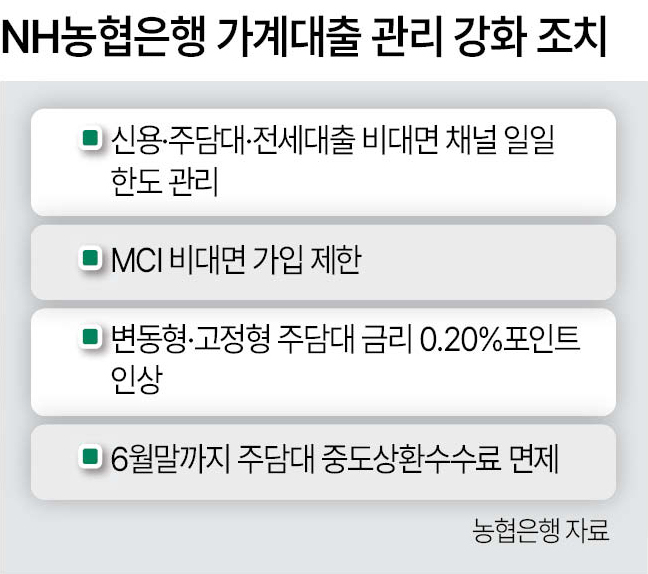
NH NongHyup Bank has already been managing daily caps on non-face-to-face applications for unsecured credit loans, mortgages and jeonse loans since mid-May. For mortgages in particular, the bank restricted enrollment in mortgage credit insurance, or MCI — a move that effectively reduces the maximum loan amount available to borrowers. Early this month, the bank raised both fixed- and variable-rate mortgage rates by 0.20 percentage points each. It is also waiving early repayment fees on mortgages through the end of this month to encourage paydowns.
With one of the five major commercial banks raising its lending bar, demand could migrate to rival institutions. Government real estate regulations have cooled mortgage demand in the Greater Seoul area somewhat, but appetite for unsecured credit loans remains strong on the back of a buoyant stock market.
According to the Bank of Korea's lending attitude survey, bank loan officers expected demand for unsecured credit loans — for both household living expenses and stock market investment — to persist through the second quarter of this year.
Financial authorities earlier lowered the target household loan growth rate for the banking sector to 1.5 percent this year from 1.7 percent last year, shrinking the overall volume of loans that financial institutions can extend. Some mutual finance cooperatives and savings banks have been subject to a "zero net increase" requirement that in effect bars them from growing their loan balances at all this year, making it inevitable that some second-tier borrowers will migrate to commercial banks.
The four major banks still have room to absorb additional lending. As of June 5, the combined household loan balance at KB Kookmin Bank, Shinhan Bank, Hana Bank and Woori Bank had fallen 1.9334 trillion won from the end of last year, excluding policy loans. Loan concentration has historically intensified in the second half of each year, however, meaning any of the banks could tighten their own lending standards at any time. KB Kookmin Bank has already moved in that direction, raising rates on June 8 by trimming the preferential rate discount on variable-rate mortgages by 0.20 percentage points.
"When one bank raises its threshold, the others inevitably feel the pressure," a lending executive at one major commercial bank said. "Even if there is credit loan demand, the amounts involved aren't that large — but we're still keeping a close eye on it." Another bank official echoed the concern. "When one bank tightens, that demand has nowhere to go but another bank — that kind of spillover has always happened," the official said.
hyuk@heraldcorp.com
won@heraldcorp.com