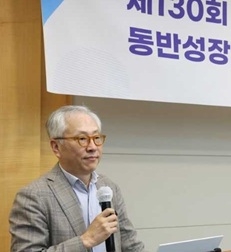
Mo Jong-rin of Yonsei University says politicization of regional development has blocked coherent strategy for 60 years; calls for walkable neighborhoods with local character over uniform apartment blocks
"Past policies to suppress Greater Seoul's growth weakened corporate competitiveness. At the same time, regional development degenerated into a political tool. Those two side effects, combined, have blocked any consistent regional development strategy for 60 years."
"What is needed is an ecosystem where people can play, work and live — like the commercial districts of Mapo, Yongsan and Seongdong. Culture and consumption spaces take shape first, then jobs follow, residential populations move in, and the living zone expands."
Mo Jong-rin, a professor at Yonsei University's Graduate School of International Studies known as the "alley economy scholar," made the remarks at a recent lecture. He is the author of books including "Neighborhoods That Draw People In," "Alley Capitalism" and "Creator Society."
The Institute for Mutual Prosperity held its Mutual Prosperity Forum on Wednesday at Seoul National University's Hoam Faculty House, where Mo delivered a lecture titled "Regional Development Theory and Discourse: Conditions and Tasks for Mutual Prosperity."
He described the current situation as the "paradox of 60 years of investment": population continues to concentrate in Greater Seoul while regional communities simultaneously hollow out, despite massive state spending. He attributed the policy failure to two causes — metropolitan-area regulations that eroded corporate competitiveness, and regional development policy reduced to a vehicle for electoral reward.
"A region's comparative advantage is not determined simply by the resources it happens to hold," Mo said. "It is a dynamic concept that each region must actively create for itself."
He proposed the "creator town" — a self-sustaining creative zone — as a Korean model for the creative city. "Unlike conventional job-centered urban development, the key is a 'work-play-live ecosystem' modeled on the Mapo-Yongsan-Seongdong example, where leisure and cultural commerce — the 'play' element — takes root first, and entrepreneurial workspaces and residential populations follow," he said.
A self-sustaining creative ecosystem emerges, he argued, not from uniform apartment blocks or new towns but from low-rise older buildings and walkable alleys where distinctive local brands can gather.
Mo also outlined an anchor strategy for building regional competitiveness in the AI era.
"The more advanced AI technology becomes, the more people will seek out 'neighborhoods worth living in' — places with alleys and walkable streets — rather than wherever the data centers happen to be," he said. "The current regional crisis is less a crisis of industry than a crisis of absent, attractive urban space." To revive regional communities, he said, old city centers must cultivate three types of anchor stores: "retail anchors" that capture consumer spending, "production anchors" that nurture entrepreneurs, and "social anchors" that sustain community bonds.
Jung Woon-chan, chairman of the Institute for Mutual Prosperity, said that true regional mutual prosperity means each area developing self-sustaining capacity rooted in its own culture and local brands, rather than relying on top-down resource allocation by the state.
freiheit@heraldcorp.com