
Relink Partners senior analyst details GI-101A in post-ASCO review; 33% response rate seen in pretreated patients with Keytruda combo, rising to 55% at recommended Phase 2 dose; J&J selects GI-102 for combination trial with its bispecific antibody
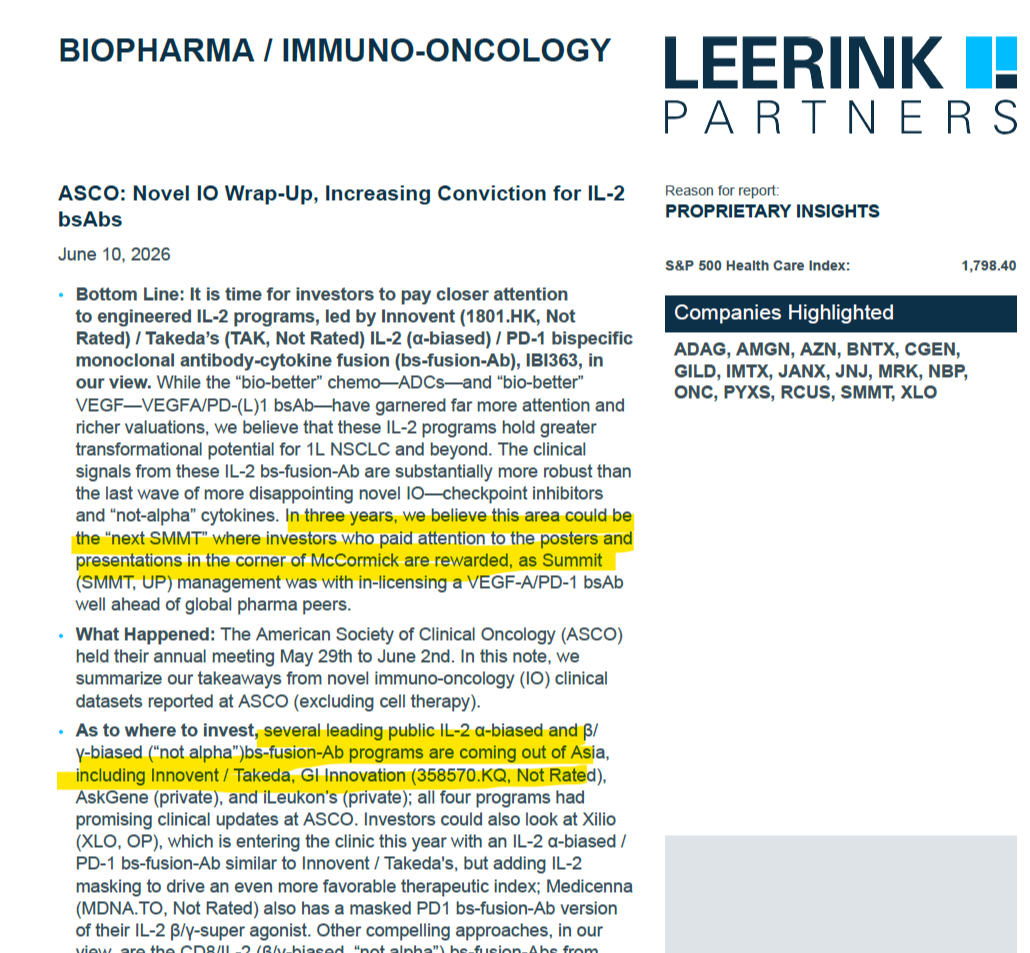
Relink Partners, a US healthcare-focused investment bank, has named GI Innovation's immuno-oncology candidate GI-101A a promising next-generation program in its immuno-oncology review of ASCO 2026.
The report argues that while the anticancer drug investment market remains heavily concentrated in antibody-drug conjugates and VEGF/PD-1 bispecific antibodies, the next major shift in the field is more likely to come from IL-2 bispecific fusion antibodies.
In the "Novel IO Wrap-Up" report published shortly after ASCO 2026, Relink Partners senior immuno-oncology analyst Dr. Daina Graybosch said that although ADCs and VEGF/PD-1 bispecific antibodies command far more attention and higher valuations, IL-2 bispecific fusion antibodies hold greater transformative potential in first-line non-small cell lung cancer and beyond.
She said the IL-2 bispecific fusion antibody space today resembles where VEGF/PD-1 bispecific antibodies stood in early clinical development three years ago, and that the field could become "the next Summit Therapeutics" within three years. Graybosch holds a doctorate in chemistry and chemical biology from Harvard University and previously advised on immuno-oncology at McKinsey before joining Relink Partners, where she leads the firm's immuno-oncology coverage and is regarded as one of the top analysts in the US biotech industry.
The report examines GI-101A's Phase 1 trial data in detail, concluding that the candidate's distinctive CD80 ligand and alpha-biased IL-2 design has demonstrated value as an effective alternative to competing PD-1-based bispecific fusion antibodies and masked anti-CTLA-4 monoclonal antibodies.
GI-101A is a fusion protein combining a CD80 ligand with an alpha-biased IL-2, giving it a multi-modal mechanism of action that sets it apart from existing immuno-oncology agents. The CD80 ligand component simultaneously mediates CTLA-4 antagonism and PD-L1 inhibition, while the alpha-biased IL-2 potently activates CD8+ T cells and NK cells. The report also highlighted that the CTLA-4 antagonism provided by the CD80 component offsets the regulatory T cell expansion typically associated with alpha-biased IL-2. Relink said GI-101A may prove more effective than PD-1-based bispecific cytokines in immunosuppressive tumor microenvironments rich in regulatory T cells.
![[Courtesy of GI Innovation]](https://wimg.heraldcorp.com/news/cms/2026/06/11/news-p.v1.20250306.c4fe520d83f948b7807f789aaf4e31c2_P1.jpg)
GI Innovation presented Phase 1 trial KN-B59 results in an oral session at ASCO 2026, showing that GI-101A combined with pembrolizumab (Keytruda) produced an objective response rate of 30 percent across all evaluable patients with second-line or later solid tumors (n=44). The ORR rose to 33 percent when narrowed to patients with prior anti-PD-(L)1 treatment experience (n=21), with responses confirmed across eight or more distinct tumor types. At the recommended Phase 2 dose of 0.3 mg/kg, the combination ORR reached 55 percent. By tumor type, four of 10 patients with clear cell renal cell carcinoma responded, as did two of four patients each with squamous cell lung cancer and urothelial carcinoma. Relink noted that responses were distributed evenly across dose levels, indicating a consistent dose-response relationship at the recommended Phase 2 dose.
On the safety side, diarrhea and colitis — the hallmark toxicities of conventional CTLA-4 antagonists — were not observed. Relink attributed the absence to the pharmacokinetic profile of the GI-101A fusion protein, which distributes rapidly to tumor and lymphoid tissues within approximately 48 hours, based on mouse biodistribution data. Systemic immune activation-related toxicities were, however, present. In the combination arm, Grade 3 or higher treatment-related adverse events occurred in 46 percent of patients, with fever reported in approximately 90 percent and elevated liver enzyme levels in approximately 50 percent. Two cases of Grade 3 cytokine release syndrome were also reported, both in the highest-dose cohort. The report flagged that toxicity data were presented as pooled figures across four dose cohorts, raising the possibility that the actual toxicity burden at the recommended Phase 2 dose may be underestimated, and called for dose-level disaggregated data going forward.
GI Innovation is currently conducting a Phase 1b dose-optimization trial of GI-101A in combination with pembrolizumab for second-line or later metastatic urothelial carcinoma in the United States and South Korea. The company's second CD80 fusion molecule, GI-102, pairs a beta/gamma-biased IL-2 with the CD80 ligand structure, and Johnson & Johnson selected it as a combination trial partner for its bispecific antibody pasritamig, citing concerns about regulatory T cell expansion risk. Relink said GI Innovation's simultaneous clinical development of both molecules places the company in a uniquely advantageous position to directly compare the efficacy differences between alpha-biased and beta/gamma-biased IL-2 approaches.
silverpaper@heraldcorp.com




