Four-hour partial walkout after labor talks collapse; bonus size and RSU inclusion at issue; government and Kakao activate emergency response
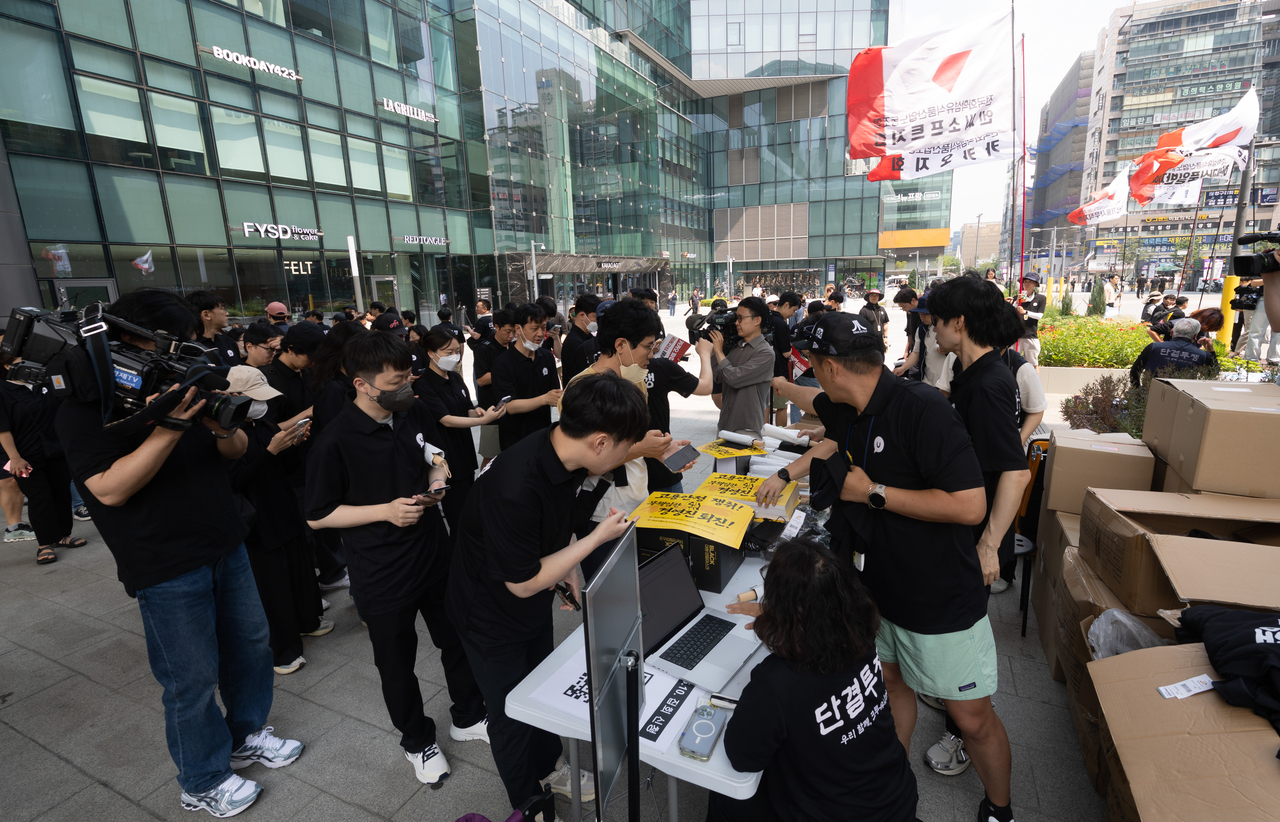
Kakao launched its first strike since the company's founding after labor and management failed to resolve a dispute over performance bonuses.
The two sides met at the negotiating table until the last moment but could not bridge their differences over the size of the bonus pool and whether restricted stock units should be counted as part of the payout.
The fallout is significant. While a disruption to KakaoTalk and other major services remains unlikely in the near term, the company's share price recently hit a 52-week low. With AI business results yet to materialize, the labor conflict has deepened what is becoming a compounding crisis for Kakao.
The Kakao chapter of the Korea Federation of Chemical, Textile, Food and Allied Industries Trade Unions launched a partial strike Wednesday morning and held a rally at Pangyo Station Plaza in Bundang-gu, Seongnam, Gyeonggi Province.
The walkout lasted four hours of working time, excluding the lunch break, marking the first strike in Kakao's history. Kakao Pay, Kakao Enterprise, DK TechIn and XL Games — affiliates whose wage negotiations also broke down — joined the action alongside Kakao's headquarters.
"We held additional talks ahead of the strike but ultimately could not reach an agreement," a Kakao official said.
The central sticking point is compensation. The union is demanding that a fixed percentage of last year's operating profit be set aside as the bonus pool. Management has pushed back, arguing the union's proposal would place an undue burden on the company.
The two sides are also split on whether RSUs should count toward performance pay. Kakao has been issuing RSUs to employees who stay for a set period, replacing the stock options it previously offered. Management considers RSUs part of overall performance compensation, while the union insists they are a separate benefit and that cash bonuses must be paid on top.
The union said it does not plan to escalate immediately to a full strike. It will assess the outcome of the four-hour partial walkout and adjust the intensity of its action depending on how future negotiations unfold.
The Ministry of Science and ICT and Kakao activated emergency response protocols over concerns that the strike could disrupt services. A service outage directly caused by a strike is considered unlikely given the nature of platform companies, but the move reflects the fact that services such as KakaoTalk and Kakao Pay are deeply embedded in everyday life.
Markets have responded coldly to the strike. Kakao's share price set a new 52-week low, falling as far as 37,600 won (about $25) during trading on June 8, sharply dampening investor sentiment. The stock, which once traded above 170,000 won, has been pushed down to the 30,000-won range — a decline of more than 40 percent so far this year.
Adding to the concern is that record earnings have done little to advance the company's AI ambitions. Kakao posted its highest-ever annual operating profit last year on a consolidated basis, and its first-quarter earnings this year also reached a record high for any single quarter.
The company has been pushing into AI — most recently with "ChatGPT for Kakao," developed in partnership with OpenAI — but tangible results have yet to emerge. The widening labor rift has left the share price moving in the opposite direction from earnings.
A prolonged dispute could compound the pressure further. Industry observers warn that internal instability could hamper Kakao's plans to revamp KakaoTalk, upgrade its AI services, and revive its advertising and commerce businesses.
rim@heraldcorp.com