National Assembly Budget Office revises health insurance fiscal projections; cumulative deficit to grow by 27.8 trillion won over next decade
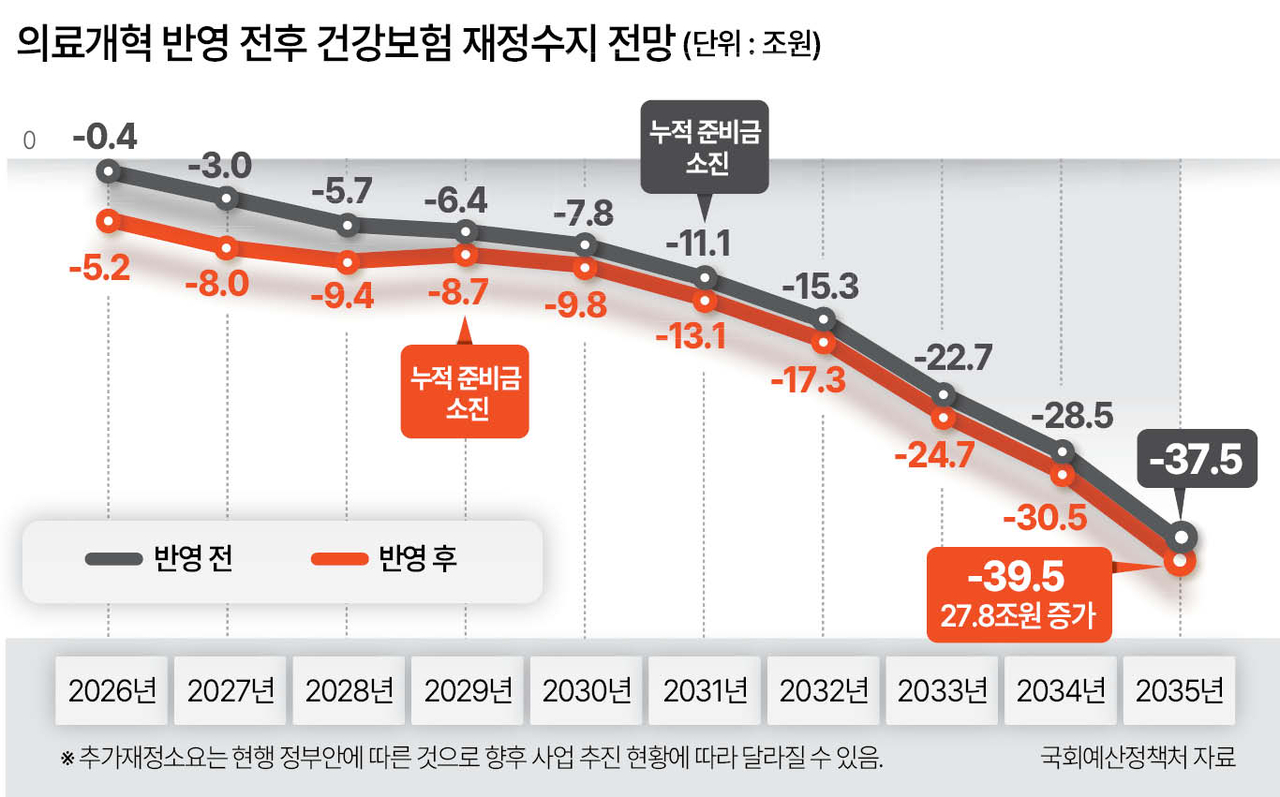
If the government's first and second medical reform action plans are factored in, the national health insurance system's accumulated reserves will be depleted two years earlier than previously projected. The cumulative deficit over the next decade is expected to swell by 27.8 trillion won (about $18.3 billion), according to a new analysis. Experts say that while the need for medical reform is broadly accepted, the government must also put in place a financing strategy and measures to secure long-term fiscal stability.
A report released Wednesday by the National Assembly Budget Office, titled "Revised National Health Insurance Fiscal Projections Reflecting the First and Second Medical Reform Action Plans," found that once the fiscal investment tied to the two reform plans is incorporated, the health insurance system's accumulated reserves will be exhausted in 2029 — two years ahead of the 2031 timeline projected without the reform measures.
The budget office recalculated its projections by incorporating initiatives from the first action plan — including medical fee increases and restructuring projects and a support project for restructuring tertiary hospitals — as well as the second action plan's support project for comprehensive secondary general hospitals and a project to strengthen essential specialized medical functions. However, the analysis excluded additional future expenditures tied to pending policy agenda items, such as the expansion of nursing care benefits under national health insurance and the institutionalization of a sick-pay system.
The analysis found that even without the reform measures, the health insurance balance would swing to a deficit of 400 billion won ($305 million) in 2026 and widen to 37.5 trillion won ($28.6 billion) by 2035. With the reform measures included, the 2026 deficit would balloon to 5.2 trillion won ($3.97 billion), reaching 39.5 trillion won ($30.1 billion) by 2035. As a result, the cumulative deficit for 2026–2035 is projected to increase by 27.8 trillion won over the baseline forecast.
The scale of health insurance spending tied to medical reform is substantial. The government plans to commit about 2 trillion won annually to support essential medical care and restructure medical fees, 10 trillion won in total to the tertiary hospital restructuring support project, 680 billion won per year to the comprehensive secondary general hospital support project, and 44 billion won annually to the essential specialized function strengthening project. In total, the reforms are expected to require more than 20 trillion won over the five years from 2024 to 2028.
The report said the government must draw a clear line between the roles of national health insurance funds and general government finances, noting that projects aimed at rewarding institutional performance or supporting structural transformation are responsibilities of the state.
The report also said spending increases driven by medical fee add-ons are expected to continue even after the reform investment period ends in 2028, and called for a review of medium- to long-term fiscal stability.
fact0514@heraldcorp.com