Herald Business-Daelyuk Aju Future Leaders Forum
Ryu Hyeon-cheol, Ministry of Employment and Labor industrial safety chief
CEOs, CSOs must think about safety around the clock
Serious Accidents Act punishes after the fact; administrative power needed for prevention
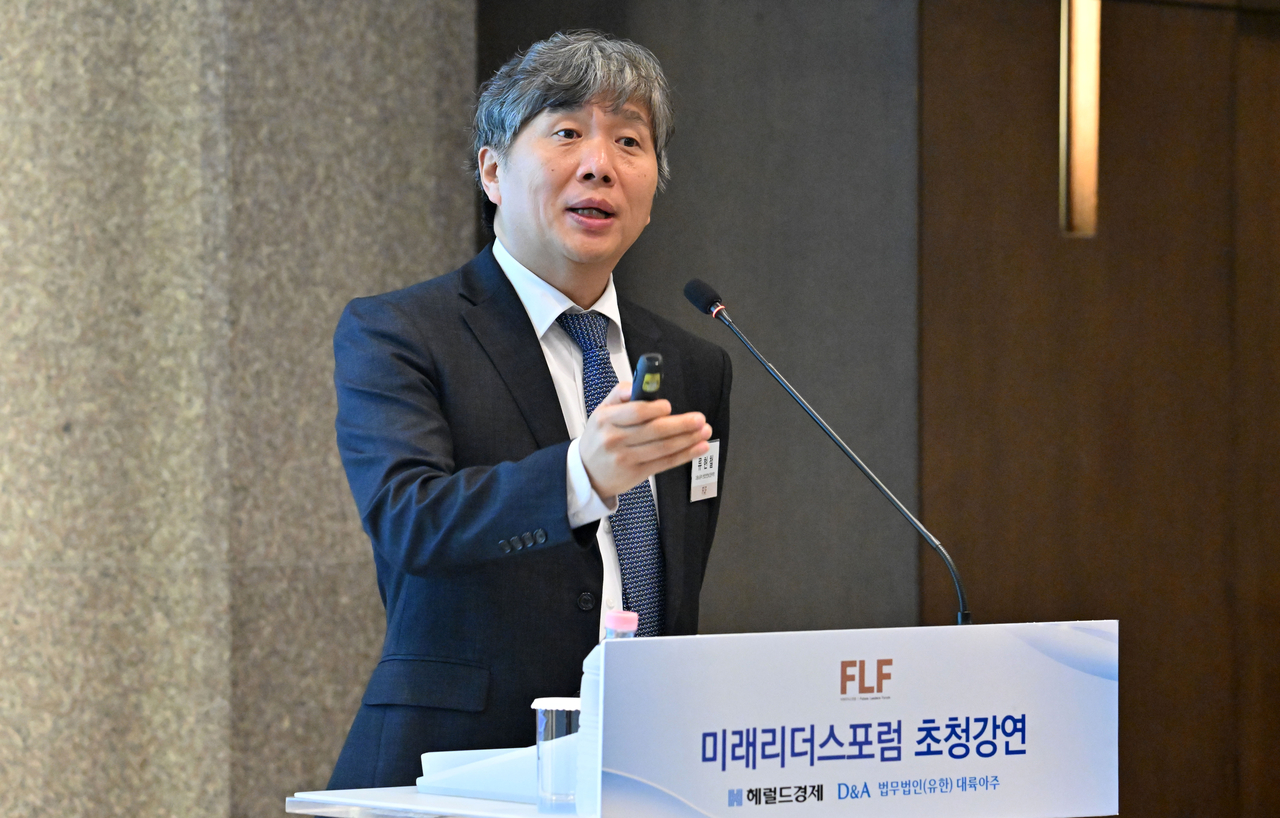
Ryu Hyeon-cheol, head of the Ministry of Employment and Labor's Industrial Safety and Health Bureau, said Wednesday that the ministry would intervene directly at industrial sites to prevent serious workplace accidents before they occur.
Ryu, who holds vice-ministerial rank, made the remarks at the June session of the Future Leaders Forum, co-hosted by The Herald Business and law firm Daelyuk Aju at The Plaza Hotel in Jung-gu, Seoul. He said the Serious Accidents Punishment Act was designed to deter accidents through the threat of punishment, but that under the current legal framework, consequences only materialize after a case has wound through first, second and third appeals — far too late to prevent harm.
He argued that while companies should be held responsible for known hazards, identifying blind spots in industrial safety is the government's job. "We will work to address whether algorithm-based management systems in the AI era are creating new problems, whether industries adapting to environmental change face unresolved risks, and how to close the safety gap between men and women, and between migrant and settled workers," Ryu said.
He added, however, that building public trust in government is equally essential. "The right to stop work is the most representative safety right on the shop floor, yet companies treat it as an enormous burden," he said. "How flexibly that right is exercised ultimately depends on social trust. Without trust in the administrative authorities, it simply cannot be enforced."
Ryu said companies must go beyond merely meeting legal requirements and take a more proactive approach to managing their workplaces. "Following only the letter of the law is what we call compliance — and for a long time, doing that was considered fulfilling one's full responsibility," he said. "But the time has come to move toward competence."
In this regard, he said the shift means "managing based on what the actual, immediate dangers are — not just checking boxes — so that safety is genuinely secured." He added that the right to life is not realized on its own: "CEOs and chief strategy officers must think about safety around the clock, and safety and health managers on the ground must anticipate and manage risks by being out there in person."
Ryu also said the government must play an active role in building industrial safety systems. "Labor and management must become the owners of self-regulation, and the government must be part of that," he said. "At the government level, we need to assess which sectors are most urgent and how to allocate limited resources to where the labor characteristics demand it most. With the AI era upon us, data-driven policy is also critical."
He highlighted "risk communication" as a key tool for companies managing industrial safety. "For a company to truly internalize a safety management system, risk communication is needed among workers, managers, specialists and administrators," Ryu said. "Because the government's administrative capacity cannot expand indefinitely, companies must be empowered to regulate themselves."
He added that a company cleared of legal wrongdoing may be acquitted in court, but without adequate communication on safety and health, it may not receive the same verdict from society.
Ryu also referenced the ministry's comprehensive labor safety plan announced in September last year, saying its core principle is guaranteeing workers' right to know — most notably by involving them in risk assessments. "The design process for safety and health systems should be open as a rule, and those responsible for the outcomes should be held firmly accountable," he said.
klee@heraldcorp.com